SEO Strategy
Why Brands Are Losing Traffic After Google AI Overviews
Many backlinks fail to improve rankings because modern search systems evaluate contextual relevance, semantic trust, editorial quality, and topical authority — not just raw link quantity.
Published: June 2, 2026
Last updated: June 2, 2026
In this article
- 1.Intro
- 2.Why Google No Longer Simply Counts Backlinks
- 3.Poor Indexation Is One of the Biggest Problems
- 4.Contextual Relevance Matters More Than Ever
- 5.Why Contextual Backlinks Matter More Than High-DR Links
- 6.Weak Content Reduces Backlink Effectiveness
- 7.Technical SEO Still Matters
- 8.Not All High-DR Links Are Valuable
- 9.Modern Link Building in 2026
- 10.AI Search Is Changing Link Evaluation
- 11.Why Many SEO Campaigns Fail Too Early
- 12.What Strong Backlinks Usually Have in Common
- 13.Final Thoughts
- 14.FAQ
- 15.Why do some backlinks not improve rankings?
- 16.Do backlinks still matter in 2026?
- 17.Are high-DR backlinks always valuable?
- 18.What makes a backlink valuable today?
- 19.Can technical SEO affect backlink performance?
- 20.Is AI changing how backlinks are evaluated?
- 21.What is contextual authority in SEO?
- 22.Why is topical relevance important for backlinks?
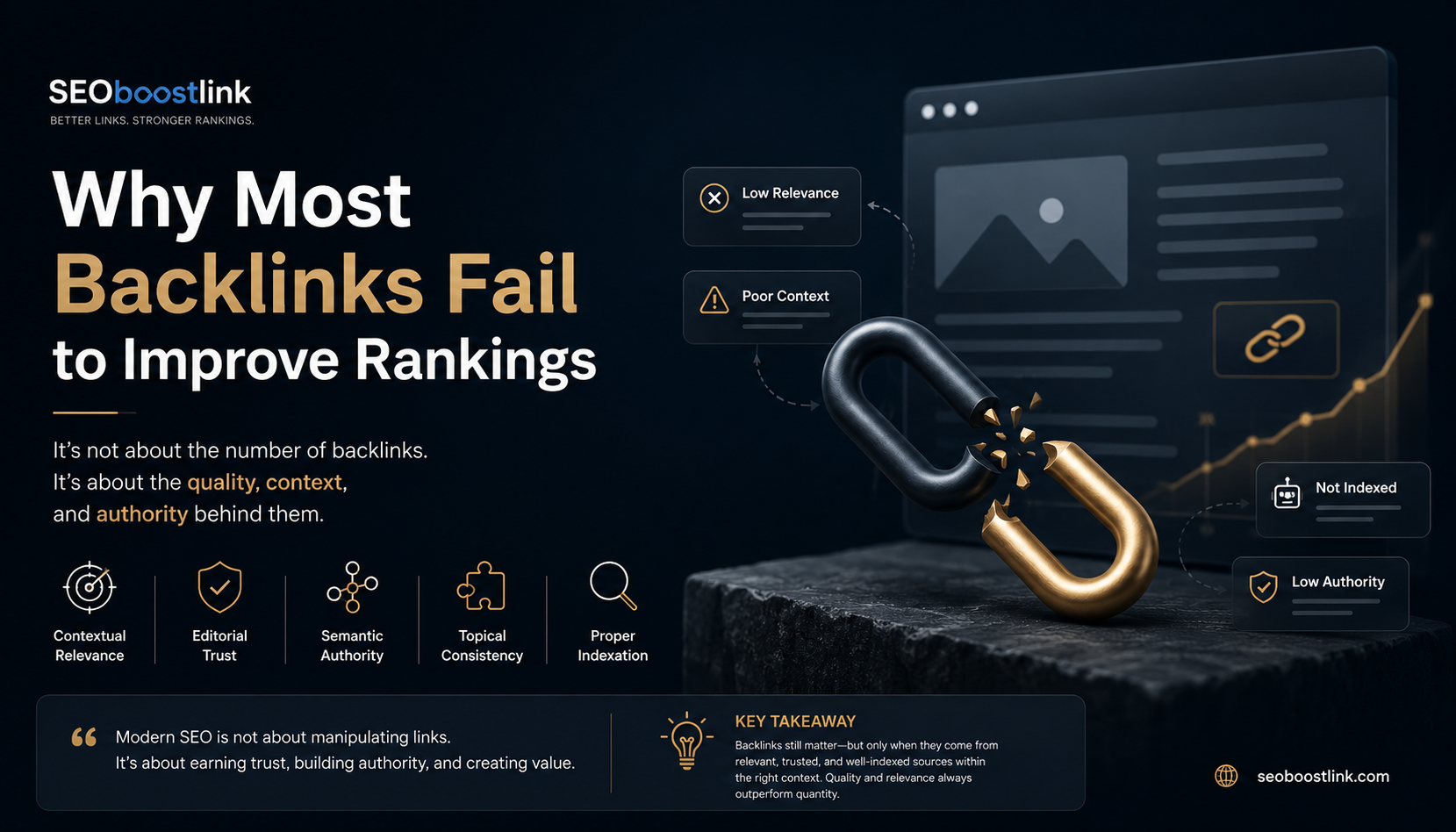
# Why Most Backlinks Fail to Improve Rankings
Intro
One of the biggest misconceptions in SEO is believing that every backlink automatically improves rankings.
That is simply not true anymore.
Many businesses spend thousands of dollars building backlinks, only to see little or no meaningful ranking improvement afterward.
Some backlinks help significantly.
Some move rankings slowly over time.
And many backlinks produce almost no measurable impact at all.
That is because modern search systems no longer evaluate backlinks as isolated ranking signals alone.
Google increasingly evaluates:
* contextual relevance
* semantic relationships
* editorial trust
* topical consistency
* crawl quality
* and overall authority patterns
This is one reason why many backlink strategies that worked years ago are becoming less effective in 2026.
---
Why Google No Longer Simply Counts Backlinks
Modern search systems have evolved significantly.
In the past, backlink quantity alone often produced strong ranking improvements.
Today, search engines increasingly attempt to understand:
* why the backlink exists
* whether the placement feels natural
* how relevant the surrounding content is
* whether the source itself appears trustworthy
* and whether the backlink fits inside a believable topical ecosystem
This means backlinks now function more like contextual trust signals than simple ranking votes.
Search engines increasingly evaluate relationships, not just hyperlinks.
---
Poor Indexation Is One of the Biggest Problems
Many backlinks fail because Google never properly indexes or processes the linking page.
If the linking page itself:
* rarely gets crawled
* has weak internal linking
* lacks authority
* receives little activity
* or struggles with indexation
then the backlink may provide very limited value.
A backlink cannot pass strong ranking signals if the page itself barely exists inside Google's active retrieval systems.
This is one reason why backlinks from trusted, active, frequently crawled websites usually perform significantly better.
---
Contextual Relevance Matters More Than Ever
One of the strongest ranking shifts happening in modern SEO is the growing importance of contextual relevance.
A backlink inside highly relevant editorial content often performs far better than a random backlink on an unrelated page.
Modern search systems increasingly evaluate:
* semantic alignment
* surrounding entities
* topical relationships
* editorial consistency
* and contextual trust
For example:
A contextual backlink from a trusted SEO article pointing toward another SEO-related resource usually creates a much stronger authority signal than a generic backlink from an unrelated website.
This is becoming increasingly important in AI-assisted search systems where semantic relationships strongly influence retrieval confidence.
Related reading:
Why Contextual Backlinks Matter More Than High-DR Links
---
Weak Content Reduces Backlink Effectiveness
Backlinks cannot fully compensate for weak content.
If the target page itself lacks:
* useful information
* topical depth
* semantic structure
* internal links
* or search intent alignment
then backlinks often produce limited results.
Modern SEO increasingly rewards pages that demonstrate:
* expertise
* contextual completeness
* topical relevance
* and long-term usefulness
This is one reason why strong content and strong backlinks usually need to work together.
---
Technical SEO Still Matters
Many businesses focus heavily on backlinks while ignoring technical SEO problems.
Issues such as:
* poor site structure
* duplicate pages
* weak internal linking
* crawl inefficiencies
* thin content
* broken indexing
* or weak semantic architecture
can significantly reduce backlink performance.
Backlinks work best when search engines can clearly understand the website structure, relationships between pages, and topical hierarchy.
---
Not All High-DR Links Are Valuable
One of the biggest mistakes in modern SEO is assuming high DR automatically means high SEO value.
That is often inaccurate.
A high-DR backlink with weak topical relevance may produce far less value than a contextual mention on a smaller but highly relevant industry publication.
Search systems increasingly evaluate:
* editorial fit
* topical alignment
* contextual relationships
* and semantic consistency
rather than relying only on authority metrics.
This is one reason why contextual authority is becoming increasingly important in modern SEO.
Related reading:
Modern Link Building in 2026
---
AI Search Is Changing Link Evaluation
Modern AI-assisted search systems increasingly evaluate broader authority patterns across the web.
Platforms like:
* Google AI Overviews
* Gemini
* ChatGPT browsing
* Perplexity
* and conversational search systems
increasingly attempt to understand:
* entity relationships
* contextual trust
* editorial relevance
* semantic consistency
* and topical expertise
This means backlinks increasingly contribute to:
* AI visibility
* GEO (Generative Engine Optimization)
* entity trust
* and semantic authority
instead of functioning only as traditional ranking signals.
---
Why Many SEO Campaigns Fail Too Early
Many businesses expect backlinks to improve rankings within days.
That expectation is usually unrealistic.
SEO is cumulative.
Search engines evaluate websites gradually through:
* trust patterns
* topical consistency
* editorial reinforcement
* contextual relationships
* and sustained authority growth
Experienced SEO professionals usually evaluate backlink impact over months rather than days.
Short-term fluctuations are normal.
Strong rankings usually come from steady authority accumulation rather than sudden spikes in backlink volume.
---
What Strong Backlinks Usually Have in Common
The backlinks that tend to perform best usually share several characteristics:
* contextual relevance
* editorial quality
* topical alignment
* real indexation
* trusted placement environments
* semantic consistency
* and believable positioning
In many cases, fewer high-quality backlinks outperform large volumes of weak or irrelevant links.
Modern SEO increasingly rewards authority quality over raw backlink quantity.
---
Final Thoughts
Most backlinks fail to improve rankings because modern search systems evaluate much more than the existence of a hyperlink.
Google increasingly evaluates:
* contextual trust
* semantic relevance
* topical consistency
* editorial quality
* technical health
* and long-term authority patterns
Backlinks still remain one of the strongest authority signals in SEO.
But modern SEO increasingly rewards backlinks that make sense within trusted topical ecosystems.
The websites that usually perform best long term are not the ones chasing the highest backlink numbers.
They are the ones building believable authority consistently over time.
---
FAQ
Why do some backlinks not improve rankings?
Some backlinks fail because the linking page lacks trust, relevance, indexation, contextual alignment, or semantic value.
Do backlinks still matter in 2026?
Yes. Backlinks still remain one of the strongest authority signals in SEO, but search systems increasingly evaluate contextual quality rather than raw quantity alone.
Are high-DR backlinks always valuable?
No. A highly relevant contextual backlink often performs better than a generic backlink from an unrelated high-DR website.
What makes a backlink valuable today?
Modern valuable backlinks usually have strong contextual relevance, editorial trust, semantic alignment, topical consistency, and proper indexation.
Can technical SEO affect backlink performance?
Absolutely. Weak site structure, poor indexing, thin content, or broken internal linking can reduce backlink effectiveness significantly.
Is AI changing how backlinks are evaluated?
Yes. AI-assisted search systems increasingly evaluate entity relationships, contextual authority, semantic trust, and editorial relevance across the web.
What is contextual authority in SEO?
Contextual authority refers to how consistently a brand appears inside trusted, semantically relevant industry conversations and topical ecosystems.
Why is topical relevance important for backlinks?
Modern search systems increasingly evaluate whether backlinks appear naturally inside relevant content that aligns with the linked page’s topic and expertise.
Core reading
Sources and references
Reference sources used to support SEO, search, and authority-building context.
Author

Lalida Pimpa
Founder, SEO Boost Link
Lalida Pimpa is the founder of SEO Boost Link, an editorial backlink and authority strategy platform focused on SaaS, B2B, and digital-first brands. Her work centers on editorial relevance, entity-based SEO, AI visibility, and long-term authority building through contextual placements and search-aligned content systems.
With experience across SEO, lead generation, and digital growth strategy, she focuses on how modern search engines and AI systems interpret trust, topical relevance, and brand relationships across the web.
LinkedInFocus Areas
- •Editorial link building
- •AI search visibility
- •Entity-based SEO
- •Editorial placement strategy
Related Articles
Topical Authority in 2026: Why Single Backlinks No Longer Move RankingsWhy Brands Are Losing Traffic After Google AI Overviews
Google, ChatGPT, Gemini, and other AI search systems increasingly evaluate topical authority rather than individual links. Learn how to build authority across an entire topic and improve long-term visibility.
What Is GEO (Generative Engine Optimization)? A Complete Guide for 2026
As search behavior shifts from Google to AI assistants like ChatGPT and Gemini, businesses must adapt to GEO (Generative Engine Optimization) to remain visible in AI-generated search experiences.
How Long Does It Take for Backlinks to Improve Rankings?
Most backlinks take between 6 and 12 weeks to begin influencing rankings. Learn how Google discovers, evaluates, and processes backlinks and why some links never improve rankings at all.
Modern Link Building in 2026
Modern link building in 2026 is no longer about raw backlink volume alone. Learn how contextual relevance, editorial trust, topical authority, semantic SEO, and AI-evaluated search systems are changing the future of backlink strategy.