SEO Strategy
Topical Authority in 2026: Why Single Backlinks No Longer Move RankingsWhy Brands Are Losing Traffic After Google AI Overviews
Google, ChatGPT, Gemini, and other AI search systems increasingly evaluate topical authority rather than individual links. Learn how to build authority across an entire topic and improve long-term visibility.
Published: June 6, 2026
Last updated: June 6, 2026
In this article
- 1.Introduction
- 2.What Is Topical Authority?
- 3.Why Single Backlinks Worked Better in the Past
- 4.How AI-Powered Search Has Changed Authority Evaluation
- 5.The Problem With Isolated Backlinks
- 6.Website A
- 7.Website B
- 8.Topical Authority Creates Link Amplification
- 9.What Search Engines Look For in 2026
- 10.Topical Coverage
- 11.Internal Content Relationships
- 12.Entity Consistency
- 13.External Validation
- 14.User Satisfaction
- 15.How to Build Topical Authority
- 16.1. Create Topic Clusters
- 17.Link Building
- 18.2. Strengthen Internal Linking
- 19.3. Cover Beginner and Advanced Topics
- 20.4. Earn Contextually Relevant Backlinks
- 21.Why This Matters for AI Search
- 22.Final Thoughts
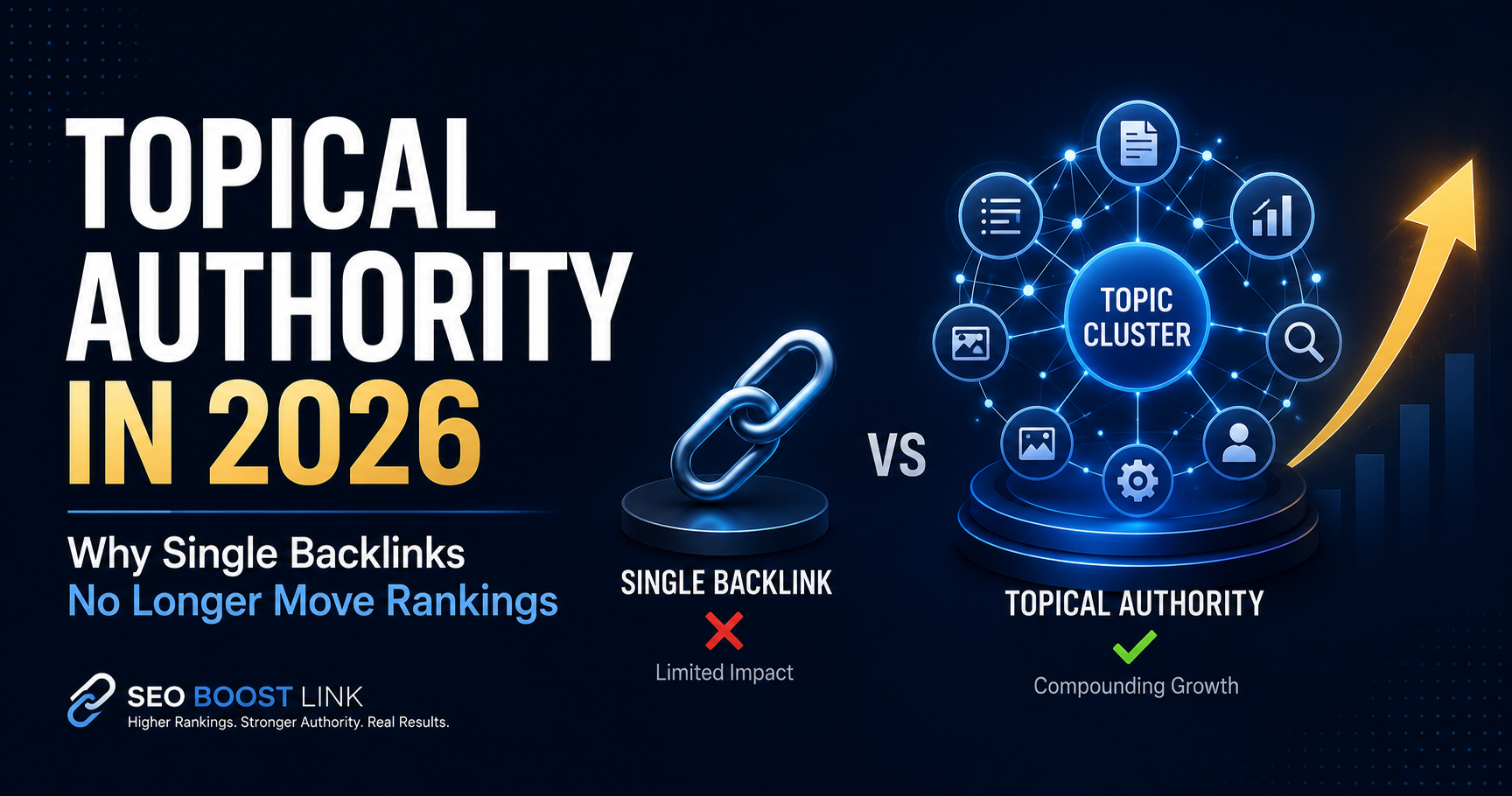
# Topical Authority in 2026: Why Single Backlinks No Longer Move Rankings
Introduction
For years, SEO professionals focused heavily on acquiring backlinks.
The common belief was simple:
More backlinks = Higher rankings.
While backlinks remain an important ranking signal, search engines and AI-powered search systems have evolved significantly.
In 2026, many websites discover a frustrating reality:
They acquire new backlinks, but rankings barely move.
The reason is not that backlinks have stopped working.
The reason is that search engines now evaluate authority differently.
A single backlink can still help.
But without topical authority, it rarely creates meaningful ranking improvements.
---
What Is Topical Authority?
Topical authority is the degree to which a website demonstrates comprehensive expertise within a specific subject area.
Instead of evaluating a single page in isolation, modern search systems evaluate the overall knowledge footprint of a website.
For example:
A website publishing one article about link building does not necessarily have authority on link building.
A website publishing dozens of interconnected articles about:
* Link building
* Link insertions
* Topical relevance
* Digital PR
* Anchor text optimization
* Entity SEO
* AI search visibility
demonstrates significantly stronger topical authority.
The difference is no longer the number of backlinks.
It is the depth and breadth of expertise.
---
Why Single Backlinks Worked Better in the Past
Historically, Google's ranking systems relied more heavily on link-based authority.
A powerful backlink from a trusted website could significantly improve rankings.
In many cases:
* One editorial backlink
* One high-DR website
* One strong homepage link
could move a page several positions.
The web was smaller.
Entity understanding was limited.
Context analysis was less sophisticated.
As search engines became more capable of understanding content relationships, relying solely on backlinks became less effective.
---
How AI-Powered Search Has Changed Authority Evaluation
Modern search systems such as:
* Google AI Overviews
* ChatGPT Search
* Gemini
* Perplexity
do not simply count links.
They attempt to understand:
* Who is the entity?
* What topics does the entity consistently discuss?
* Is the website recognized within a specific field?
* Does the content demonstrate expertise?
* Are there supporting articles covering related concepts?
In other words:
Search engines increasingly evaluate knowledge networks rather than isolated signals.
This is where topical authority becomes critical.
---
The Problem With Isolated Backlinks
Imagine two websites receive the same editorial backlink.
Website A
Publishes:
* One article about SEO
* One article about backlinks
Website B
Publishes:
* 50 articles about SEO
* Technical SEO guides
* Link building research
* Entity SEO content
* GEO optimization tutorials
* AI search visibility studies
Both websites receive the same backlink.
Which website appears more authoritative?
The answer is obvious.
The backlink strengthens existing authority.
It does not create authority from nothing.
This is why many websites continue building links but see little ranking improvement.
The surrounding topical ecosystem is missing.
---
Topical Authority Creates Link Amplification
One of the biggest misconceptions in SEO is that backlinks create authority.
In reality, backlinks often amplify authority that already exists.
When search engines recognize strong topical coverage:
* New backlinks become more impactful
* Pages index faster
* Rankings improve more consistently
* AI systems gain more confidence in citations
Think of topical authority as fuel.
Backlinks are accelerators.
Without fuel, pressing the accelerator achieves very little.
---
What Search Engines Look For in 2026
Modern ranking systems increasingly evaluate:
Topical Coverage
Do you cover the entire subject comprehensively?
Internal Content Relationships
Are articles connected logically through internal linking?
Entity Consistency
Does the website consistently demonstrate expertise in a specific field?
External Validation
Do authoritative websites mention or reference your content?
User Satisfaction
Do visitors engage with your content and continue exploring related topics?
Authority is no longer determined by a single metric.
It emerges from multiple signals working together.
---
How to Build Topical Authority
1. Create Topic Clusters
Instead of publishing random articles, build content around related themes.
Example:
Main Topic:
Link Building
Supporting Topics:
* Guest Posts
* Link Insertions
* Digital PR
* Anchor Text
* Topical Relevance
* AI Search Visibility
2. Strengthen Internal Linking
Every article should support related content.
Strong internal linking helps search engines understand relationships between concepts.
3. Cover Beginner and Advanced Topics
Authority grows when content serves users across different stages of knowledge.
Cover:
* Definitions
* Tutorials
* Case studies
* Advanced strategies
4. Earn Contextually Relevant Backlinks
A contextual backlink from a relevant website often provides more value than a generic high-authority link.
Relevance matters.
Context matters.
Topical alignment matters.
---
Why This Matters for AI Search
AI-powered search systems are fundamentally different from traditional ranking systems.
They attempt to identify:
* Trusted sources
* Subject matter experts
* Consistent entities
When an AI model decides which sources to reference, it is more likely to select websites that demonstrate strong topical authority.
This trend will continue accelerating as AI-generated answers become more common.
Brands that invest only in backlinks risk becoming invisible.
Brands that invest in expertise, authority, and topic ownership are more likely to earn long-term visibility.
---
Final Thoughts
Backlinks still matter.
However, the era when a single backlink could dramatically improve rankings is largely over.
In 2026, search engines increasingly reward websites that demonstrate comprehensive expertise across entire topics.
The future of SEO belongs to websites that combine:
* Topical authority
* Entity recognition
* Contextual relevance
* Quality backlinks
* Consistent expertise
The goal is no longer to rank a page.
The goal is to become the most trusted source on a topic.
When that happens, rankings, citations, and AI visibility become natural outcomes rather than isolated objectives.
Core reading
Sources and references
Reference sources used to support SEO, search, and authority-building context.
Author

Lalida Pimpa
Founder, SEO Boost Link
Lalida Pimpa is the founder of SEO Boost Link, an editorial backlink and authority strategy platform focused on SaaS, B2B, and digital-first brands. Her work centers on editorial relevance, entity-based SEO, AI visibility, and long-term authority building through contextual placements and search-aligned content systems.
With experience across SEO, lead generation, and digital growth strategy, she focuses on how modern search engines and AI systems interpret trust, topical relevance, and brand relationships across the web.
LinkedInFocus Areas
- •Editorial link building
- •AI search visibility
- •Entity-based SEO
- •Editorial placement strategy
Related Articles
What Is GEO (Generative Engine Optimization)? A Complete Guide for 2026
As search behavior shifts from Google to AI assistants like ChatGPT and Gemini, businesses must adapt to GEO (Generative Engine Optimization) to remain visible in AI-generated search experiences.
Why Brands Are Losing Traffic After Google AI Overviews
Many backlinks fail to improve rankings because modern search systems evaluate contextual relevance, semantic trust, editorial quality, and topical authority — not just raw link quantity.
How Long Does It Take for Backlinks to Improve Rankings?
Most backlinks take between 6 and 12 weeks to begin influencing rankings. Learn how Google discovers, evaluates, and processes backlinks and why some links never improve rankings at all.
Modern Link Building in 2026
Modern link building in 2026 is no longer about raw backlink volume alone. Learn how contextual relevance, editorial trust, topical authority, semantic SEO, and AI-evaluated search systems are changing the future of backlink strategy.