SEO Strategy
What Is GEO (Generative Engine Optimization)? A Complete Guide for 2026
As search behavior shifts from Google to AI assistants like ChatGPT and Gemini, businesses must adapt to GEO (Generative Engine Optimization) to remain visible in AI-generated search experiences.
Published: June 6, 2026
Last updated: June 6, 2026
In this article
- 1.What Is GEO?
- 2.Why GEO Matters in 2026
- 3.GEO vs Traditional SEO
- 4.How AI Systems Decide Which Brands to Mention
- 5.1. Contextual Authority
- 6.2. Topical Authority
- 7.3. Entity Consistency
- 8.4. Website Structure and Clarity
- 9.5. Editorial Mentions and Contextual Backlinks
- 10.GEO and Entity-Based SEO
- 11.How Businesses Can Improve GEO
- 12.The Future of Search Is About Trust
- 13.Frequently Asked Questions
- 14.What is GEO?
- 15.How is GEO different from SEO?
- 16.Does GEO replace SEO?
- 17.Can ChatGPT recommend my business?
- 18.Do backlinks still matter for GEO?
- 19.What are the most important GEO signals?
- 20.Is GEO only for large companies?
- 21.Which AI search engines matter most today?
- 22.Why is GEO becoming important now?
# What Is GEO (Generative Engine Optimization)? A Complete Guide for 2026
As AI-powered search continues to evolve, businesses face a new challenge:
How do you remain visible when users increasingly ask AI systems for answers instead of searching through traditional search results?
For years, SEO focused primarily on helping websites rank higher in Google.
Today, search behavior is changing.
Millions of users now ask questions directly to AI systems such as ChatGPT, Gemini, Perplexity, Claude, and Google's AI Overviews.
Instead of comparing multiple websites, users increasingly expect AI to summarize information, recommend solutions, and suggest trusted brands instantly.
This shift is creating a new discipline known as Generative Engine Optimization (GEO).
What Is GEO?
GEO stands for Generative Engine Optimization.
It refers to optimizing your digital presence so AI-powered search systems are more likely to understand, reference, mention, or recommend your brand within AI-generated answers.
Unlike traditional SEO, which focuses primarily on search engine rankings, GEO focuses on increasing visibility inside AI-assisted search experiences.
The goal is not simply to rank higher.
The goal is to become a trusted source that AI systems recognize and confidently reference.
You may also hear related terms such as:
* AEO (Answer Engine Optimization)
* AI Search Optimization
* AI Visibility Optimization
While the terminology varies, the underlying objective remains similar:
Help AI systems understand that your brand is credible, authoritative, and relevant within a specific topic ecosystem.
Why GEO Matters in 2026
Search behavior is changing faster than many businesses realize.
Historically, users would:
1. Search Google
2. Review multiple websites
3. Compare information
4. Make a decision
Increasingly, users now:
1. Ask ChatGPT
2. Ask Gemini
3. Ask Perplexity
4. Receive a summarized answer
This shift reduces the number of clicks flowing through traditional search results.
Many websites are already experiencing:
* Lower organic traffic
* Fewer informational clicks
* Reduced visibility despite maintaining rankings
The reason is simple.
Users often receive answers directly from AI systems before ever visiting a website.
As AI-assisted search becomes more common, businesses that fail to build AI visibility risk becoming increasingly invisible.
GEO vs Traditional SEO
Traditional SEO focuses on:
* Rankings
* Keywords
* Technical optimization
* Search engine traffic
GEO focuses on:
* AI visibility
* Brand recognition
* Entity understanding
* Trust signals
* Contextual authority
* AI recommendations
SEO and GEO are not competitors.
They are complementary strategies.
Strong SEO provides the foundation.
Strong GEO helps extend visibility into AI-generated search experiences.
How AI Systems Decide Which Brands to Mention
AI systems do not randomly choose brands.
Modern AI search environments increasingly evaluate multiple signals before recommending a company, website, product, or service.
1. Contextual Authority
AI systems analyze where and how your brand appears across the web.
For example:
A cybersecurity company consistently mentioned on cybersecurity publications will likely develop stronger authority signals than a company receiving mentions on unrelated websites.
Context matters.
Relevance matters.
Topical alignment matters.
The more your brand appears within trusted industry conversations, the more likely AI systems are to associate your business with expertise in that topic.
2. Topical Authority
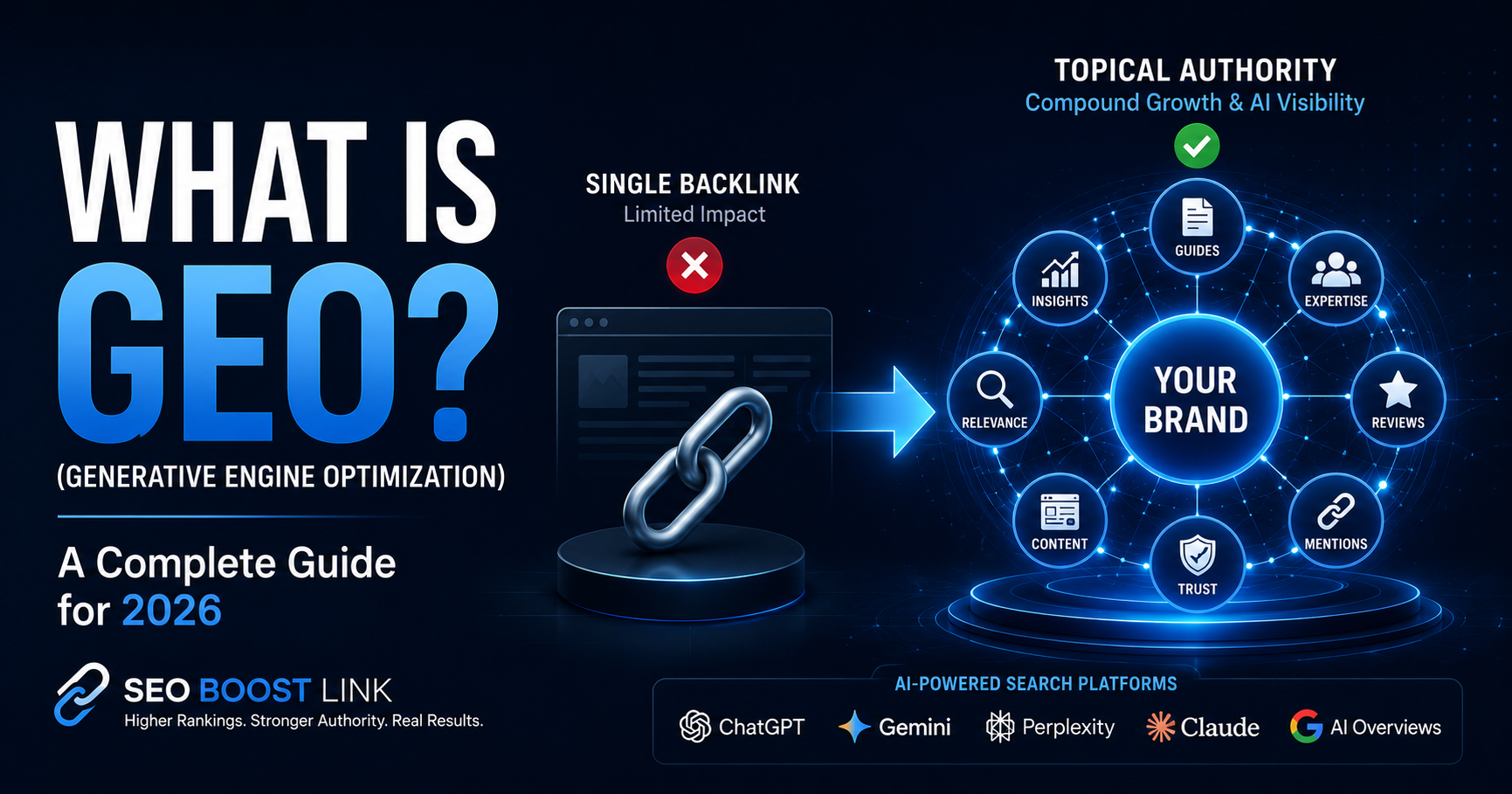
One of the biggest misconceptions about GEO is believing that a few backlinks are enough.
Modern AI search systems increasingly evaluate authority across entire topic ecosystems.
A single backlink may help.
However, sustained visibility typically comes from demonstrating expertise across multiple related topics.
For example:
A website publishing one article about SEO has limited topical authority.
A website publishing dozens of interconnected articles about:
* SEO
* Link Building
* Entity SEO
* GEO
* AI Search
* Digital PR
* Topical Authority
demonstrates much stronger expertise signals.
This is one reason why topical authority has become increasingly important in modern SEO and GEO strategies.
3. Entity Consistency
AI systems increasingly rely on entity understanding.
An entity can represent:
* A company
* A person
* A product
* A service
* A location
Your brand information should remain consistent across:
* Website
* Social profiles
* Business directories
* Author profiles
* Company descriptions
* Editorial mentions
Consistency helps AI systems understand:
* Who you are
* What you do
* Which topics your brand specializes in
The stronger your entity recognition becomes, the easier it becomes for AI systems to connect your brand with relevant topics.
4. Website Structure and Clarity
AI systems generally prefer content that is easy to interpret.
This includes:
* Schema markup
* FAQ sections
* Clear heading hierarchy
* Author information
* Topic clusters
* Internal linking
A well-structured website helps AI systems understand expertise more efficiently.
5. Editorial Mentions and Contextual Backlinks
Backlinks still matter.
However, modern AI search systems increasingly evaluate more than link quantity.
Factors that appear increasingly important include:
* Contextual relevance
* Editorial quality
* Semantic relationships
* Industry trust
* Topical consistency
A relevant editorial mention on an authoritative industry publication may provide stronger GEO value than dozens of unrelated backlinks.
GEO and Entity-Based SEO
Entity SEO and GEO are becoming increasingly connected.
Traditional SEO often focused heavily on keywords.
Modern AI systems focus increasingly on entities and relationships.
Instead of simply understanding words, AI systems attempt to understand:
* Companies
* Products
* People
* Concepts
* Industries
And how those entities connect together.
This means businesses must focus on building clear entity recognition across the web.
The stronger your entity presence becomes, the stronger your potential AI visibility.
How Businesses Can Improve GEO
Businesses do not need to abandon SEO.
Instead, they should expand their strategy.
Practical GEO improvements include:
* Publishing expertise-driven content
* Building topical authority
* Creating topic clusters
* Strengthening entity consistency
* Improving structured data
* Earning contextual editorial mentions
* Building trusted brand signals
* Improving website clarity
* Strengthening internal linking
The goal is no longer simply to rank pages.
The goal is to become a trusted source that AI systems understand and recommend.
The Future of Search Is About Trust
Search is evolving from a keyword-driven environment into a trust-driven environment.
As AI-generated answers become increasingly common, visibility may depend less on ranking first and more on being recognized as a trustworthy authority.
Businesses that invest in:
* Expertise
* Authority
* Entity recognition
* Topical coverage
* Contextual trust
will likely be far better positioned for the future of AI-assisted search.
The future of visibility is no longer just about ranking pages.
It is about becoming a trusted entity that AI systems understand, recognize, and confidently recommend.
Frequently Asked Questions
What is GEO?
GEO stands for Generative Engine Optimization. It refers to optimizing your digital presence so AI systems such as ChatGPT, Gemini, and Perplexity are more likely to reference or recommend your brand.
How is GEO different from SEO?
Traditional SEO focuses on rankings within search engines. GEO focuses on increasing visibility within AI-generated answers and AI-assisted search experiences.
Does GEO replace SEO?
No. GEO builds on top of SEO. Strong SEO foundations remain essential for long-term visibility.
Can ChatGPT recommend my business?
AI systems may reference businesses that demonstrate strong authority, trust signals, entity consistency, contextual relevance, and topical expertise.
Do backlinks still matter for GEO?
Yes. However, contextual relevance, editorial quality, semantic trust, and topical alignment appear increasingly important in modern AI-assisted search environments.
What are the most important GEO signals?
Some of the most important GEO signals include topical authority, entity recognition, contextual mentions, trusted backlinks, structured content, and brand consistency.
Is GEO only for large companies?
No. Smaller businesses can improve AI visibility by building expertise within a specific niche and earning relevant mentions from trusted sources.
Which AI search engines matter most today?
ChatGPT, Gemini, Perplexity, Claude, and Google's AI Overviews are currently among the most influential AI-assisted search environments.
Why is GEO becoming important now?
AI-powered search experiences are changing how users discover information. As users increasingly rely on AI-generated answers, businesses need strategies that improve visibility beyond traditional rankings.
Core reading
Continue exploring
Related Reading
Sources and references
Reference sources used to support SEO, search, and authority-building context.
Author

Lalida Pimpa
Founder, SEO Boost Link
Lalida Pimpa is the founder of SEO Boost Link, an editorial backlink and authority strategy platform focused on SaaS, B2B, and digital-first brands. Her work centers on editorial relevance, entity-based SEO, AI visibility, and long-term authority building through contextual placements and search-aligned content systems.
With experience across SEO, lead generation, and digital growth strategy, she focuses on how modern search engines and AI systems interpret trust, topical relevance, and brand relationships across the web.
LinkedInFocus Areas
- •Editorial link building
- •AI search visibility
- •Entity-based SEO
- •Editorial placement strategy
Related Articles
Topical Authority in 2026: Why Single Backlinks No Longer Move RankingsWhy Brands Are Losing Traffic After Google AI Overviews
Google, ChatGPT, Gemini, and other AI search systems increasingly evaluate topical authority rather than individual links. Learn how to build authority across an entire topic and improve long-term visibility.
Why Brands Are Losing Traffic After Google AI Overviews
Many backlinks fail to improve rankings because modern search systems evaluate contextual relevance, semantic trust, editorial quality, and topical authority — not just raw link quantity.
How Long Does It Take for Backlinks to Improve Rankings?
Most backlinks take between 6 and 12 weeks to begin influencing rankings. Learn how Google discovers, evaluates, and processes backlinks and why some links never improve rankings at all.
Modern Link Building in 2026
Modern link building in 2026 is no longer about raw backlink volume alone. Learn how contextual relevance, editorial trust, topical authority, semantic SEO, and AI-evaluated search systems are changing the future of backlink strategy.