AI Visibility
How to Evaluate Domain Authority Before Building Links in 2026
Domain Authority alone is no longer enough. Learn how modern SEO teams evaluate backlink quality using topical relevance, traffic quality, editorial standards, and contextual trust signals.
Published: May 26, 2026
Last updated: May 26, 2026
In this article
- 1.topical relevance
- 2.traffic quality
- 3.editorial trust
- 4.semantic alignment
- 5.entity consistency
- 6.and contextual placement logic
- 7.Traffic Quality Matters More Than DA
- 8.little real traffic
- 9.declining visibility
- 10.weak topical focus
- 11.or artificially inflated link profiles
- 12.organic traffic trends
- 13.ranking keyword quality
- 14.traffic geography
- 15.branded search presence
- 16.and whether the audience aligns with the target market
- 17.Topical Relevance Is No Longer Optional
- 18.a random backlink from a general news or lifestyle website
- 19.what topics a brand belongs to
- 20.which entities surround it
- 21.and whether the placement feels naturally aligned with the broader content ecosystem
- 22.Editorial Standards Signal Trust
- 23.Evaluate the Site’s Own Link Profile
- 24.spam-heavy backlinks
- 25.obvious PBN patterns
- 26.unrelated casino or crypto links
- 27.or large-scale low-quality guest posting footprints
- 28.referring domain quality
- 29.anchor distribution
- 30.topical consistency
- 31.and overall link ecosystem health
- 32.Indexation and Crawlability Still Matter
- 33.are not indexed
- 34.are blocked from crawling
- 35.or receive no meaningful search visibility
- 36.whether the page is indexed
- 37.whether Google is crawling the domain consistently
- 38.and whether the page has realistic visibility potential
- 39.What AI Search Changes About Link Evaluation
- 40.raw authority metrics
- 41.anchor text
- 42.and link quantity
- 43.contextual trust
- 44.semantic consistency
- 45.entity relationships
- 46.and topical alignment
- 47.The Strongest Backlinks Feel Natural
- 48.inside useful content
- 49.within relevant topic discussions
- 50.on sites with real editorial standards
- 51.and in environments where the mention genuinely helps readers
- 52.human trust
- 53.algorithmic understanding
- 54.Final Thoughts
- 55.editorial trust
- 56.semantic relevance
- 57.real audience alignment
- 58.and believable contextual placement
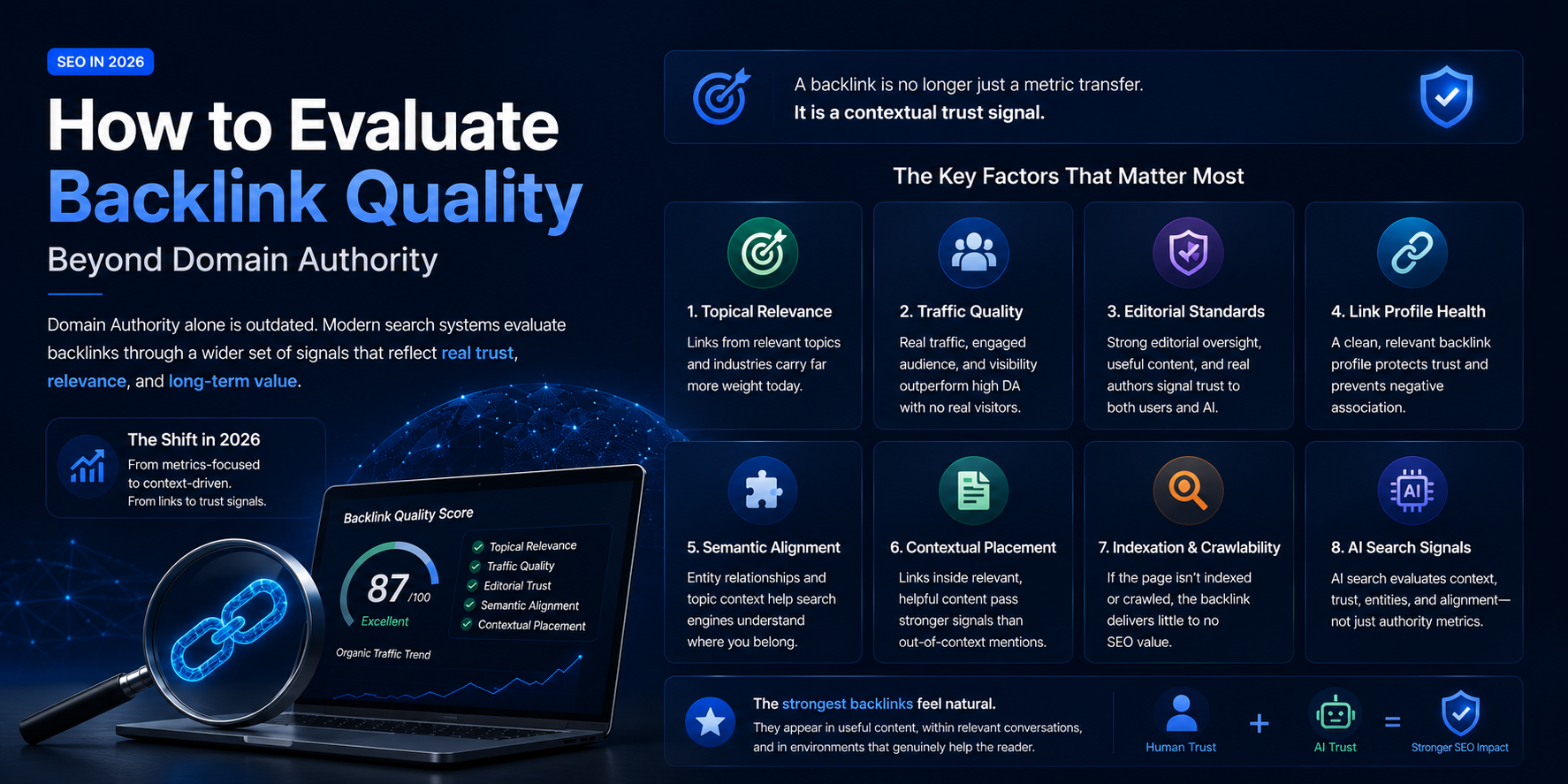
Domain Authority was once treated as the primary shortcut for evaluating backlink quality.
Higher DA meant stronger links. Lower DA meant weaker links.
In 2026, that approach is increasingly outdated.
While Domain Authority (DA) can still provide useful directional data, modern search systems evaluate backlinks through a much broader set of signals.
Relying on DA alone often leads brands toward placements that look strong on paper but contribute very little long-term SEO value.
Experienced SEO teams now evaluate links through a combination of:
topical relevance
traffic quality
editorial trust
semantic alignment
entity consistency
and contextual placement logic
A backlink is no longer just a metric transfer.
It is a contextual trust signal.
Traffic Quality Matters More Than DA
One of the most common mistakes in link building is assuming that a high-DA website automatically provides strong SEO value.
In reality, many high-DA sites have:
little real traffic
declining visibility
weak topical focus
or artificially inflated link profiles
A site with genuine search traffic and active readership often provides stronger long-term value than a high-DA domain with no meaningful audience.
For example:
a DA 40 SaaS publication with real B2B traffic and topical relevance can easily outperform:
a DA 75 generic site with weak editorial standards and no engaged audience
Before evaluating any placement, strong SEO teams typically verify:
organic traffic trends
ranking keyword quality
traffic geography
branded search presence
and whether the audience aligns with the target market
The quality of the audience matters as much as the authority metric itself.
This is one reason why many modern SEO teams now prioritize contextual backlinks and semantic relevance over raw DR or DA metrics alone.
Topical Relevance Is No Longer Optional
Modern search systems increasingly evaluate semantic relationships between websites, entities, and topics.
This means the surrounding context of a backlink matters significantly more than it did several years ago.
A backlink from a highly relevant publication inside your exact market category sends a much stronger signal than a generic mention on an unrelated website, even if the unrelated site has a higher DA score.
For example:
an AI software company mentioned inside a respected SaaS or automation publication usually creates stronger contextual relevance than:
a random backlink from a general news or lifestyle website
Search systems attempt to understand:
what topics a brand belongs to
which entities surround it
and whether the placement feels naturally aligned with the broader content ecosystem
This is why contextual relevance has become one of the most important link evaluation factors in modern SEO.
This shift is becoming even more important as AI-assisted search systems increasingly evaluate semantic trust and entity consistency across the web.
Editorial Standards Signal Trust
Strong backlinks usually come from environments with real editorial oversight.
When evaluating a website, experienced SEO teams often look beyond metrics and ask:
Does the site have real authors?
Is the content useful and well-written?
Are articles updated consistently?
Does the site appear to serve real readers?
Would this placement still make sense if SEO did not exist?
These signals help distinguish genuine publications from large-scale link-selling environments.
AI-evaluated search systems increasingly analyze the quality and credibility of surrounding content, not just the existence of a hyperlink.
A contextual mention inside a well-written, editorially reviewed article sends a very different signal than a link inserted into thin or low-value content.
This is one reason why editorially relevant guest posting strategies continue outperforming large-scale low-context link campaigns.
Evaluate the Site’s Own Link Profile
A backlink source should also be evaluated based on the quality of links pointing into it.
If a domain has accumulated:
spam-heavy backlinks
obvious PBN patterns
unrelated casino or crypto links
or large-scale low-quality guest posting footprints
then its trust signals may already be weakened.
Modern SEO is heavily influenced by association signals.
Being placed inside low-trust ecosystems can dilute the credibility of otherwise legitimate backlinks.
This is why strong SEO teams review:
referring domain quality
anchor distribution
topical consistency
and overall link ecosystem health
before recommending any placement.
Indexation and Crawlability Still Matter
A surprisingly common issue in modern link building is placing links on pages that:
are not indexed
are blocked from crawling
or receive no meaningful search visibility
An unindexed page passes little to no practical SEO value.
Before approving any placement, experienced teams usually verify:
whether the page is indexed
whether Google is crawling the domain consistently
and whether the page has realistic visibility potential
A backlink that search engines rarely discover or revisit contributes very little long-term authority.
What AI Search Changes About Link Evaluation
AI-powered search systems are changing how backlink quality is interpreted.
Traditional SEO focused heavily on:
raw authority metrics
anchor text
and link quantity
Modern AI search environments increasingly evaluate:
contextual trust
semantic consistency
entity relationships
and topical alignment
The question is no longer simply:
“How powerful is this domain?”
The question is increasingly:
“Does this backlink strengthen the search system’s understanding of where this brand legitimately belongs?”
This is a major shift.
A smaller number of highly relevant editorial placements can now outperform large-scale link campaigns built primarily around DA metrics.
This is also why many brands are adapting their link strategies around AI-evaluated search systems rather than traditional SEO metrics alone.
The Strongest Backlinks Feel Natural
One of the clearest patterns in modern SEO is that the best-performing backlinks rarely feel manufactured.
They usually appear:
inside useful content
within relevant topic discussions
on sites with real editorial standards
and in environments where the mention genuinely helps readers
The strongest placements reinforce both:
human trust
and
algorithmic understanding
At SEO Boost Link, every placement goes through this broader evaluation framework before being recommended to clients.
Because in 2026, quality over quantity is no longer just a philosophy.
It is increasingly the difference between temporary rankings and durable search visibility.
Final Thoughts
Modern backlink evaluation is becoming increasingly contextual.
Metrics like Domain Authority still provide useful signals, but they are no longer enough on their own to determine whether a placement will strengthen long-term visibility.
The strongest backlinks today are usually the ones that combine:
editorial trust
semantic relevance
real audience alignment
and believable contextual placement
As AI-assisted search systems continue evolving, search visibility will increasingly depend on whether a brand consistently appears inside trustworthy, topically aligned ecosystems.
Q: Is Domain Authority still important in 2026?
A: Domain Authority can still provide useful directional insight, but modern SEO evaluates backlinks using many additional signals such as contextual relevance, editorial quality, and semantic alignment.
Q: Can a lower-DA website provide stronger SEO value?
A: Yes. A highly relevant niche publication with real traffic and editorial trust can often provide more value than a generic high-DA website with weak topical relevance.
Q: Why does topical relevance matter in backlink evaluation?
A: Topical relevance helps search systems understand how a brand relates to a specific subject area, industry, or expertise category.
Q: What makes a backlink look natural to search systems?
A: Natural backlinks typically appear inside useful editorial content where the mention genuinely supports the topic and benefits readers.
Q: How do AI-powered search systems evaluate backlinks?
A: AI-assisted search systems increasingly evaluate contextual trust, entity relationships, semantic consistency, and topical alignment rather than relying only on raw link metrics.
Core reading
Frequently asked questions
Blog post FAQ
Is Domain Authority still important in 2026?
Domain Authority can still provide useful directional insight, but modern SEO evaluates backlinks using many additional signals such as contextual relevance, editorial quality, and semantic alignment.
Can a lower-DA website provide stronger SEO value?
Yes. A highly relevant niche publication with real traffic and editorial trust can often provide more value than a generic high-DA website with weak topical relevance.
Why does topical relevance matter in backlink evaluation?
Topical relevance helps search systems understand how a brand relates to a specific subject area, industry, or expertise category.
What makes a backlink look natural to search systems?
Natural backlinks typically appear inside useful editorial content where the mention genuinely supports the topic and benefits readers.
How do AI-powered search systems evaluate backlinks?
AI-assisted search systems increasingly evaluate contextual trust, entity relationships, semantic consistency, and topical alignment rather than relying only on raw link metrics.
Sources and references
Reference sources used to support SEO, search, and authority-building context.
Author

Lalida Pimpa
Founder, SEO Boost Link
Lalida Pimpa is the founder of SEO Boost Link, an editorial backlink and authority strategy platform focused on SaaS, B2B, and digital-first brands. Her work centers on editorial relevance, entity-based SEO, AI visibility, and long-term authority building through contextual placements and search-aligned content systems.
With experience across SEO, lead generation, and digital growth strategy, she focuses on how modern search engines and AI systems interpret trust, topical relevance, and brand relationships across the web.
LinkedInFocus Areas
- •Editorial link building
- •AI search visibility
- •Entity-based SEO
- •Editorial placement strategy
Related Articles
The AI Model Race Is Ending. The Ecosystem Race Has Already Begun.
The biggest AI announcements are no longer about benchmark scores. They're about infrastructure, developer ecosystems, enterprise workflows, and trust. This shift could fundamentally change how businesses choose AI platforms—and how brands earn visibility in AI-powered search.
Digital Memory Is Becoming the New Competitive Advantage
AI search is changing how businesses compete. Success increasingly depends on what AI remembers about your brand, not just what your website says.
Your Website Is No Longer Your Brand's Single Source of Truth
AI no longer builds an understanding of your business from your website alone. Learn why your brand is now shaped by the entire web, and what businesses must do to stay visible.
Why AI Search Favors Third-Party Validation Over Brand Claims
AI search engines increasingly rely on trusted third-party sources rather than brand claims alone. Learn why editorial mentions, expert references, and independent validation are becoming essential for AI visibility.