SEO Strategy
Modern Link Building in 2026
Modern link building in 2026 is no longer about raw backlink volume alone. Learn how contextual relevance, editorial trust, topical authority, semantic SEO, and AI-evaluated search systems are changing the future of backlink strategy.
Published: May 28, 2026
Last updated: May 28, 2026
In this article
- 1.Intro
- 2.The Evolution of Link Building
- 3.Why Contextual Relevance Matters
- 4.Why Contextual Backlinks Matter More Than High-DR Links
- 5.The Rise of Topical Authority
- 6.Guest Posting in Modern SEO
- 7.Link Insertions vs Guest Posts
- 8.AI-Evaluated Search Is Changing SEO
- 9.Why Raw DR Metrics Are Becoming Less Important
- 10.Why Contextual Backlinks Matter More Than High-DR Links
- 11.AI Overviews and Traffic Changes
- 12.Why Brands Are Losing Traffic After Google AI Overviews
- 13.Google's AI Spam Policy Update
- 14.Topical Authority and Internal Linking
- 15.What Strong Link Strategies Look Like in 2026
- 16.Common Mistakes Businesses Still Make
- 17.Final Thoughts
# Modern Link Building in 2026
Intro
Search engines no longer evaluate backlinks the same way they did several years ago.
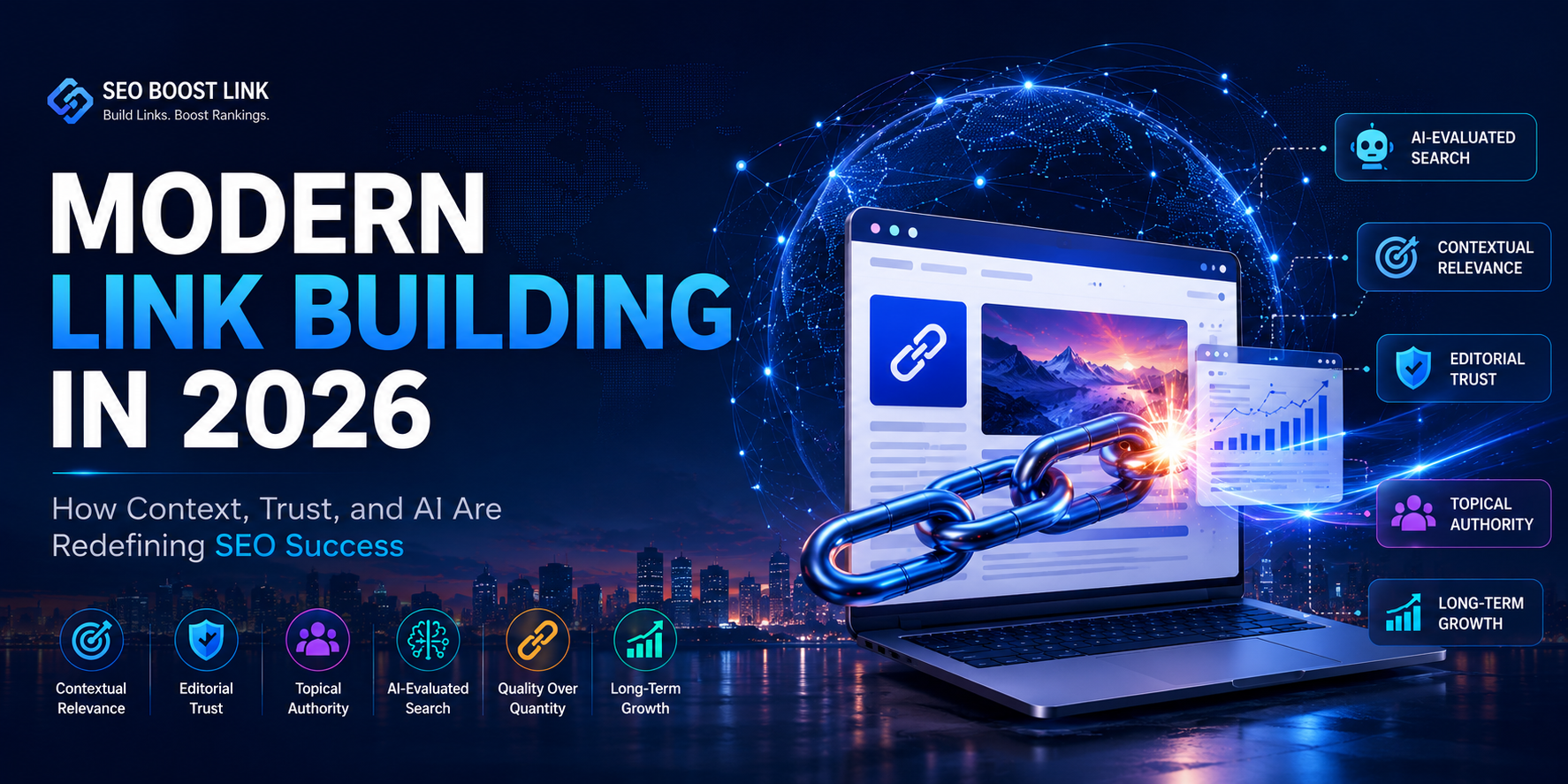
In 2026, modern SEO is increasingly shaped by contextual relevance, semantic relationships, editorial trust, topical authority, and AI-assisted search systems that attempt to understand how brands fit within broader topic ecosystems.
The goal of link building is no longer simply to acquire as many backlinks as possible.
The goal is to build search-visible authority that makes sense to both algorithms and human readers.
This shift is changing how brands approach:
* contextual backlinks
* link insertions
* topical authority
* semantic SEO
* entity consistency
* GEO (Generative Engine Optimization)
* and AI-driven search visibility
---
The Evolution of Link Building
Traditional link building often focused heavily on:
* raw backlink volume
* Domain Authority metrics
* anchor text manipulation
* and scalable outreach tactics
While some of these signals still matter, modern search systems increasingly evaluate the broader context surrounding a backlink.
A backlink now functions more like a contextual trust signal than a simple ranking vote.
Search systems increasingly analyze:
* where the mention appears
* what entities surround it
* whether the placement feels editorially natural
* and how consistently a brand appears within trusted topical ecosystems
This is one reason why many scalable backlink tactics have become less effective over time.
---
Why Contextual Relevance Matters
Contextual relevance has become one of the strongest signals in modern link evaluation.
A backlink placed naturally inside highly relevant editorial content sends stronger semantic trust signals than a generic mention on an unrelated website.
This helps search systems understand:
* what your brand represents
* which industries you belong to
* what expertise areas you are associated with
* and whether your brand naturally fits within a topic ecosystem
This is especially important in AI-assisted search systems where semantic relationships increasingly influence retrieval confidence.
Related reading:
Why Contextual Backlinks Matter More Than High-DR Links
---
The Rise of Topical Authority
Modern SEO increasingly rewards brands that demonstrate depth and consistency within a specific topic category.
This is known as topical authority.
Search systems attempt to determine whether a website consistently publishes useful, trustworthy, semantically aligned content within a particular subject area.
This means that isolated backlinks often matter less than broader patterns of contextual reinforcement across multiple trusted publications.
Brands that repeatedly appear across credible industry conversations gradually strengthen their topical positioning over time.
Strong topical authority increasingly influences:
* search rankings
* AI retrieval confidence
* semantic trust
* entity visibility
* and long-term discoverability
---
Guest Posting in Modern SEO
Guest posting still remains valuable in 2026, but its role has evolved.
Modern guest posting is less about mass link acquisition and more about:
* editorial positioning
* entity association
* topical reinforcement
* and long-term authority building
High-quality guest posts help search systems associate brands with relevant industries and expertise areas.
The strongest guest posting strategies usually prioritize:
* contextual fit
* editorial standards
* audience alignment
* semantic relevance
* and believable industry positioning
---
Link Insertions vs Guest Posts
Link insertions and guest posts serve different purposes.
Link insertions reinforce existing contextual signals inside already indexed and trusted content.
Guest posts help expand topical depth and narrative positioning through newly published editorial content.
The strongest SEO strategies often combine both approaches to build broader semantic consistency across trusted publication ecosystems.
---
AI-Evaluated Search Is Changing SEO
AI-assisted search systems increasingly evaluate:
* semantic trust
* entity relationships
* topical consistency
* editorial quality
* and contextual alignment
rather than relying only on traditional ranking signals.
This is changing how search visibility is earned.
Brands that repeatedly appear across semantically aligned, trustworthy publications gradually strengthen retrieval confidence across:
* Google AI Overviews
* Perplexity
* Gemini
* ChatGPT browsing systems
* and other conversational search interfaces
This is one reason why modern SEO increasingly overlaps with GEO (Generative Engine Optimization).
Related reading:
What Is GEO? How AI Search Is Changing Website Visibility
---
Why Raw DR Metrics Are Becoming Less Important
For many years, the SEO industry became heavily obsessed with metrics like:
* Domain Rating (DR)
* DA
* backlink volume
* and referring domains
But in modern search systems, high DR alone is often insufficient.
A contextual mention from a trusted niche-relevant source can now create stronger authority signals than a generic placement on a high-DR website with no topical relationship.
Search engines increasingly evaluate:
* topical alignment
* semantic relationships
* editorial quality
* author relevance
* brand consistency
* and content intent
instead of only raw link metrics.
This is one reason why contextual backlinks increasingly outperform generic high-DR placements in modern SEO.
Related reading:
Why Contextual Backlinks Matter More Than High-DR Links
---
AI Overviews and Traffic Changes
Many brands are already seeing traffic shifts after the rise of Google AI Overviews.
In many search results, AI-generated summaries now answer questions directly before users click websites.
This changes user behavior significantly.
Businesses increasingly need stronger authority signals, semantic relevance, and contextual trust to remain visible in AI-assisted search experiences.
This is especially important because AI systems increasingly decide:
* which brands get cited
* which sources get trusted
* and which websites become part of retrieval ecosystems
Related reading:
Why Brands Are Losing Traffic After Google AI Overviews
---
Google's AI Spam Policy Update
Google's May 2026 spam policy update formally expanded spam enforcement to include attempts to manipulate AI-generated search responses.
This reinforced an important industry shift:
AI search visibility is increasingly treated as part of search quality itself.
The safest long-term strategies continue focusing on:
* editorial trust
* helpful content
* topical authority
* contextual relevance
* and genuine audience value
Search systems are increasingly becoming better at identifying:
* manipulative link patterns
* recommendation poisoning
* low-context placements
* AI-generated spam
* and unnatural authority signals
---
Topical Authority and Internal Linking
One of the biggest shifts in modern SEO is the importance of topical clusters.
Instead of optimizing isolated pages, search engines increasingly evaluate whether a website demonstrates depth across an entire subject area.
This is why internal linking matters significantly.
Strong topical architecture helps search engines understand:
* subject depth
* semantic relationships
* content hierarchy
* and expertise consistency
A modern SEO strategy should connect related content into structured topic clusters rather than publishing disconnected articles.
This increasingly helps both traditional search engines and AI-assisted retrieval systems understand authority relationships between pages.
---
What Strong Link Strategies Look Like in 2026
The strongest modern link-building strategies usually focus on:
* contextual relevance
* editorial quality
* semantic consistency
* real audience trust
* industry alignment
* and believable authority positioning
This often results in fewer backlinks overall, but significantly stronger long-term visibility.
The future of SEO is becoming increasingly semantic.
Search systems are evolving toward understanding meaning, relationships, and contextual trust patterns rather than evaluating isolated ranking signals alone.
---
Common Mistakes Businesses Still Make
Many businesses still focus on outdated SEO assumptions such as:
* buying large volumes of backlinks
* chasing DR metrics alone
* publishing AI-generated filler content
* building irrelevant links
* ignoring topical relevance
* neglecting internal linking
* and treating SEO as only a technical ranking system
Modern search visibility increasingly depends on:
* semantic trust
* contextual consistency
* editorial alignment
* topical authority
* and entity-level credibility
---
Final Thoughts
Modern link building is no longer primarily about acquiring backlinks at scale.
It is increasingly about helping search engines and AI systems clearly understand:
* what your brand represents
* which markets you belong to
* what expertise areas you are associated with
* and why your brand deserves visibility within that ecosystem
Brands that focus on contextual authority, editorial trust, topical consistency, and semantic relevance are building stronger long-term visibility foundations for the future of search.
---
Q: What is modern link building?
A: Modern link building focuses on contextual relevance, editorial trust, semantic consistency, and topical authority rather than raw backlink quantity alone.
Q: Are backlinks still important in 2026?
A: Yes, but search systems increasingly evaluate the quality, context, and credibility surrounding backlinks rather than relying only on link volume.
Q: What is topical authority?
A: Topical authority refers to a brand or website consistently demonstrating expertise and relevance within a specific subject area or industry ecosystem.
Q: How does AI search change link building?
A: AI-assisted search systems increasingly evaluate semantic relationships, contextual trust, entity consistency, and editorial relevance across trusted publications.
Q: What makes a backlink valuable today?
A: Valuable backlinks usually come from credible, contextually relevant publications with strong editorial standards, semantic alignment, and trusted audiences.
Q: What is GEO in SEO?
A: GEO (Generative Engine Optimization) focuses on helping brands become more visible inside AI-generated search systems such as ChatGPT, Gemini, Perplexity, and Google AI Overviews.
Q: Why are contextual backlinks becoming more important?
A: Search engines increasingly evaluate semantic relevance, editorial context, topical alignment, and natural placement patterns rather than relying only on authority metrics.
Q: How important is internal linking for modern SEO?
A: Internal linking helps search engines and AI systems understand topical relationships, semantic structure, and authority hierarchy across a website.
Core reading
Frequently asked questions
Blog post FAQ
What is modern link building?
Modern link building focuses on contextual relevance, editorial trust, semantic consistency, and topical authority rather than raw backlink quantity alone.
Are backlinks still important in 2026?
Yes, but search systems increasingly evaluate the quality, context, and credibility surrounding backlinks rather than relying only on link volume.
What is topical authority?
Topical authority refers to a brand or website consistently demonstrating expertise and relevance within a specific subject area or industry ecosystem.
How does AI search change link building?
AI-assisted search systems increasingly evaluate semantic relationships, contextual trust, entity consistency, and editorial relevance across trusted publications.
What makes a backlink valuable today?
Valuable backlinks usually come from credible, contextually relevant publications with strong editorial standards, semantic alignment, and trusted audiences.
What is GEO in SEO?
GEO (Generative Engine Optimization) focuses on helping brands become more visible inside AI-generated search systems such as ChatGPT, Gemini, Perplexity, and Google AI Overviews.
Why are contextual backlinks becoming more important?
Search engines increasingly evaluate semantic relevance, editorial context, topical alignment, and natural placement patterns rather than relying only on authority metrics.
How important is internal linking for modern SEO?
Internal linking helps search engines and AI systems understand topical relationships, semantic structure, and authority hierarchy across a website.
Sources and references
Reference sources used to support SEO, search, and authority-building context.
Author

Lalida Pimpa
Founder, SEO Boost Link
Lalida Pimpa is the founder of SEO Boost Link, an editorial backlink and authority strategy platform focused on SaaS, B2B, and digital-first brands. Her work centers on editorial relevance, entity-based SEO, AI visibility, and long-term authority building through contextual placements and search-aligned content systems.
With experience across SEO, lead generation, and digital growth strategy, she focuses on how modern search engines and AI systems interpret trust, topical relevance, and brand relationships across the web.
LinkedInFocus Areas
- •Editorial link building
- •AI search visibility
- •Entity-based SEO
- •Editorial placement strategy
Related Articles
Topical Authority in 2026: Why Single Backlinks No Longer Move RankingsWhy Brands Are Losing Traffic After Google AI Overviews
Google, ChatGPT, Gemini, and other AI search systems increasingly evaluate topical authority rather than individual links. Learn how to build authority across an entire topic and improve long-term visibility.
What Is GEO (Generative Engine Optimization)? A Complete Guide for 2026
As search behavior shifts from Google to AI assistants like ChatGPT and Gemini, businesses must adapt to GEO (Generative Engine Optimization) to remain visible in AI-generated search experiences.
Why Brands Are Losing Traffic After Google AI Overviews
Many backlinks fail to improve rankings because modern search systems evaluate contextual relevance, semantic trust, editorial quality, and topical authority — not just raw link quantity.
How Long Does It Take for Backlinks to Improve Rankings?
Most backlinks take between 6 and 12 weeks to begin influencing rankings. Learn how Google discovers, evaluates, and processes backlinks and why some links never improve rankings at all.