SEO Strategy
Why Contextual Backlinks Beat High-DR Links in 2026
Modern SEO is shifting away from raw backlink metrics and moving toward contextual authority, semantic relevance, and editorial trust. Learn why contextual backlinks increasingly outperform generic high-DR links in 2026.
Published: May 28, 2026
Last updated: May 28, 2026
In this article
- 1.What Most People Misunderstand About High DR Links
- 2.Context Is Becoming Part of the Ranking Signal
- 3.Why Contextual Authority Matters in AI Search
- 4.Relevance Often Outperforms Raw Authority
- 5.Why Editorial Fit Matters More Than Ever
- 6.The Problem With Generic Link Building
- 7.Modern SEO Is Becoming More Semantic
- 8.Final Thoughts
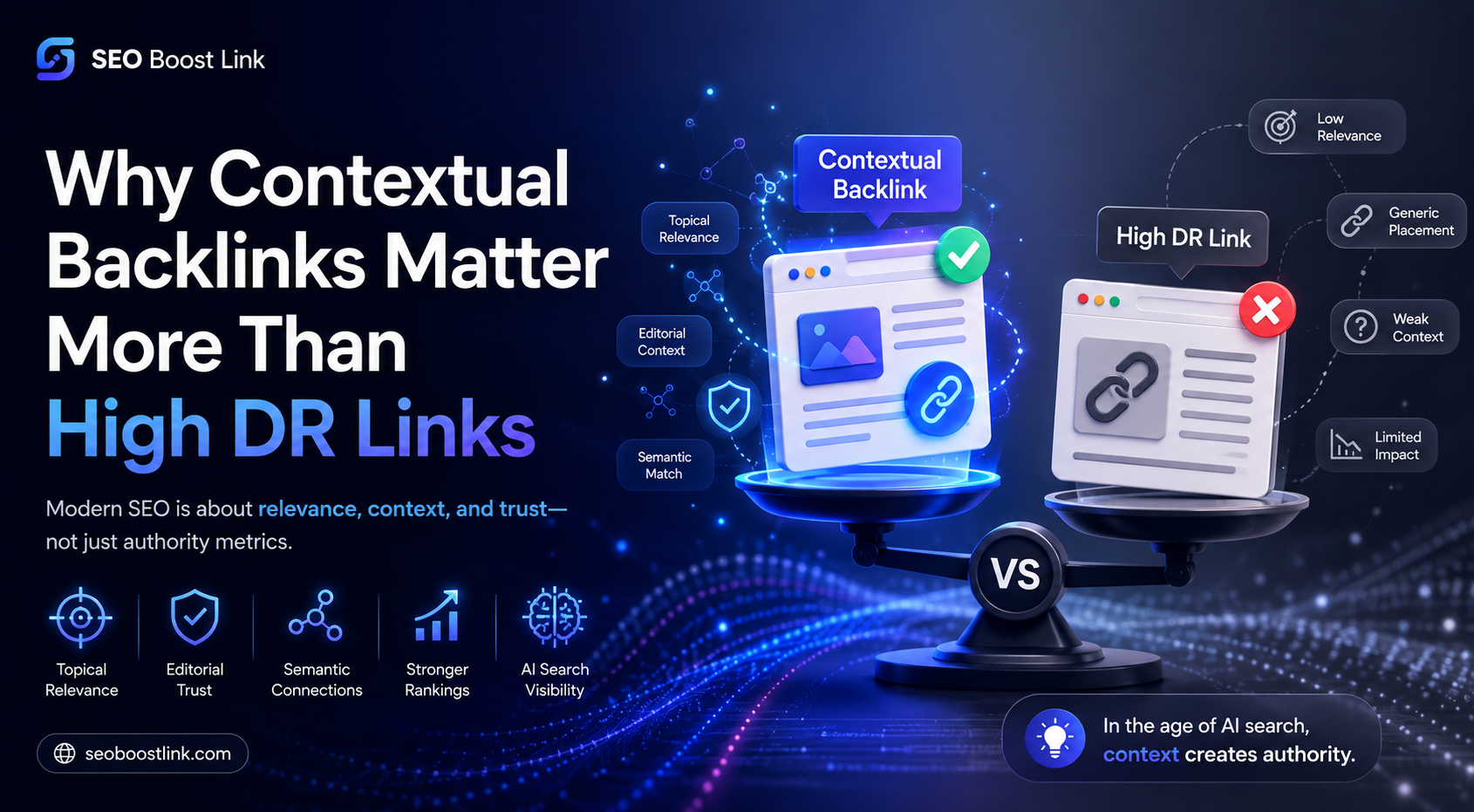
For years, the SEO industry became heavily obsessed with numbers.
Higher DR.
More backlinks.
Larger outreach campaigns.
Bigger link inventories.
And for a long time, that approach worked surprisingly well.
But search systems are evolving rapidly.
Today, modern search engines increasingly attempt to understand:
• context
• semantic relationships
• topical relevance
• editorial trust
• and brand authority
instead of evaluating backlinks as isolated signals alone.
This is one reason why contextual backlinks are becoming significantly more valuable than generic high-DR links.
What Most People Misunderstand About High DR Links
Many businesses still assume that a backlink automatically becomes powerful simply because the website has a high Domain Rating (DR).
But modern search systems increasingly appear to evaluate much more than raw authority metrics.
For example:
A generic backlink from a high-DR website with little topical relevance may send a weaker semantic signal than a contextual editorial mention from a smaller but highly relevant industry publication.
This is especially important as AI-assisted search systems continue evolving.
Search engines increasingly attempt to understand:
• why a brand is being mentioned
• whether the placement feels natural
• what topic ecosystem surrounds the mention
• and whether the source itself appears contextually trustworthy
That changes how modern link building works.
Context Is Becoming Part of the Ranking Signal
Modern search systems increasingly analyze the surrounding environment of a backlink.
This includes:
• article topic
• page intent
• nearby entities
• semantic relationships
• author credibility
• audience alignment
• and contextual relevance
A backlink today acts less like a simple “vote” and more like a contextual trust reference.
This is why many mass-scale backlink strategies are becoming less effective over time.
Search engines are becoming better at identifying:
• irrelevant placements
• low-context mentions
• forced anchor usage
• manipulative link patterns
• and disconnected topical relationships
Meanwhile, naturally integrated editorial mentions often create stronger long-term authority signals.
Why Contextual Authority Matters in AI Search
AI-powered search systems are changing how information is interpreted online.
Platforms like:
• Google AI Overviews
• ChatGPT
• Gemini
• Perplexity
• and conversational AI systems
increasingly attempt to synthesize information semantically instead of relying only on traditional ranking mechanics.
This means search systems increasingly evaluate:
• topical consistency
• entity relationships
• semantic trust
• editorial credibility
• and repeated contextual associations across the web
A brand consistently appearing within relevant industry conversations often builds stronger AI trust signals than a brand simply accumulating random backlinks.
This is one reason why contextual authority is becoming increasingly important in GEO (Generative Engine Optimization).
Relevance Often Outperforms Raw Authority
A contextual mention on:
• a respected SaaS publication
• an industry-specific blog
• a niche editorial site
• or a trusted business resource
may provide significantly stronger long-term value than a generic placement on a large but unrelated website.
Because modern search systems increasingly try to understand:
# “Does this brand genuinely belong in this conversation?”
That is fundamentally different from older SEO models focused mainly on link quantity and authority metrics.
Why Editorial Fit Matters More Than Ever
One of the strongest signals in modern SEO is editorial fit.
Search systems increasingly appear to reward mentions that feel:
• natural
• contextually aligned
• semantically relevant
• and useful for real users
This is one reason why many modern SEO strategies increasingly overlap with:
• digital PR
• editorial SEO
• entity SEO
• GEO
• and authority-driven content strategies
The future of link building is becoming less about “placing links” and more about building believable contextual relationships across the web.
The Problem With Generic Link Building
Many businesses still buy backlinks based almost entirely on:
• DR
• traffic screenshots
• homepage metrics
• or large placement lists
But without contextual alignment, many of those links create weak semantic value.
In some cases, large-scale irrelevant backlink campaigns may even create trust inconsistencies over time.
Especially in AI-assisted search environments, search systems increasingly attempt to evaluate whether a brand’s backlink profile reflects believable topical expertise.
Modern SEO Is Becoming More Semantic
Modern SEO increasingly revolves around:
• topical authority
• semantic consistency
• entity recognition
• editorial trust
• and contextual relevance
Search engines increasingly try to understand:
• what your brand represents
• which industry conversations you belong to
• and whether trusted sources consistently associate your brand with specific topics
This is why contextual backlinks are becoming more important than ever.
Final Thoughts
High DR links are not useless.
But modern search systems increasingly evaluate far more than authority metrics alone.
Contextual relevance, editorial fit, semantic trust, and topical alignment are becoming significantly more important in modern SEO and AI-assisted search.
The future of link building will likely belong less to brands building the largest backlink profiles — and more to brands building the strongest contextual authority across the web.
Q: What are contextual backlinks?
A: Contextual backlinks are links placed naturally within semantically relevant content that aligns with the topic, audience, and expertise of the linked brand.
Q: Are high DR backlinks still important?
A: Yes, high DR backlinks can still help SEO, but contextual relevance and editorial trust are becoming increasingly important in modern search systems.
Q: Why do contextual backlinks matter more now?
A: AI-assisted search systems increasingly evaluate semantic relevance, topical consistency, and contextual trust instead of relying only on raw backlink authority metrics.
Q: What is contextual authority?
A: Contextual authority refers to how consistently a brand appears within trusted, topically relevant industry conversations and content ecosystems.
Q: How is AI changing link building?
A: AI-powered search systems increasingly analyze editorial relevance, semantic relationships, topical alignment, and contextual trust signals rather than simply counting backlinks.
Core reading
Frequently asked questions
Blog post FAQ
What are contextual backlinks?
Contextual backlinks are links placed naturally within semantically relevant content that aligns with the topic, audience, and expertise of the linked brand.
Are high DR backlinks still important?
Yes, high DR backlinks can still help SEO, but contextual relevance and editorial trust are becoming increasingly important in modern search systems.
Why do contextual backlinks matter more now?
AI-assisted search systems increasingly evaluate semantic relevance, topical consistency, and contextual trust instead of relying only on raw backlink authority metrics.
What is contextual authority?
Contextual authority refers to how consistently a brand appears within trusted, topically relevant industry conversations and content ecosystems.
How is AI changing link building?
AI-powered search systems increasingly analyze editorial relevance, semantic relationships, topical alignment, and contextual trust signals rather than simply counting backlinks.
Sources and references
Reference sources used to support SEO, search, and authority-building context.
Author

Lalida Pimpa
Founder, SEO Boost Link
Lalida Pimpa is the founder of SEO Boost Link, an editorial backlink and authority strategy platform focused on SaaS, B2B, and digital-first brands. Her work centers on editorial relevance, entity-based SEO, AI visibility, and long-term authority building through contextual placements and search-aligned content systems.
With experience across SEO, lead generation, and digital growth strategy, she focuses on how modern search engines and AI systems interpret trust, topical relevance, and brand relationships across the web.
LinkedInFocus Areas
- •Editorial link building
- •AI search visibility
- •Entity-based SEO
- •Editorial placement strategy
Related Articles
Topical Authority in 2026: Why Single Backlinks No Longer Move RankingsWhy Brands Are Losing Traffic After Google AI Overviews
Google, ChatGPT, Gemini, and other AI search systems increasingly evaluate topical authority rather than individual links. Learn how to build authority across an entire topic and improve long-term visibility.
What Is GEO (Generative Engine Optimization)? A Complete Guide for 2026
As search behavior shifts from Google to AI assistants like ChatGPT and Gemini, businesses must adapt to GEO (Generative Engine Optimization) to remain visible in AI-generated search experiences.
Why Brands Are Losing Traffic After Google AI Overviews
Many backlinks fail to improve rankings because modern search systems evaluate contextual relevance, semantic trust, editorial quality, and topical authority — not just raw link quantity.
How Long Does It Take for Backlinks to Improve Rankings?
Most backlinks take between 6 and 12 weeks to begin influencing rankings. Learn how Google discovers, evaluates, and processes backlinks and why some links never improve rankings at all.