AI Visibility
How AI Search Systems Evaluate Backlink Quality in 2026
AI-powered search systems like Google's AI Overviews and Perplexity no longer evaluate backlinks through volume alone. Context, topical relevance, and entity relationships now play a central role in search visibility.
Published: May 26, 2026
Last updated: May 26, 2026
In this article
- 1.How to Adapt Your Link Strategy for AI-Evaluated Search
- 2.Why Traditional Link Building Is Losing Effectiveness
- 3.where the mention appears
- 4.what entities surround it
- 5.whether the surrounding content feels contextually natural
- 6.how consistently the brand appears within related topic clusters
- 7.and whether the mention reinforces an understandable market position
- 8.AI Search Systems Evaluate Context Differently
- 9.contextual trust
- 10.topical clarity
- 11.entity confidence
- 12.and semantic consistency
- 13.what your brand represents
- 14.which market you belong to
- 15.what problems you solve
- 16.and why your brand deserves to be surfaced within that topic ecosystem
- 17.What Modern Link Strategies Prioritize
- 18.editorial relevance
- 19.industry alignment
- 20.semantic consistency
- 21.entity association
- 22.real audience trust
- 23.and believable placement logic
- 24.clear topical positioning
- 25.consistent brand associations
- 26.and trusted contextual mentions
- 27.Building Search-Visible Authority
- 28.Google AI Overviews
- 29.ChatGPT browsing systems
- 30.What Strong Link Profiles Look Like in 2026
- 31.high topical relevance
- 32.credible editorial environments
- 33.natural language integration
- 34.consistent market positioning
- 35.and audience alignment
- 36.Final Thoughts
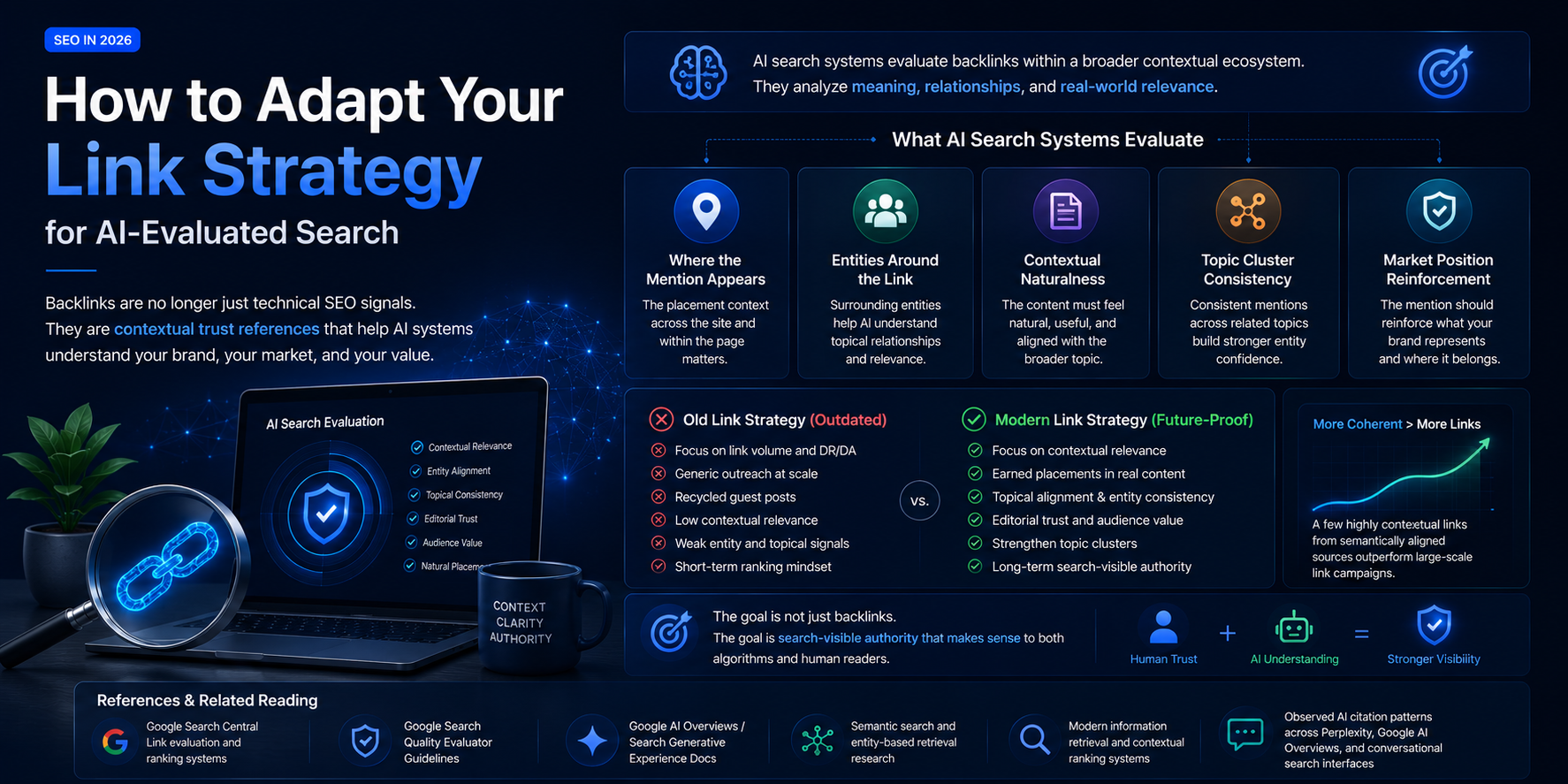
How to Adapt Your Link Strategy for AI-Evaluated Search
Brands that continue optimizing primarily around link volume, DR metrics, or scalable placement patterns will increasingly struggle to build durable visibility in AI-driven search environments.
The reason is simple: modern search systems no longer evaluate backlinks as isolated ranking inputs. They evaluate them as part of a broader contextual ecosystem surrounding a brand, topic, and audience.
A backlink now acts less like a technical SEO signal and more like a semantic trust reference.
Why Traditional Link Building Is Losing Effectiveness
AI search systems analyze:
where the mention appears
what entities surround it
whether the surrounding content feels contextually natural
how consistently the brand appears within related topic clusters
and whether the mention reinforces an understandable market position
This changes the objective of link building entirely.
The strongest backlink profiles in 2026 are not necessarily the largest.
They are the most coherent.
A smaller number of highly contextual mentions from semantically aligned sources can often outperform large-scale link campaigns built around generic outreach, recycled guest posts, or DR-focused placements.
This shift is one reason why contextual backlinks and semantically aligned editorial mentions are becoming more important than generic link acquisition strategies.
AI Search Systems Evaluate Context Differently
This is especially important for brands competing in AI-generated search experiences, where retrieval systems increasingly prioritize:
contextual trust
topical clarity
entity confidence
and semantic consistency
over raw link quantity.
The future of link building is not about manufacturing authority signals at scale.
It is about helping search engines, and AI systems, clearly understand:
what your brand represents
which market you belong to
what problems you solve
and why your brand deserves to be surfaced within that topic ecosystem
In AI-evaluated search, the surrounding meaning of a link often matters more than the raw existence of the link itself.
This is also why many SEO teams are moving beyond Domain Authority metrics alone when evaluating backlink quality.
What Modern Link Strategies Prioritize
The most effective link strategies today are increasingly built around:
editorial relevance
industry alignment
semantic consistency
entity association
real audience trust
and believable placement logic
Search systems are becoming better at identifying whether a backlink appears naturally inside a meaningful topic environment or whether it exists primarily for manipulation.
This is one reason why many scalable backlink tactics now produce weaker long-term visibility outcomes.
AI-assisted retrieval systems increasingly reward:
clear topical positioning
consistent brand associations
and trusted contextual mentions
rather than isolated authority metrics alone.
This is also why editorially relevant guest posting and contextual link placements continue outperforming large-scale low-context campaigns.
Building Search-Visible Authority
The goal is no longer simply to acquire backlinks.
The goal is to build search-visible authority that makes sense to both algorithms and human readers.
Brands that repeatedly appear across credible, topically aligned publications gradually strengthen their association with specific markets, expertise areas, and problem domains.
Over time, this creates stronger retrieval confidence across:
Google AI Overviews
Perplexity
Gemini
ChatGPT browsing systems
and other AI-assisted search environments.
This is where contextual authority compounds.
A backlink profile that consistently reinforces the same semantic themes becomes easier for AI systems to interpret and trust.
This is one reason why many modern SEO strategies now combine guest posting with contextual insertions to reinforce broader semantic consistency across trusted ecosystems.
What Strong Link Profiles Look Like in 2026
The strongest backlink profiles increasingly share several characteristics:
high topical relevance
credible editorial environments
natural language integration
consistent market positioning
and audience alignment
These profiles usually grow more slowly than mass-scale link campaigns, but they tend to create more durable long-term visibility.
This is because modern search systems increasingly evaluate whether a brand appears naturally embedded within its broader topic ecosystem.
Final Thoughts
The future of link building is becoming increasingly semantic.
Modern search visibility depends less on raw backlink quantity and more on whether search systems can confidently understand where a brand belongs within a market conversation.
Brands that adapt their link strategies around contextual trust, editorial relevance, and entity consistency are building stronger long-term visibility foundations for both traditional search and AI-assisted retrieval systems.
Q: What is AI-evaluated search?
A: AI-evaluated search refers to search systems that use semantic understanding, entity relationships, and contextual analysis to interpret content and rankings more deeply than traditional keyword-based systems.
Q: Why are contextual backlinks becoming more important?
A: Contextual backlinks help search systems understand how a brand relates to specific topics, industries, and entities within a broader semantic ecosystem.
Q: Do AI search systems still use backlinks?
A: Yes, but AI-assisted systems increasingly evaluate the quality, relevance, and contextual coherence surrounding backlinks rather than relying only on raw link quantity.
Q: Are large-scale backlink campaigns still effective?
A: Large-scale campaigns focused mainly on volume often produce weaker long-term results compared to smaller, highly relevant editorial placements.
Q: What makes a strong backlink profile in 2026?
A: Strong backlink profiles typically demonstrate contextual relevance, editorial trust, semantic consistency, and believable topical alignment across trusted publications.
Core reading
Frequently asked questions
Blog post FAQ
What is AI-evaluated search?
AI-evaluated search refers to search systems that use semantic understanding, entity relationships, and contextual analysis to interpret content and rankings more deeply than traditional keyword-based systems.
Why are contextual backlinks becoming more important?
Contextual backlinks help search systems understand how a brand relates to specific topics, industries, and entities within a broader semantic ecosystem.
Do AI search systems still use backlinks?
Yes, but AI-assisted systems increasingly evaluate the quality, relevance, and contextual coherence surrounding backlinks rather than relying only on raw link quantity.
Are large-scale backlink campaigns still effective?
Large-scale campaigns focused mainly on volume often produce weaker long-term results compared to smaller, highly relevant editorial placements.
What makes a strong backlink profile in 2026?
Strong backlink profiles typically demonstrate contextual relevance, editorial trust, semantic consistency, and believable topical alignment across trusted publications.
Sources and references
Reference sources used to support SEO, search, and authority-building context.
Author

Lalida Pimpa
Founder, SEO Boost Link
Lalida Pimpa is the founder of SEO Boost Link, an editorial backlink and authority strategy platform focused on SaaS, B2B, and digital-first brands. Her work centers on editorial relevance, entity-based SEO, AI visibility, and long-term authority building through contextual placements and search-aligned content systems.
With experience across SEO, lead generation, and digital growth strategy, she focuses on how modern search engines and AI systems interpret trust, topical relevance, and brand relationships across the web.
LinkedInFocus Areas
- •Editorial link building
- •AI search visibility
- •Entity-based SEO
- •Editorial placement strategy
Related Articles
The AI Model Race Is Ending. The Ecosystem Race Has Already Begun.
The biggest AI announcements are no longer about benchmark scores. They're about infrastructure, developer ecosystems, enterprise workflows, and trust. This shift could fundamentally change how businesses choose AI platforms—and how brands earn visibility in AI-powered search.
Digital Memory Is Becoming the New Competitive Advantage
AI search is changing how businesses compete. Success increasingly depends on what AI remembers about your brand, not just what your website says.
Your Website Is No Longer Your Brand's Single Source of Truth
AI no longer builds an understanding of your business from your website alone. Learn why your brand is now shaped by the entire web, and what businesses must do to stay visible.
Why AI Search Favors Third-Party Validation Over Brand Claims
AI search engines increasingly rely on trusted third-party sources rather than brand claims alone. Learn why editorial mentions, expert references, and independent validation are becoming essential for AI visibility.