AI Visibility
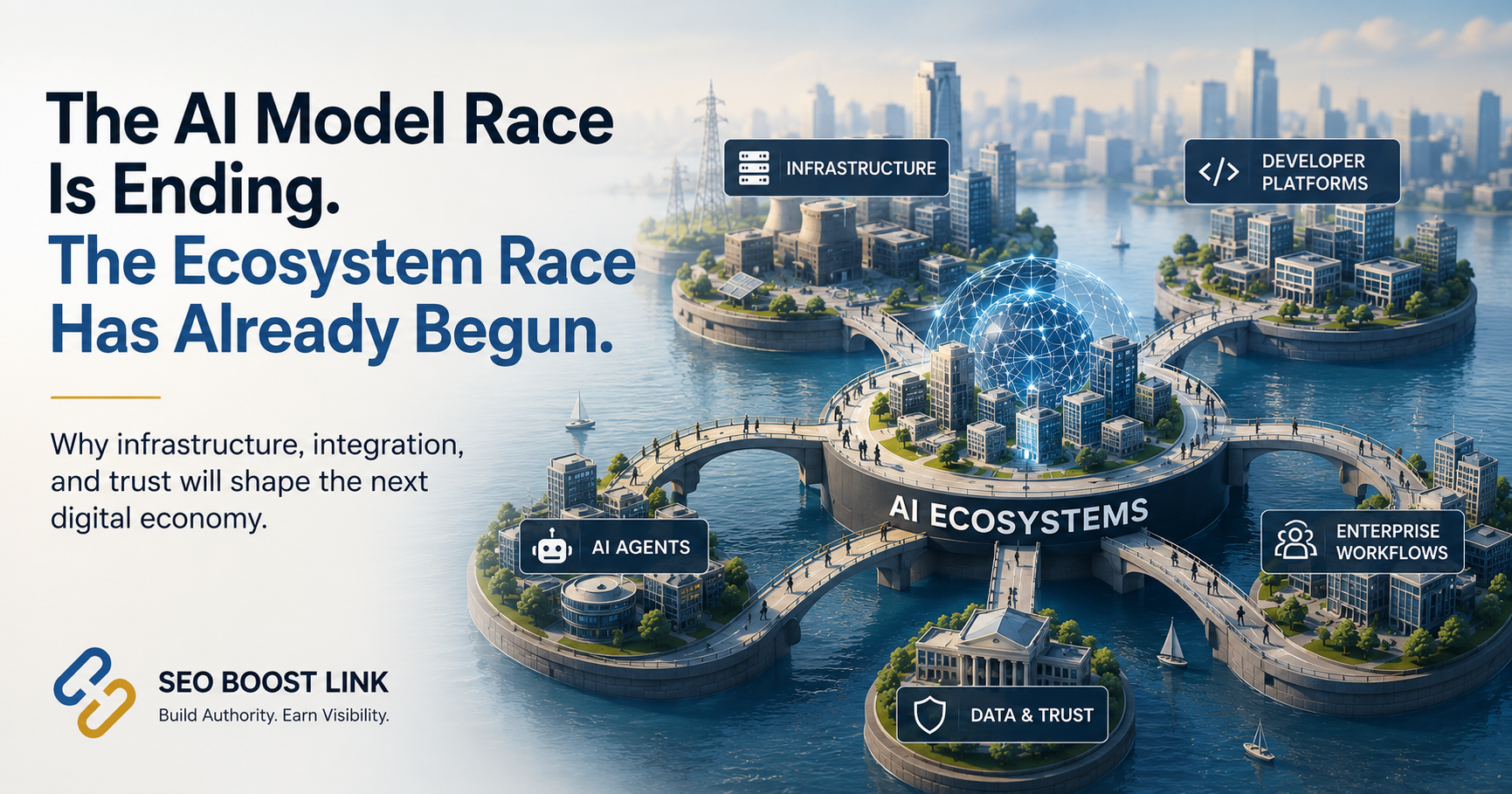
The AI Model Race Is Ending. The Ecosystem Race Has Already Begun.
The biggest AI announcements are no longer about benchmark scores. They're about infrastructure, developer ecosystems, enterprise workflows, and trust. This shift could fundamentally change how businesses choose AI platforms—and how brands earn visibility in AI-powered search.
Published: July 26, 2026
Last updated: July 26, 2026
In this article
- 1.Technology History Has Seen This Before
- 2.AI chips
- 3.High-bandwidth memory
- 4.Power infrastructure
- 5.Data centers
- 6.Enterprise security
- 7.AI agents
- 8.Developer platforms
- 9.Integration frameworks
- 10.Why This Matters For Businesses
- 11.The Same Shift Is Happening In Search
- 12.Editorial Mentions Are Becoming Infrastructure
- 13.Looking Beyond Today's Headlines
- 14.Key Takeaways
- 15.Frequently Asked Questions
- 16.Final Thought
The AI Model Race Is Ending. The Ecosystem Race Has Already Begun.
For the past few years, artificial intelligence has largely been viewed through a single lens:
Which company has the smartest model?
Every major release was measured by benchmark scores, reasoning performance, coding ability, context windows, multimodal capabilities, and increasingly complex leaderboards.
The assumption seemed obvious.
Build the most capable model, and everything else follows.
But over the past several weeks, something interesting has happened.
The industry's biggest announcements weren't primarily about making models smarter.
Instead, they focused on developer platforms, AI agents, enterprise workflows, memory, infrastructure, security, chips, interoperability, and large-scale deployment.
Individually, these announcements seem unrelated.
Collectively, they reveal something much more important.
The AI industry is entering a new phase.
The Headlines Are Different. The Direction Is The Same.
Google continues expanding its open ecosystem around Gemma.
OpenAI is investing heavily in enterprise workflows, Codex, infrastructure, and tools that allow AI to operate beyond conversations.
Anthropic is emphasizing AI agents, enterprise security, and responsible deployment.
NVIDIA continues investing billions into AI factories, networking, high-bandwidth memory, and data center infrastructure.
Meta remains committed to open-weight models and developer adoption.
Meanwhile, Chinese AI companies continue narrowing the performance gap with increasingly capable open models.
At first glance, these look like separate strategies.
They're not.
They're all solving the same problem from different angles.
The competition is no longer centered on producing a slightly better model.
It's increasingly about building the ecosystem that everyone else chooses to build on.
Models Attract Attention. Ecosystems Create Lock-In.
A language model is valuable.
An ecosystem is exponentially more valuable.
Models answer questions.
Ecosystems become part of how organizations operate.
Once AI becomes connected to documents, email, calendars, CRMs, design software, developer tools, internal knowledge, APIs, and enterprise workflows, switching becomes far more difficult.
Not because another model can't generate similar answers.
But because changing platforms means changing the surrounding infrastructure.
History repeatedly shows that durable competitive advantages rarely come from products alone.
They come from ecosystems.
Technology History Has Seen This Before
The companies that shaped previous technology eras didn't simply build better products.
They built platforms.
Microsoft Windows became indispensable because developers built software around it.
The iPhone wasn't defined by its hardware alone.
Its App Store created an ecosystem that transformed the smartphone industry.
Amazon Web Services became the default cloud platform because businesses built their infrastructure on top of it.
Android achieved global scale through manufacturers, developers, and service providers working together.
The product attracted users.
The ecosystem retained them.
AI appears to be following the same trajectory.
Follow The Investment, Not The Headlines
Perhaps the clearest signal comes from where capital is flowing.
If smarter models were the only objective, investment would primarily target larger training runs.
Instead, the industry's largest investments are going toward:
AI chips
High-bandwidth memory
Power infrastructure
Data centers
Networking
Enterprise security
AI agents
APIs
Developer platforms
Integration frameworks
These aren't chatbot investments.
They're infrastructure investments.
Infrastructure creates network effects.
Infrastructure creates switching costs.
Infrastructure becomes the foundation for long-term competitive advantage.
Why This Matters For Businesses
Many organizations are still asking:
"Which AI model should we use?"
It's a reasonable question.
But it may no longer be the most strategic one.
A better question is:
Which AI ecosystem will our business depend on over the next five years?
As AI becomes embedded into communication, research, customer support, software development, marketing, and decision-making, choosing an AI platform increasingly becomes an infrastructure decision.
That decision will influence future integrations, workflows, security policies, developer tools, and organizational knowledge.
Businesses won't simply adopt AI.
They'll build on it.
The Same Shift Is Happening In Search
Interestingly, a similar transition is taking place in search.
For years, digital visibility centered on optimizing individual webpages.
Today's AI systems work differently.
Instead of evaluating a single page in isolation, they synthesize information from multiple independent sources.
Editorial coverage.
Research publications.
Knowledge graphs.
Professional profiles.
Brand mentions.
Structured data.
Trusted third-party references.
Modern AI systems don't simply retrieve information.
They verify it.
This fundamentally changes how digital authority is built.
The brands most likely to earn visibility won't necessarily be those publishing the largest volume of content.
They'll be the organizations whose expertise can be independently confirmed across the broader web.
Trust is becoming infrastructure.
Editorial Mentions Are Becoming Infrastructure
This shift is one of the reasons editorial backlinks matter more than ever.
Not because they manipulate rankings.
Not because they increase Domain Authority.
But because they create independent, verifiable signals about a business.
An editorial mention tells both search engines and AI systems that your expertise exists beyond your own website.
Every trusted publication.
Every credible citation.
Every independent reference.
Together, they form a network of evidence.
And evidence is becoming increasingly valuable as AI systems learn to validate information rather than simply index it.
Digital authority is no longer measured by what you publish about yourself.
It's increasingly measured by what the broader digital ecosystem says about you.
Looking Beyond Today's Headlines
The AI industry will continue producing larger models.
Benchmarks will continue improving.
Reasoning capabilities will continue advancing.
Those developments matter.
But they may not define the companies that ultimately lead the next generation of computing.
The deeper transformation is happening underneath the models.
Infrastructure.
Developer ecosystems.
Enterprise workflows.
Interoperability.
Verification.
Trust.
Those are becoming the operating system of the next digital economy.
History suggests the companies—and the brands—that understand this shift early will build advantages that extend far beyond AI itself.
Key Takeaways
AI competition is shifting from models to ecosystems.
Infrastructure investments reveal where long-term value is being created.
Businesses should evaluate AI platforms, not just AI models.
Digital authority increasingly depends on independent verification across multiple trusted sources.
Editorial mentions are becoming strategic assets in AI-powered search.
Frequently Asked Questions
Why are AI ecosystems becoming more important than AI models?
As AI integrates into business workflows, value comes from developer platforms, APIs, enterprise tools, security, and interoperability—not just model performance.
How does this affect SEO?
AI-powered search increasingly evaluates information across multiple trusted sources rather than relying solely on individual webpages. Building digital authority is becoming more important than publishing more content.
What are editorial backlinks?
Editorial backlinks are natural mentions and links earned through independent publications because your expertise is genuinely worth referencing. They strengthen both brand credibility and AI-visible digital authority.
Final Thought
The AI model race isn't ending because innovation has slowed.
It's ending because models are becoming only one layer of a much larger system.
The companies shaping the future aren't simply building better AI.
They're building the infrastructure, ecosystems, and trust networks that others will depend on.
And as AI becomes part of how information is created, verified, and discovered, businesses face a similar challenge.
The question is no longer:
"Which AI model is the smartest?"
It's becoming:
"Which ecosystem—and which digital authority—will still matter five years from now?"
CTA
Building digital authority has never been more important.
If your business wants to strengthen its visibility across search engines and AI-powered discovery, the first step isn't buying more links—it's understanding whether your brand is ready for editorial coverage.
Start with a Fit Review to see whether an editorial backlink strategy is the right fit for your business.
Core reading
Sources and references
Reference sources used to support SEO, search, and authority-building context.
Author

Lalida Pimpa
Founder, SEO Boost Link
Lalida Pimpa is the founder of SEO Boost Link, an editorial backlink and authority strategy platform focused on SaaS, B2B, and digital-first brands. Her work centers on editorial relevance, entity-based SEO, AI visibility, and long-term authority building through contextual placements and search-aligned content systems.
With experience across SEO, lead generation, and digital growth strategy, she focuses on how modern search engines and AI systems interpret trust, topical relevance, and brand relationships across the web.
LinkedInFocus Areas
- •Editorial link building
- •AI search visibility
- •Entity-based SEO
- •Editorial placement strategy
Related Articles
Digital Memory Is Becoming the New Competitive Advantage
AI search is changing how businesses compete. Success increasingly depends on what AI remembers about your brand, not just what your website says.
Your Website Is No Longer Your Brand's Single Source of Truth
AI no longer builds an understanding of your business from your website alone. Learn why your brand is now shaped by the entire web, and what businesses must do to stay visible.
Why AI Search Favors Third-Party Validation Over Brand Claims
AI search engines increasingly rely on trusted third-party sources rather than brand claims alone. Learn why editorial mentions, expert references, and independent validation are becoming essential for AI visibility.
Why AI Visibility Is Becoming a Business Strategy, Not Just an SEO Strategy
AI visibility is no longer just an SEO concern. As AI-powered search becomes mainstream, businesses must treat digital authority, trust, and representation as part of their overall business strategy.