AI Visibility
Your Website Is No Longer Your Brand's Single Source of Truth
AI no longer builds an understanding of your business from your website alone. Learn why your brand is now shaped by the entire web, and what businesses must do to stay visible.
Published: July 6, 2026
Last updated: July 6, 2026
In this article
- 1.The Website-Centric Internet Is Ending
- 2.How AI Builds a Brand Profile
- 3.Industry articles
- 4.Reddit discussions
- 5.LinkedIn posts
- 6.Customer experiences
- 7.News coverage
- 8.Case studies
- 9.Conference presentations
- 10.GitHub repositories
- 11.Research papers
- 12.Why Third-Party References Matter More Than Ever
- 13.Official information
- 14.Product details
- 15.Company background
- 16.Contact information
- 17.What This Means for Businesses
- 18.Building a Brand That AI Can Trust
- 19.Looking Ahead
- 20.Frequently Asked Questions
Introduction
For decades, businesses treated their website as the center of their digital presence.
Everything pointed back to it.
Marketing campaigns drove traffic to it.
SEO focused on improving it.
Customers visited it to learn about products and services.
Search engines primarily evaluated it.
If you wanted to improve your online visibility, the answer was usually simple.
Build a better website.
Today, that assumption is beginning to change.
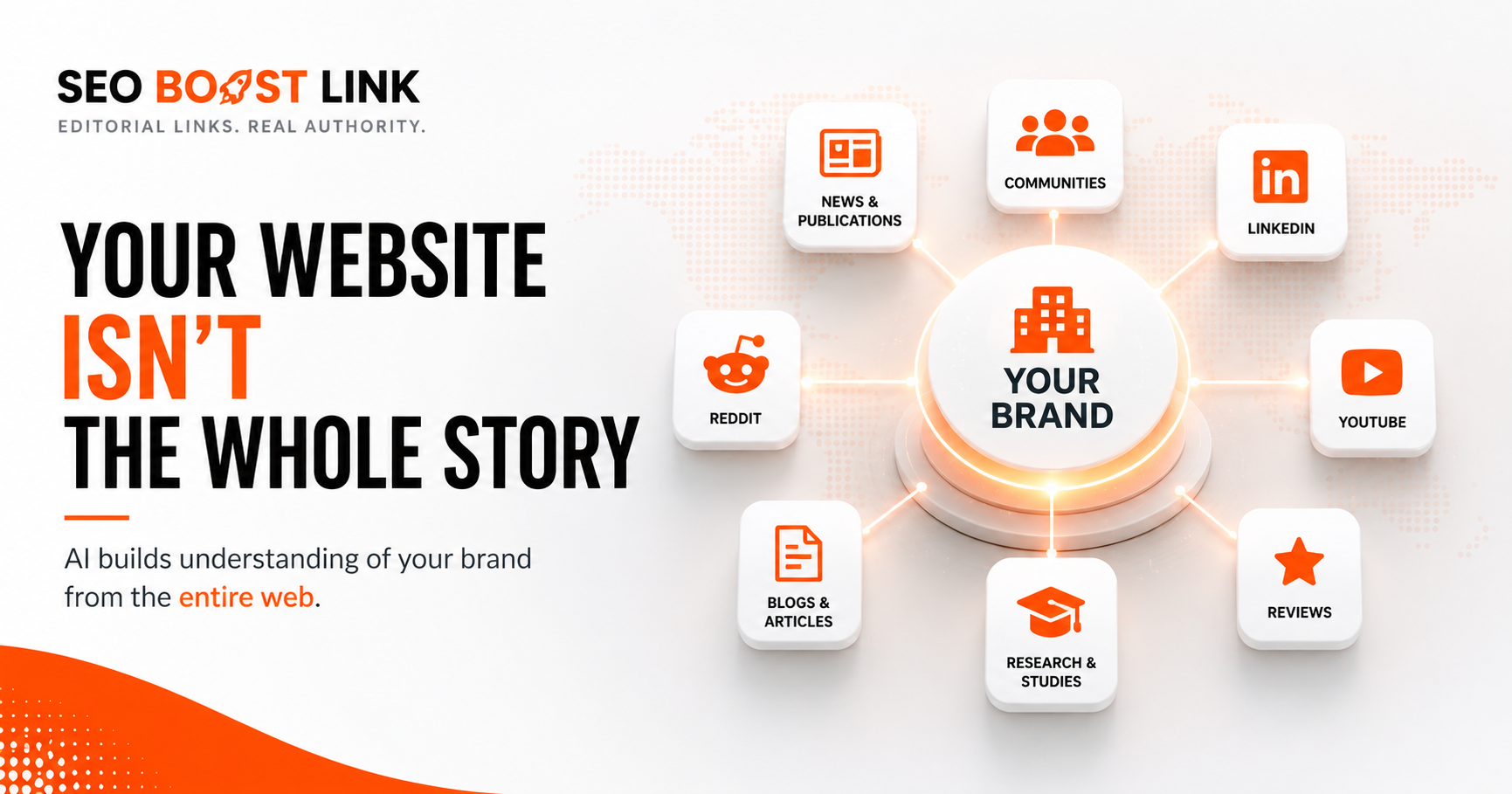
AI search systems no longer rely on a single source to understand your business.
Instead, they build a much broader picture by combining information from across the web.
Your website still matters.
It remains one of the most important sources of information about your business.
But it is no longer the only source that shapes how AI understands your brand.
That distinction is changing the future of digital authority.
The Website-Centric Internet Is Ending
Traditional SEO rewarded businesses for creating the best possible website.
The stronger your technical SEO, content, backlinks, and user experience, the more likely your pages were to rank.
The website acted as the primary destination.
AI changes that model.
Instead of sending users to ten different websites, AI increasingly generates answers directly.
To do that responsibly, it must gather information from multiple places before deciding what to present.
Rather than asking,
"What does this company's website say?"
AI is increasingly asking,
"What does the internet collectively say about this company?"
That is a fundamental shift.
The web is no longer simply a collection of websites.
It has become a network of evidence.
How AI Builds a Brand Profile
Imagine someone meeting your business for the first time.
They probably wouldn't rely on your homepage alone.
They might also read:
Reviews
Industry articles
Reddit discussions
LinkedIn posts
Customer experiences
News coverage
Case studies
Podcasts
Conference presentations
GitHub repositories
Documentation
Research papers
Humans naturally compare information before forming an opinion.
AI works in a surprisingly similar way.
Large language models and AI search systems build confidence by identifying consistent information across multiple sources.
If several trusted publications describe your company similarly, confidence increases.
If only your website makes certain claims, confidence is naturally lower.
Your brand is no longer defined by one domain.
It is defined by your digital footprint.
Why Third-Party References Matter More Than Ever
Every business says positive things about itself.
"We're experts."
"We're trusted."
"We're industry leaders."
Those statements are expected.
What matters more is whether other trusted sources say the same thing.
Editorial publications.
Industry blogs.
Independent reviews.
Conference speakers.
Professional communities.
These external references provide context that your own website cannot.
They help AI answer important questions such as:
Is this company recognised by others?
Does it consistently appear in relevant discussions?
Is its expertise acknowledged outside its own marketing?
This is one reason editorial backlinks remain valuable.
Their importance extends beyond SEO.
They represent independent recognition.
Your Website Is Becoming Evidence, Not the Entire Story
Many businesses still think their website is the complete representation of their brand.
In reality, it is becoming one piece of a much larger puzzle.
Your website provides:
Official information
Product details
Services
Company background
Contact information
But AI combines that information with signals from elsewhere.
A podcast interview may reinforce your expertise.
A research paper may establish authority.
A customer case study may strengthen trust.
An industry publication may connect your brand to a specific topic.
None of these replace your website.
Together, they make your website more believable.
The future of digital authority is no longer about owning every conversation.
It is about becoming part of the conversations that matter.
What This Means for Businesses
Businesses should stop thinking about visibility as something that happens only on their own website.
Instead, they should ask broader questions.
Where is our brand being mentioned?
Which trusted publications recognise our expertise?
What topics are we consistently associated with?
Would AI find enough independent evidence to confidently recommend us?
These questions represent a new way of thinking about online authority.
Success is becoming less about publishing more content and more about earning meaningful recognition across the web.
Building a Brand That AI Can Trust
This doesn't mean abandoning your website.
It means understanding its new role.
Your website remains the foundation of your digital presence.
It should contain accurate, well-structured, and up-to-date information.
But it cannot do all the work on its own.
Businesses that succeed in the AI era are likely to invest in three areas simultaneously.
First, they maintain a high-quality website that clearly communicates who they are and what they do.
Second, they create content that deserves to be referenced by others rather than simply consumed.
Third, they earn independent editorial mentions, expert references, and industry recognition that reinforce their credibility.
Together, these signals create a stronger and more complete representation of the brand.
Looking Ahead
The future of search is becoming less about websites and more about representation.
AI does not simply retrieve pages.
It builds understanding.
That understanding comes from many sources working together.
In the years ahead, businesses that focus only on their own website may struggle to build the level of trust that AI systems increasingly require.
Those that invest in a broader digital presence, one supported by independent references and consistent recognition, will be better positioned to remain visible as AI search continues to evolve.
Your website is still one of your most valuable digital assets.
It simply no longer tells the whole story.
Frequently Asked Questions
Does my website still matter?
Absolutely. Your website remains the authoritative source for official information, but AI increasingly evaluates it alongside many other trusted sources.
What is a brand's digital footprint?
It is the collection of information about your business across websites, news articles, communities, reviews, social platforms, research, and other third-party sources.
Why are editorial mentions important?
Editorial mentions provide independent validation that helps both people and AI understand your expertise and credibility.
Is this replacing SEO?
No. It expands SEO beyond your own website into a broader strategy focused on digital authority and trusted recognition.
Summary
The role of a website is changing.
Instead of acting as the single source of truth, it has become one important piece of a much larger digital ecosystem.
AI search systems increasingly build an understanding of brands by combining information from websites, editorial publications, communities, research, reviews, and many other independent sources.
Businesses that recognise this shift will be better prepared to build lasting visibility in both traditional search and AI-driven discovery.
CTA
Building a trustworthy website is still essential, but it is no longer enough.
At SEO Boost Link, we help businesses earn editorial backlinks and trusted third-party references that strengthen digital authority beyond their own website, creating the signals that matter for both search engines and AI search systems.
Core reading
Sources and references
Reference sources used to support SEO, search, and authority-building context.
Author

Lalida Pimpa
Founder, SEO Boost Link
Lalida Pimpa is the founder of SEO Boost Link, an editorial backlink and authority strategy platform focused on SaaS, B2B, and digital-first brands. Her work centers on editorial relevance, entity-based SEO, AI visibility, and long-term authority building through contextual placements and search-aligned content systems.
With experience across SEO, lead generation, and digital growth strategy, she focuses on how modern search engines and AI systems interpret trust, topical relevance, and brand relationships across the web.
LinkedInFocus Areas
- •Editorial link building
- •AI search visibility
- •Entity-based SEO
- •Editorial placement strategy
Related Articles
The AI Model Race Is Ending. The Ecosystem Race Has Already Begun.
The biggest AI announcements are no longer about benchmark scores. They're about infrastructure, developer ecosystems, enterprise workflows, and trust. This shift could fundamentally change how businesses choose AI platforms—and how brands earn visibility in AI-powered search.
Digital Memory Is Becoming the New Competitive Advantage
AI search is changing how businesses compete. Success increasingly depends on what AI remembers about your brand, not just what your website says.
Why AI Search Favors Third-Party Validation Over Brand Claims
AI search engines increasingly rely on trusted third-party sources rather than brand claims alone. Learn why editorial mentions, expert references, and independent validation are becoming essential for AI visibility.
Why AI Visibility Is Becoming a Business Strategy, Not Just an SEO Strategy
AI visibility is no longer just an SEO concern. As AI-powered search becomes mainstream, businesses must treat digital authority, trust, and representation as part of their overall business strategy.