AI Visibility
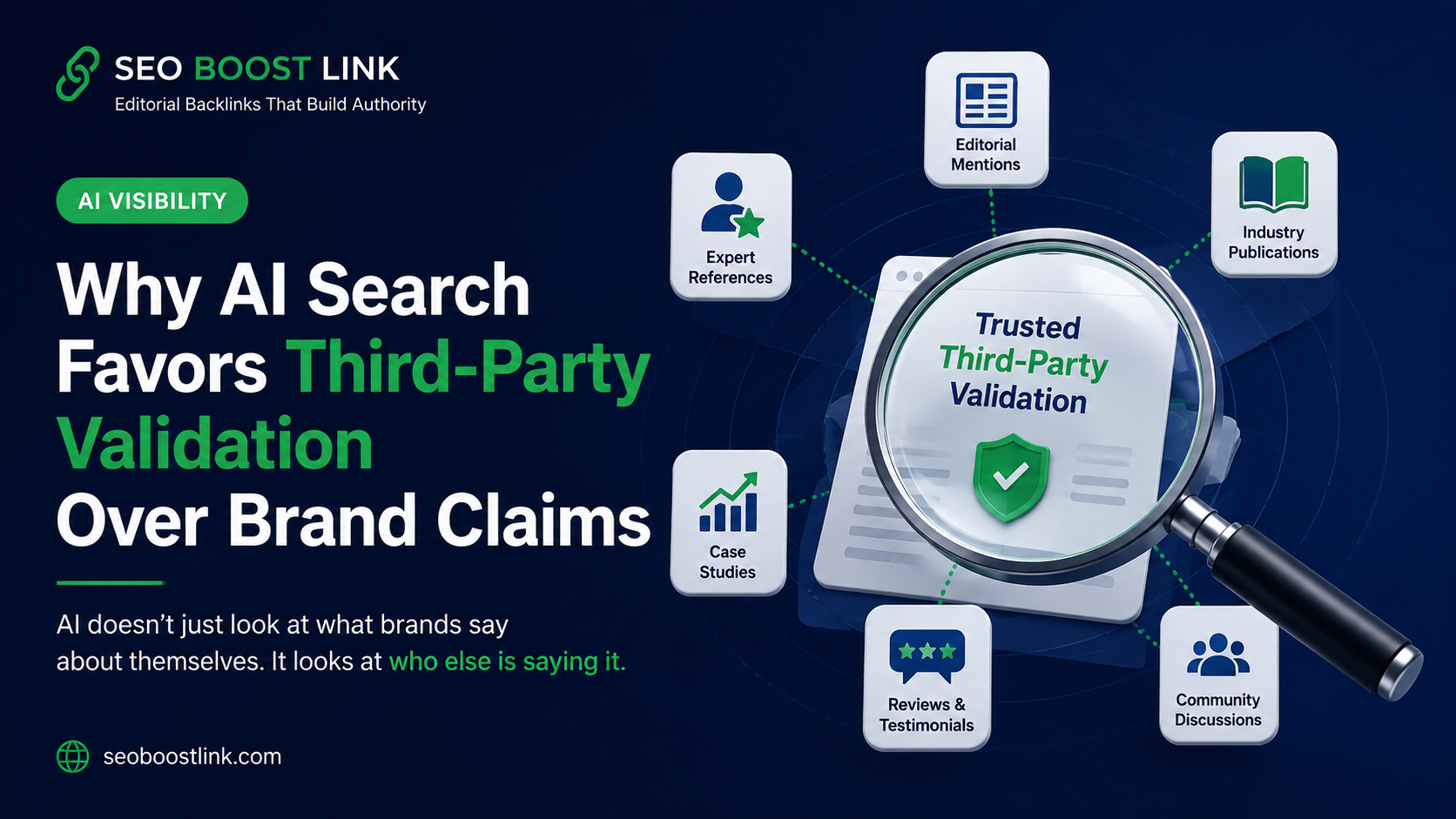
Why AI Search Favors Third-Party Validation Over Brand Claims
AI search engines increasingly rely on trusted third-party sources rather than brand claims alone. Learn why editorial mentions, expert references, and independent validation are becoming essential for AI visibility.
Published: July 4, 2026
Last updated: July 4, 2026
In this article
- 1.Why AI Search Favors Third-Party Validation Over Brand Claims
- 2.Why AI Systems Need Independent Validation
- 3.excellent service
- 4.experienced professionals
- 5.innovative solutions
- 6.industry-leading expertise
- 7.Editorial articles
- 8.Industry publications
- 9.Expert interviews
- 10.Case studies written by third parties
- 11.Trusted news coverage
- 12.Research citations
- 13.Professional recommendations
- 14.Brand Claims vs Third-Party Signals
- 15.Company A
- 16.Best SEO platform
- 17.Trusted by thousands
- 18.Industry leader
- 19.Award-winning solution
- 20.Company B
- 21.respected industry blogs
- 22.conference speakers
- 23.editorial publications
- 24.customer case studies
- 25.comparison articles
- 26.professional communities
- 27.Why Editorial Mentions Matter More Than Ever
- 28.Why This Matters for AI Visibility
- 29.real-world discussions
- 30.How Businesses Can Earn Third-Party Validation
- 31.Publish Information Worth Referencing
- 32.Original research
- 33.Industry analysis
- 34.Practical frameworks
- 35.Data-backed case studies
- 36.Detailed comparisons
- 37.Educational guides
- 38.Become Part of Industry Conversations
- 39.Industry publications
- 40.Expert interviews
- 41.Professional communities
- 42.Educational resources
- 43.Focus on Expertise Instead of Promotion
- 44.Build Editorial Relationships
- 45.Common Mistakes Businesses Still Make
- 46.Third-Party Validation and Editorial Backlinks
- 47.A discoverable citation
- 48.Context about the business
- 49.Industry association
- 50.Independent recognition
- 51.A pathway for human readers
- 52.A signal that other professionals considered the business relevant
- 53.Looking Ahead
- 54.Frequently Asked Questions
Why AI Search Favors Third-Party Validation Over Brand Claims
Introduction
For years, businesses focused on improving what they controlled.
They invested in better websites, stronger landing pages, polished product descriptions, and carefully written marketing copy. Traditional SEO rewarded this effort because search engines primarily evaluated what existed on a website alongside technical signals and backlinks.
AI search changes part of that equation.
Today's AI systems are designed to answer questions, summarize information, compare products, and recommend businesses. To do that responsibly, they need confidence that information is accurate. Instead of relying solely on what a company says about itself, AI increasingly looks for signals from independent sources.
This represents an important shift in digital visibility.
The question is no longer:
"What does your website say about your business?"
It is becoming:
"Who else is saying the same thing about your business?"
Understanding this change helps explain why editorial backlinks, media mentions, industry publications, customer reviews, and expert references are becoming more valuable in the AI era.
Why AI Systems Need Independent Validation
Every business naturally describes itself in the best possible way.
Every company claims to have:
excellent service
experienced professionals
innovative solutions
industry-leading expertise
From an AI perspective, these statements are difficult to verify because they originate from the company itself.
If an AI assistant recommends a software platform, marketing agency, or healthcare provider, users expect that recommendation to be supported by evidence rather than marketing language.
Independent validation helps provide that evidence.
Examples include:
Editorial articles
Industry publications
Expert interviews
Case studies written by third parties
Trusted news coverage
Research citations
Professional recommendations
These signals reduce uncertainty.
Rather than trusting a single source, AI can compare multiple independent references before generating an answer.
Brand Claims vs Third-Party Signals
Consider two software companies.
Company A
Its website says:
Best SEO platform
Trusted by thousands
Industry leader
Award-winning solution
Outside the website, very few people mention the company.
Company B
Its website makes similar claims.
However, the company is also mentioned by:
respected industry blogs
conference speakers
podcasts
editorial publications
customer case studies
comparison articles
professional communities
Both companies describe themselves positively.
Only one receives consistent validation from independent sources.
From an AI perspective, Company B presents stronger evidence.
This does not guarantee higher visibility every time, but it creates a more trustworthy information environment.
That distinction becomes increasingly important as AI systems aim to reduce hallucinations and improve factual reliability.
Why Editorial Mentions Matter More Than Ever
Editorial mentions differ from advertisements.
An editorial reference typically exists because an editor, journalist, researcher, or subject matter expert decided the brand deserved inclusion within a broader discussion.
That context matters.
For example:
"Several companies providing enterprise backlink solutions include Company A, Company B, and SEO Boost Link."
This type of mention carries different informational value than:
"SEO Boost Link is the world's best backlink provider."
The first statement contributes to broader industry understanding.
The second is simply a marketing claim.
AI systems are increasingly designed to recognize this difference.
Independent context often provides stronger evidence than self-promotion.
Why This Matters for AI Visibility
Businesses often ask:
"Do AI search engines use backlinks?"
The more useful question may be:
"What kind of information helps AI build confidence?"
Editorial backlinks do more than pass authority.
They also create discoverable relationships between:
brands
industries
products
services
expertise
real-world discussions
When multiple trusted publications reference a business naturally, AI systems gain additional context for understanding where that company fits within its industry.
Visibility becomes less about a single ranking factor and more about consistent recognition across the web.
How Businesses Can Earn Third-Party Validation
Third-party validation cannot be manufactured overnight.
It is earned over time through consistent expertise, valuable contributions, and genuine recognition from others.
Businesses that perform well in AI search often share several characteristics.
Publish Information Worth Referencing
Many companies create content designed only to rank for keywords.
Instead, create resources that other writers, journalists, and professionals actually want to reference.
Examples include:
Original research
Industry analysis
Practical frameworks
Data-backed case studies
Detailed comparisons
Educational guides
When your content becomes useful to other creators, independent mentions begin to happen naturally.
Become Part of Industry Conversations
A website should not exist in isolation.
The strongest brands appear across multiple trusted environments, including:
Industry publications
Podcasts
Expert interviews
Conferences
Professional communities
Educational resources
Every legitimate mention adds another piece of evidence that helps AI understand who you are.
Focus on Expertise Instead of Promotion
AI systems increasingly evaluate information quality rather than marketing intensity.
Instead of constantly saying,
"We are experts."
Show expertise by explaining:
Why something works.
When it doesn't.
Common misconceptions.
Practical recommendations.
Real examples.
Educational content builds credibility far more effectively than promotional content.
Build Editorial Relationships
Editorial backlinks remain valuable because they are based on editorial judgment rather than automation.
An editor decides:
"This company deserves to be included in this article."
That decision creates a stronger trust signal than links placed purely for SEO purposes.
This is one reason editorial backlinks continue to play an important role in digital authority.
They represent recognition rather than simply placement.
Common Mistakes Businesses Still Make
Many companies continue optimizing for yesterday's internet.
Mistake 1: Talking Only About Yourself
Some websites contain hundreds of pages describing how great the business is.
Very few discuss customer challenges, industry trends, or educational insights.
AI systems learn more from useful information than repetitive self-promotion.
Mistake 2: Chasing Metrics Instead of Credibility
Businesses often ask:
What's the Domain Rating?
Is the link DoFollow?
How many backlinks will I receive?
Those questions are understandable.
However, AI search shifts attention toward a broader question:
"Does this reference improve confidence in the information?"
A relevant editorial mention on a respected industry website may contribute more contextual value than dozens of unrelated backlinks.
Mistake 3: Ignoring Brand Recognition
A business can have strong technical SEO and still remain largely invisible outside its own website.
If trusted publications, experts, and industry communities rarely mention the brand, AI has fewer external signals to evaluate.
Visibility increasingly comes from being part of conversations that happen across the web, not only from publishing content on your own domain.
Third-Party Validation and Editorial Backlinks
Editorial backlinks are sometimes misunderstood as merely an SEO tactic.
In reality, they often serve a broader purpose.
When an editorial publication references a business naturally within relevant content, it creates multiple layers of value:
A discoverable citation
Context about the business
Industry association
Independent recognition
A pathway for human readers
A signal that other professionals considered the business relevant
This is fundamentally different from acquiring links solely to influence rankings.
As AI search evolves, context becomes just as important as the link itself.
Businesses that consistently earn relevant editorial references are building digital authority that extends beyond traditional search engines.
Looking Ahead
No one outside the major AI companies knows every factor their systems use.
However, one trend is becoming increasingly clear.
AI aims to reduce uncertainty.
When multiple trusted sources independently describe a company in similar ways, confidence increases.
When only the company's own website makes certain claims, confidence is naturally lower.
That doesn't mean businesses should stop investing in their websites.
It means websites should become one part of a broader digital presence.
The brands most likely to succeed in AI search over the next few years will not simply publish more content.
They will become businesses that other credible sources choose to reference.
In many ways, the future of visibility looks remarkably similar to how trust has always worked in the real world.
People believe what others consistently say about you, not only what you say about yourself.
AI is beginning to work the same way.
Frequently Asked Questions
Does AI Search ignore company websites?
No. Company websites remain an important source of information. However, AI systems increasingly compare information across multiple sources before generating responses.
Are backlinks still important?
Yes, but context matters more than ever. Editorial backlinks from relevant, trusted publications provide both authority and independent validation.
What is third-party validation?
Third-party validation refers to independent recognition of a business through editorial articles, expert recommendations, industry publications, reviews, research, podcasts, or other trusted sources outside the company's own website.
How can small businesses improve AI visibility?
Focus on creating genuinely useful content, earning editorial mentions, building expertise within your niche, and participating in credible industry conversations instead of relying solely on self-promotion.
Summary
AI search is changing how digital trust is built.
Rather than relying only on what brands publish about themselves, AI increasingly evaluates independent evidence from trusted third-party sources.
Editorial mentions, expert references, industry publications, and naturally earned backlinks help create the context AI systems need to understand which businesses deserve visibility.
For organizations preparing for the future of AI search, the goal is no longer just publishing more content.
It is becoming a brand that other credible sources choose to reference.
CTA
If your goal is long-term visibility in both traditional search and AI search, editorial backlinks should be part of a broader digital authority strategy.
At SEO Boost Link, we focus on earning relevant editorial placements that help businesses build credibility, strengthen topical authority, and create the independent signals that matter in an AI-driven web.
Core reading
Sources and references
Reference sources used to support SEO, search, and authority-building context.
Author

Lalida Pimpa
Founder, SEO Boost Link
Lalida Pimpa is the founder of SEO Boost Link, an editorial backlink and authority strategy platform focused on SaaS, B2B, and digital-first brands. Her work centers on editorial relevance, entity-based SEO, AI visibility, and long-term authority building through contextual placements and search-aligned content systems.
With experience across SEO, lead generation, and digital growth strategy, she focuses on how modern search engines and AI systems interpret trust, topical relevance, and brand relationships across the web.
LinkedInFocus Areas
- •Editorial link building
- •AI search visibility
- •Entity-based SEO
- •Editorial placement strategy
Related Articles
The AI Model Race Is Ending. The Ecosystem Race Has Already Begun.
The biggest AI announcements are no longer about benchmark scores. They're about infrastructure, developer ecosystems, enterprise workflows, and trust. This shift could fundamentally change how businesses choose AI platforms—and how brands earn visibility in AI-powered search.
Digital Memory Is Becoming the New Competitive Advantage
AI search is changing how businesses compete. Success increasingly depends on what AI remembers about your brand, not just what your website says.
Your Website Is No Longer Your Brand's Single Source of Truth
AI no longer builds an understanding of your business from your website alone. Learn why your brand is now shaped by the entire web, and what businesses must do to stay visible.
Why AI Visibility Is Becoming a Business Strategy, Not Just an SEO Strategy
AI visibility is no longer just an SEO concern. As AI-powered search becomes mainstream, businesses must treat digital authority, trust, and representation as part of their overall business strategy.