AI Visibility
How AI Search Engines Evaluate Trust in 2026
Trust is becoming one of the most important ranking and visibility signals in AI-powered search. Learn how modern search systems evaluate authority, credibility, brand reputation, contextual relevance, and trust beyond traditional SEO metrics.
Published: June 5, 2026
Last updated: June 5, 2026
In this article
- 1.Why Trust Matters More in AI Search
- 2.How AI Search Engines Evaluate Trust
- 3.1. Topical Authority
- 4.2. Editorial Trust
- 5.3. Contextual Relevance
- 6.4. Brand Mentions
- 7.5. Entity Recognition
- 8.6. Consistency Across the Web
- 9.Why Many Websites Struggle to Build Trust
- 10.The Future of SEO, GEO, and AI Visibility
- 11.Final Thoughts
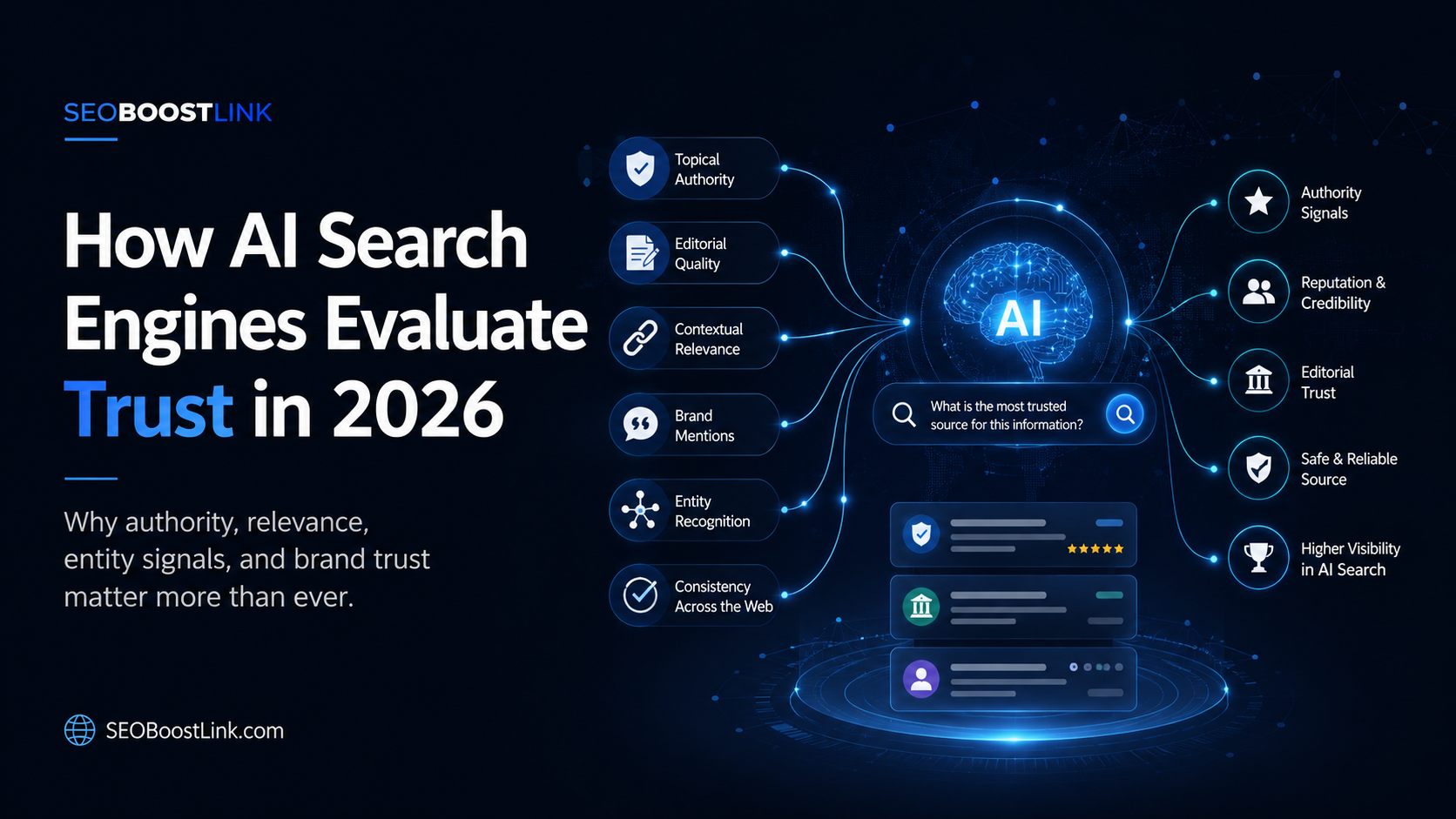
Artificial intelligence is changing how search engines evaluate websites.
For years, SEO professionals focused heavily on rankings, backlinks, domain authority, and keyword optimization. While these signals still matter, modern AI-powered search systems are increasingly focused on something much deeper:
Trust.
As platforms like Google AI Overviews, ChatGPT, Gemini, Perplexity, and Microsoft's Copilot continue to evolve, search is becoming less about matching keywords and more about identifying trustworthy sources of information.
This shift is changing how websites earn visibility.
Why Trust Matters More in AI Search
Traditional search engines primarily evaluated pages.
Modern AI systems increasingly evaluate entities, relationships, sources, and reputation.
When AI generates answers, it assumes responsibility for recommending information to users. As a result, AI systems must determine which brands, websites, authors, and sources are trustworthy enough to reference.
This means visibility is no longer determined solely by technical SEO.
Trust has become a competitive advantage.
How AI Search Engines Evaluate Trust
Although search companies do not publish their exact algorithms, several trust-related signals appear consistently across modern search systems.
1. Topical Authority
AI systems prefer sources that consistently publish useful content about a specific subject.
A website with dozens of high-quality articles about SEO is generally perceived as more trustworthy for SEO-related topics than a general website that occasionally mentions SEO.
Topical consistency helps AI understand expertise.
2. Editorial Trust
Search systems increasingly evaluate whether content appears to be written for users rather than manipulation.
Factors may include:
- Original insights
- Expert knowledge
- Clear explanations
- Supporting evidence
- Helpful user experience
Trustworthy content tends to provide value rather than simply target keywords.
3. Contextual Relevance
Modern AI systems analyze relationships between topics.
A backlink or mention from a highly relevant source may contribute more trust than multiple mentions from unrelated websites.
Context helps AI understand why a source is being referenced.
4. Brand Mentions
Trust is not built only through backlinks.
AI systems can observe mentions across websites, social platforms, communities, podcasts, articles, and industry discussions.
Brands that are consistently referenced within their niche often develop stronger authority signals.
5. Entity Recognition
Search engines increasingly operate as entity-based systems.
An entity can be:
- A company
- A person
- A product
- A website
- An organization
The more clearly search engines understand an entity and its relationships, the easier it becomes to evaluate trust.
6. Consistency Across the Web
Trustworthy brands tend to present consistent information.
This includes:
- Brand name
- Website
- Social profiles
- Author information
- Company details
Consistency helps AI connect information across multiple sources.
Why Many Websites Struggle to Build Trust
Many websites focus exclusively on rankings.
They build backlinks, publish content, and optimize keywords without developing broader authority.
As AI search evolves, trust becomes increasingly difficult to fake.
Search systems are becoming better at understanding:
- Expertise
- Reputation
- Relevance
- Credibility
- User value
Trust is earned through sustained quality rather than isolated tactics.
The Future of SEO, GEO, and AI Visibility
The future of search is likely to reward brands that are genuinely useful, recognizable, and trusted.
This affects:
- SEO
- GEO (Generative Engine Optimization)
- AEO (Answer Engine Optimization)
- AI Visibility
Rather than asking:
"How can I rank?"
Businesses may increasingly need to ask:
"Why should AI trust us?"
That question may become one of the most important visibility challenges of the next decade.
Final Thoughts
Trust is becoming a foundational signal in AI-powered search.
While backlinks, content, and technical SEO remain important, AI systems are increasingly evaluating the broader reputation and credibility of websites and brands.
The future of search belongs not only to the most optimized websites, but also to the most trusted ones.
Businesses that focus on expertise, authority, contextual relevance, and genuine value creation will be best positioned for the next generation of search.
Core reading
Sources and references
Reference sources used to support SEO, search, and authority-building context.
Author

Lalida Pimpa
Founder, SEO Boost Link
Lalida Pimpa is the founder of SEO Boost Link, an editorial backlink and authority strategy platform focused on SaaS, B2B, and digital-first brands. Her work centers on editorial relevance, entity-based SEO, AI visibility, and long-term authority building through contextual placements and search-aligned content systems.
With experience across SEO, lead generation, and digital growth strategy, she focuses on how modern search engines and AI systems interpret trust, topical relevance, and brand relationships across the web.
LinkedInFocus Areas
- •Editorial link building
- •AI search visibility
- •Entity-based SEO
- •Editorial placement strategy
Related Articles
The AI Model Race Is Ending. The Ecosystem Race Has Already Begun.
The biggest AI announcements are no longer about benchmark scores. They're about infrastructure, developer ecosystems, enterprise workflows, and trust. This shift could fundamentally change how businesses choose AI platforms—and how brands earn visibility in AI-powered search.
Digital Memory Is Becoming the New Competitive Advantage
AI search is changing how businesses compete. Success increasingly depends on what AI remembers about your brand, not just what your website says.
Your Website Is No Longer Your Brand's Single Source of Truth
AI no longer builds an understanding of your business from your website alone. Learn why your brand is now shaped by the entire web, and what businesses must do to stay visible.
Why AI Search Favors Third-Party Validation Over Brand Claims
AI search engines increasingly rely on trusted third-party sources rather than brand claims alone. Learn why editorial mentions, expert references, and independent validation are becoming essential for AI visibility.