SEO Strategy
Google Just Changed the Rules for AI Search, Here's What It Means for Link Building
Google updated its Search spam policies in May 2026 to explicitly include attempts to manipulate AI-generated search responses. Here is what changed, which tactics are now at higher risk, and what the update means for sustainable link building.
Published: May 26, 2026
Last updated: May 26, 2026
In this article
- 1.Google Just Changed the Rules for AI Search
- 2.What Exactly Changed
- 3.What Tactics Are Now at Higher Risk
- 4.Recommendation Poisoning
- 5.AI-Focused Listicle Spam
- 6.keyword repetition
- 7.entity stuffing
- 8.predictable answer formatting
- 9.and scalable AI-generated structures
- 10.Cloaking for AI Crawlers
- 11.Low-Value AI Content Flooding
- 12.Expired Domain Abuse
- 13.What This Update Does Not Prohibit
- 14.and user value
- 15.What This Means for Backlink Strategy
- 16.editorial trust
- 17.topical authority
- 18.and credible contextual mentions
- 19.The Short Version
- 20.Build content for real readers
- 21.Earn editorially relevant links
- 22.Focus on topical authority
- 23.Avoid manufactured AI visibility tactics
- 24.Final Thoughts
Google Just Changed the Rules for AI Search
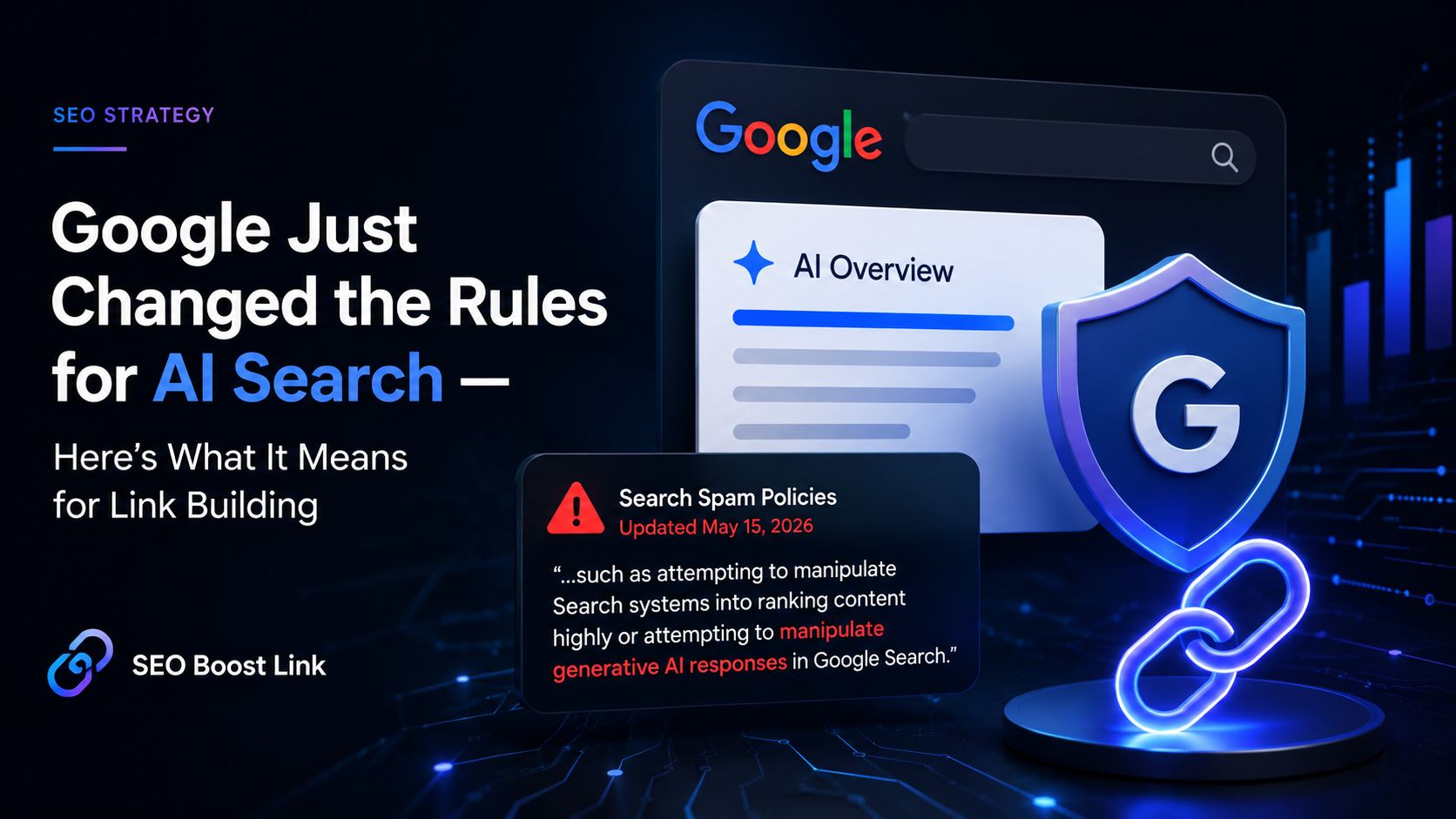
On May 15, 2026, Google updated its Search spam policies to explicitly include attempts to manipulate generative AI responses within Google Search, including AI Overviews and AI Mode.
The update is small in wording but significant in implication.
For the first time, Google's public spam documentation formally extends beyond traditional rankings and directly addresses AI-generated search experiences.
For SEO teams, publishers, and brands experimenting with GEO (Generative Engine Optimization), this closes an important gap between traditional search enforcement and AI search enforcement.
What Exactly Changed
According to Google's updated Search spam documentation, the definition of spam now includes:
"...attempting to manipulate Search systems into ranking content highly or attempting to manipulate generative AI responses in Google Search."
Previously, Google's spam language primarily focused on manipulating rankings in traditional search results.
The updated wording explicitly brings AI-generated responses under the same enforcement framework.
This means AI Overviews and AI Mode are no longer treated as separate experimental surfaces from a policy perspective.
The same quality and anti-manipulation standards now apply across both traditional search and AI-assisted search experiences.
This shift is becoming increasingly important as AI-evaluated search systems continue moving toward semantic trust and contextual relevance rather than traditional ranking manipulation alone.
What Tactics Are Now at Higher Risk
While Google did not publish a list of newly banned techniques alongside the wording update, the revised policy language — combined with broader industry reporting — points toward several categories of tactics that now carry significantly higher risk.
Recommendation Poisoning
This refers to content intentionally designed to influence AI systems into repeatedly recommending a brand, product, or service regardless of actual relevance or editorial merit.
Examples include pages engineered primarily to feed AI-generated answers rather than help readers.
AI-Focused Listicle Spam
Some publishers began mass-producing "best tools" or "top providers" pages designed mainly for AI retrieval systems rather than human usefulness.
These pages often prioritize:
keyword repetition
entity stuffing
predictable answer formatting
and scalable AI-generated structures
over original insight or testing.
Cloaking for AI Crawlers
Showing different content to AI crawlers or Googlebot than to human visitors has long been considered risky.
The updated policy language reinforces that AI-generated search experiences fall under the same anti-cloaking principles.
Low-Value AI Content Flooding
Google has repeatedly clarified that AI-assisted content itself is not prohibited.
However, large-scale production of thin, repetitive, low-value pages designed only to occupy AI answer pipelines is increasingly likely to trigger spam evaluation systems.
Expired Domain Abuse
Using previously trusted expired domains to publish thin AI-generated content or artificial authority pages remains a high-risk tactic under Google's broader spam policies.
These are also some of the same patterns that cause many large-scale low-context backlink campaigns to lose long-term effectiveness in AI-assisted search systems.
What This Update Does Not Prohibit
One of the most important points in Google's guidance is that AI-generated or AI-assisted content is not automatically considered spam.
Google's position continues to focus on:
quality
usefulness
originality
and user value
rather than the mere use of AI tools.
Helpful content that demonstrates expertise, satisfies search intent, and serves a real audience remains acceptable regardless of whether AI tools assisted in the writing or production process.
The distinction is not AI versus human.
The distinction is usefulness versus manipulation.
This is also why contextual relevance and editorial quality continue becoming more important than scalable content volume alone.
What This Means for Backlink Strategy
For sustainable link building strategies, this update changes less than many people assume.
Editorially relevant links, genuine outreach, contextual guest posting, digital PR, and topical authority building remain aligned with Google's long-term direction.
What becomes increasingly risky are tactics designed primarily to manufacture AI visibility without providing real informational value.
In practice, this reinforces a principle that experienced SEO teams have understood for years:
Links work best when they exist because the placement makes contextual and editorial sense.
At SEO Boost Link, we have consistently advised clients to treat AI visibility as an extension of search quality rather than a loophole to exploit.
The long-term signals still come from:
relevance
editorial trust
topical authority
and credible contextual mentions
The rise of AI search does not remove the importance of trust signals.
In many ways, it increases it.
This is also why many SEO teams are now adapting their link strategies around semantic trust and contextual authority rather than raw backlink metrics alone.
The Short Version
Google has now formally connected traditional search spam enforcement and AI search spam enforcement under the same policy framework.
If a tactic would be considered manipulative in classic SEO, it is increasingly likely to be treated the same way in AI-generated search experiences.
The safest long-term strategy remains straightforward:
Build content for real readers
Earn editorially relevant links
Focus on topical authority
Avoid manufactured AI visibility tactics
Treat AI search as part of search quality, not a shortcut around it
Final Thoughts
If you are unsure whether your current SEO or link building approach is aligned with where search is heading, a useful question is this:
Would this placement, citation, or page still make sense if AI Overviews did not exist?
If the answer is yes, you are likely operating on solid ground.
If the answer is no, the strategy may depend more on exploiting temporary system behavior than building durable search authority.
As AI-assisted search systems continue evolving, the brands that benefit most will likely be the ones building believable editorial trust rather than attempting to engineer artificial recommendation patterns.
Q: Did Google ban AI-generated content?
A: No. Google continues to state that AI-assisted content itself is not automatically considered spam. The focus remains on usefulness, originality, and user value.
Q: What is recommendation poisoning?
A: Recommendation poisoning refers to attempts to manipulate AI-generated search systems into repeatedly recommending a brand or product regardless of genuine relevance or editorial merit.
Q: Are backlinks still safe after Google's AI spam policy update?
A: Editorially relevant backlinks and contextual authority-building strategies remain aligned with Google's long-term guidance. Manipulative AI-focused tactics carry higher risk.
Q: What types of SEO tactics are becoming riskier?
A: Low-value AI content flooding, AI-focused listicle spam, cloaking for AI crawlers, and manipulative recommendation-engineering tactics are increasingly risky.
Q: What is the safest long-term SEO strategy in AI search?
A: Building useful content, earning contextually relevant editorial links, and strengthening topical authority remain the most sustainable long-term approaches.
Core reading
Frequently asked questions
Blog post FAQ
Did Google ban AI-generated content?
No. Google continues to state that AI-assisted content itself is not automatically considered spam. The focus remains on usefulness, originality, and user value.
What is recommendation poisoning?
Recommendation poisoning refers to attempts to manipulate AI-generated search systems into repeatedly recommending a brand or product regardless of genuine relevance or editorial merit.
Are backlinks still safe after Google's AI spam policy update?
Editorially relevant backlinks and contextual authority-building strategies remain aligned with Google's long-term guidance. Manipulative AI-focused tactics carry higher risk.
What types of SEO tactics are becoming riskier?
Low-value AI content flooding, AI-focused listicle spam, cloaking for AI crawlers, and manipulative recommendation-engineering tactics are increasingly risky.
What is the safest long-term SEO strategy in AI search?
Building useful content, earning contextually relevant editorial links, and strengthening topical authority remain the most sustainable long-term approaches.
Sources and references
Reference sources used to support SEO, search, and authority-building context.
Author

Lalida Pimpa
Founder, SEO Boost Link
Lalida Pimpa is the founder of SEO Boost Link, an editorial backlink and authority strategy platform focused on SaaS, B2B, and digital-first brands. Her work centers on editorial relevance, entity-based SEO, AI visibility, and long-term authority building through contextual placements and search-aligned content systems.
With experience across SEO, lead generation, and digital growth strategy, she focuses on how modern search engines and AI systems interpret trust, topical relevance, and brand relationships across the web.
LinkedInFocus Areas
- •Editorial link building
- •AI search visibility
- •Entity-based SEO
- •Editorial placement strategy
Related Articles
Topical Authority in 2026: Why Single Backlinks No Longer Move RankingsWhy Brands Are Losing Traffic After Google AI Overviews
Google, ChatGPT, Gemini, and other AI search systems increasingly evaluate topical authority rather than individual links. Learn how to build authority across an entire topic and improve long-term visibility.
What Is GEO (Generative Engine Optimization)? A Complete Guide for 2026
As search behavior shifts from Google to AI assistants like ChatGPT and Gemini, businesses must adapt to GEO (Generative Engine Optimization) to remain visible in AI-generated search experiences.
Why Brands Are Losing Traffic After Google AI Overviews
Many backlinks fail to improve rankings because modern search systems evaluate contextual relevance, semantic trust, editorial quality, and topical authority — not just raw link quantity.
How Long Does It Take for Backlinks to Improve Rankings?
Most backlinks take between 6 and 12 weeks to begin influencing rankings. Learn how Google discovers, evaluates, and processes backlinks and why some links never improve rankings at all.