Future of Search & AI
The Future of SEO May Depend on What AI Chooses, Not What Humans Click
The biggest story behind the Visa and OpenAI partnership is not payments. It is the possibility that AI may soon influence purchasing decisions at scale. If AI becomes part of how people discover, evaluate, and buy products, the future of SEO may depend on what AI chooses, not what humans click.
Published: June 17, 2026
Last updated: June 17, 2026
In this article
- 1.Introduction
- 2.What Visa and OpenAI Actually Announced
- 3.The Shift From Information Layer to Transaction Layer
- 4.The Traditional Search Journey
- 5.The Emerging AI Commerce Journey
- 6.Why This Matters for SEO
- 7.The Rise of AI Visibility
- 8.Trust Becomes a Competitive Advantage
- 9.What Businesses Should Do Today
- 10.Frequently Asked Questions
- 11.What is agentic commerce?
- 12.Does the Visa and OpenAI partnership mean AI can spend money on its own?
- 13.How does this affect SEO?
- 14.What is AI Visibility?
- 15.Key Takeaways
- 16.Final Thoughts
- 17.CTA
- 18.WHAT AI CHOOSES
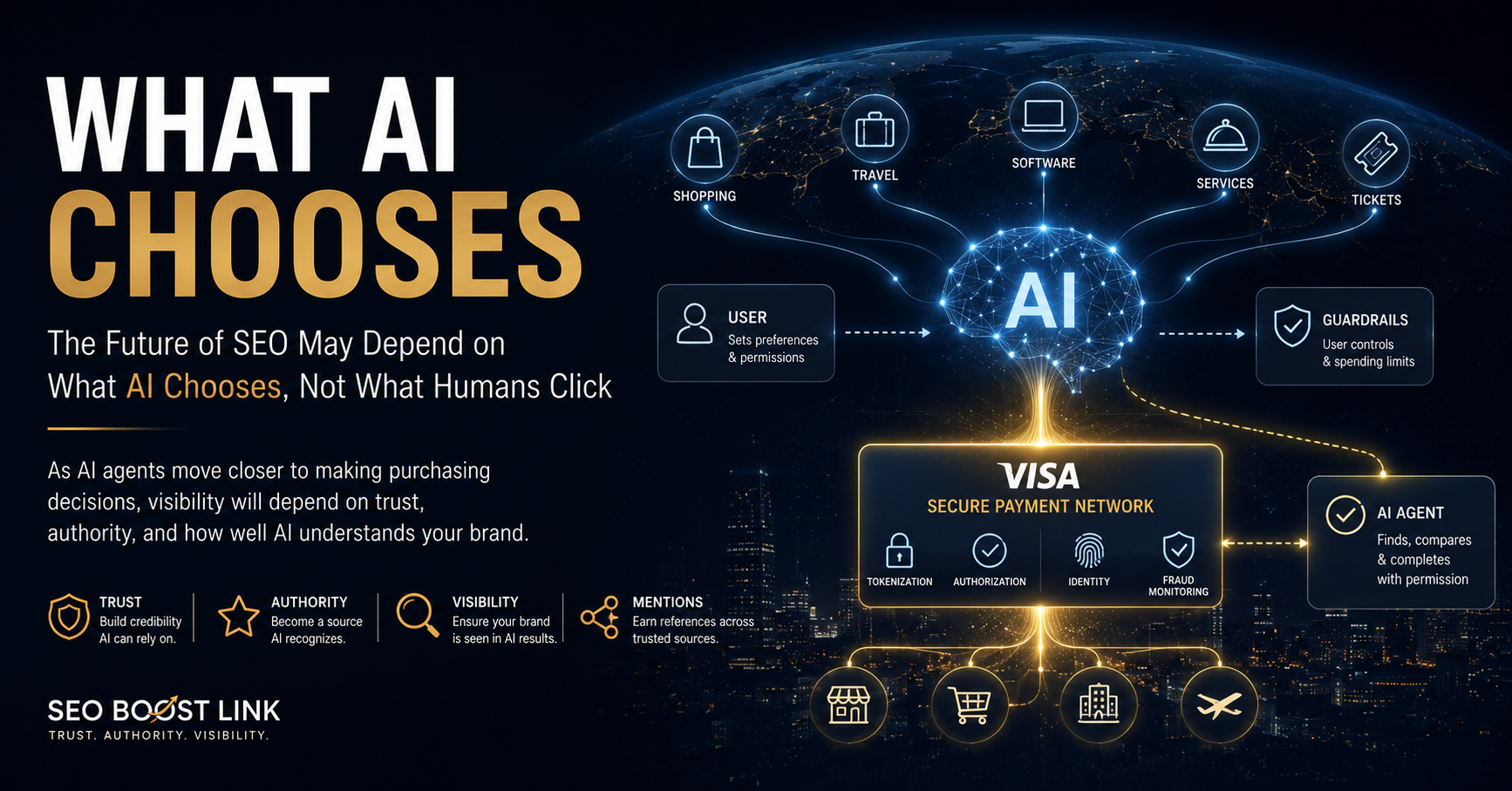
# The Future of SEO May Depend on What AI Chooses, Not What Humans Click
Introduction
For more than two decades, digital marketing has been built around a simple idea:
Help humans find information.
Search engines became the gateway to discovery.
Businesses invested heavily in SEO because visibility in search results influenced visibility in the marketplace.
The process was straightforward.
A person searched.
Search engines returned results.
The user clicked.
The business earned attention.
But recent developments suggest that this model may be evolving.
The partnership between Visa and OpenAI points toward a future where AI may play a much larger role in how people discover, evaluate, and purchase products and services.
The implications extend far beyond payments.
They may reshape the future of search itself.
What Visa and OpenAI Actually Announced
Visa and OpenAI announced a collaboration focused on enabling agentic commerce.
The objective is to create infrastructure that allows AI agents to participate in commerce on behalf of users while operating within user-defined permissions and controls.
Importantly, this does not mean AI agents can freely spend money without approval.
The focus is on creating secure systems that allow AI-powered experiences to help users complete commercial activities under predefined conditions.
Visa contributes its expertise in:
* Payment infrastructure
* Tokenization
* Authorization
* Fraud prevention
* Transaction security
OpenAI contributes the intelligence layer.
Together, they are exploring how AI agents may become participants within digital commerce ecosystems.
The Shift From Information Layer to Transaction Layer
Most AI discussions focus on information.
AI answers questions.
AI summarizes content.
AI writes text.
AI generates images.
However, the Visa partnership suggests a larger transition.
AI is moving closer to the transaction layer.
Historically, AI helped users make decisions.
Now AI may increasingly help execute decisions.
This distinction matters.
An assistant that provides information is useful.
An assistant that can help complete actions is transformative.
The moment AI begins influencing transactions, it becomes part of the economic infrastructure of the internet.
The Traditional Search Journey
For years, the customer journey followed a familiar pattern.
Search → Website → Comparison → Checkout → Payment
Businesses competed for:
* Rankings
* Clicks
* Traffic
* Conversions
SEO was fundamentally about attracting human attention.
The user remained the primary decision-maker throughout the process.
The Emerging AI Commerce Journey
Agentic commerce introduces a different possibility.
User → AI Agent → Evaluation → Recommendation → Transaction
The AI may help compare products.
The AI may help evaluate alternatives.
The AI may help identify trusted providers.
The AI may help complete transactions.
Humans remain in control.
But AI increasingly participates in the decision-making process.
This creates an entirely new visibility challenge.
Businesses must think about more than human discoverability.
They must consider AI discoverability.
Why This Matters for SEO
Many organizations still view SEO as a ranking problem.
But the future may involve a broader challenge.
How do AI systems discover, understand, evaluate, and trust a brand?
If AI agents become part of commercial decision-making, businesses may need to optimize for:
* Trust
* Authority
* Reputation
* Brand recognition
* Consistent information
* Third-party validation
Traditional rankings remain important.
But rankings alone may not be enough.
The brands most visible to AI systems could gain significant advantages.
The Rise of AI Visibility
This is where AI Visibility becomes increasingly important.
AI systems do not think like search engines.
They rely on patterns of trust, references, mentions, authority signals, and contextual understanding.
Questions businesses may need to ask include:
* Does AI recognize our brand?
* Does AI understand what we do?
* Can AI find consistent information about us?
* Do authoritative sources mention us?
* Would an AI system confidently recommend us?
These questions extend beyond traditional SEO.
They belong to a broader discipline that includes GEO (Generative Engine Optimization), AEO (Answer Engine Optimization), and AI Visibility.
Trust Becomes a Competitive Advantage
If AI agents help users make decisions, trust becomes even more important.
An AI system cannot personally experience a product.
Instead, it evaluates available signals.
It looks for evidence.
References.
Authority.
Credibility.
Reputation.
This means trust signals become increasingly valuable assets.
The businesses that establish strong digital authority may be better positioned to earn visibility in AI-driven environments.
What Businesses Should Do Today
Organizations do not need to redesign their marketing strategies overnight.
However, they should begin preparing for a future where AI becomes part of the discovery and decision-making process.
Practical priorities include:
* Strengthening brand authority
* Earning credible mentions
* Publishing useful expertise
* Maintaining consistent business information
* Building trust across multiple platforms
* Investing in long-term visibility rather than short-term tactics
These principles benefit both traditional search and AI-powered discovery.
Frequently Asked Questions
What is agentic commerce?
Agentic commerce refers to commerce experiences where AI agents assist users in discovering, evaluating, and potentially completing transactions within predefined permissions.
Does the Visa and OpenAI partnership mean AI can spend money on its own?
No. The announced collaboration focuses on secure infrastructure, permissions, controls, and user-defined boundaries rather than unrestricted autonomous spending.
How does this affect SEO?
If AI systems increasingly influence purchasing decisions, businesses may need to optimize not only for search engines and human users but also for AI systems that evaluate trust, authority, and credibility.
What is AI Visibility?
AI Visibility refers to how effectively a business, brand, product, or service can be discovered, understood, and referenced by AI-powered systems.
Key Takeaways
* The Visa and OpenAI partnership is about more than payments.
* AI is moving closer to the transaction layer of the internet.
* Future discovery may increasingly involve AI agents.
* Businesses may need to optimize for AI visibility as well as search visibility.
* Trust, authority, and credibility are likely to become more important in AI-driven commerce.
Final Thoughts
For years, businesses competed for clicks.
The next phase of digital commerce may be different.
As AI becomes more involved in how people discover, evaluate, and purchase products, the competitive landscape may shift from attracting human attention to earning AI trust.
The future of SEO may not depend solely on what humans click.
It may increasingly depend on what AI chooses.
CTA
As AI transforms search, discovery, and commerce, businesses need more than rankings.
They need authority, trust, and visibility that AI systems can recognize.
At SEO Boost Link, we explore how brands can build digital authority and remain discoverable in an AI-first world.
OG IMAGE BRIEF (1200 × 630)
Headline:
WHAT AI CHOOSES
Subheadline:
The Future of SEO May Depend on What AI Chooses, Not What Humans Click
Visual Direction:
Premium editorial style inspired by Bloomberg, The Economist, and MIT Technology Review.
Background:
A digital commerce network connecting AI, brands, and payment infrastructure.
Visual Elements:
* AI decision nodes
* Brand icons flowing toward a transaction layer
* Trust and authority signals highlighted
* No robots
* No cartoon AI
* No stock people
Color Palette:
Dark navy, black, white, gold accents.
Goal:
Position SEO Boost Link as a thought leader on AI Visibility, GEO, AEO, Trust Signals, and the future of search.
Core reading
Sources and references
Reference sources used to support SEO, search, and authority-building context.
Author

Lalida Pimpa
Founder, SEO Boost Link
Lalida Pimpa is the founder of SEO Boost Link, an editorial backlink and authority strategy platform focused on SaaS, B2B, and digital-first brands. Her work centers on editorial relevance, entity-based SEO, AI visibility, and long-term authority building through contextual placements and search-aligned content systems.
With experience across SEO, lead generation, and digital growth strategy, she focuses on how modern search engines and AI systems interpret trust, topical relevance, and brand relationships across the web.
LinkedInFocus Areas
- •Editorial link building
- •AI search visibility
- •Entity-based SEO
- •Editorial placement strategy
Related Articles
AI Access May Become the Next Competitive Advantage
The future of AI may not be defined solely by capability. It may be defined by access. As governments begin treating advanced AI as strategic infrastructure, businesses face a new question: who will have access to the most powerful intelligence systems?
AI Search Visibility Is Now Measurable: What SEO Teams Should Track in 2026
AI visibility is no longer something brands have to guess. Google and Bing are beginning to expose how websites appear inside AI-generated search experiences. Here is what SEO teams should measure now, what the data actually means, and where authority building fits into the picture.
When AI Agents Become Your Second Audience: Why Digital Authority Is Evolving Beyond Search Rankings
AI is creating a second audience for your content. Alongside human readers, intelligent systems are increasingly retrieving, evaluating, and synthesizing information before presenting it to users. This shift doesn't replace SEO, but it expands what digital authority means and how businesses should think about long-term visibility.
The AI Citation Gap: Why Great Content Still Doesn't Get Cited
Ranking on Google no longer guarantees visibility in AI-generated answers. Learn why AI citations follow different discovery mechanisms and how to build authority across both search engines and AI.