AI Search
The AI Citation Gap: Why Great Content Still Doesn't Get Cited
Ranking on Google no longer guarantees visibility in AI-generated answers. Learn why AI citations follow different discovery mechanisms and how to build authority across both search engines and AI.
Published: August 5, 2026
Last updated: August 5, 2026
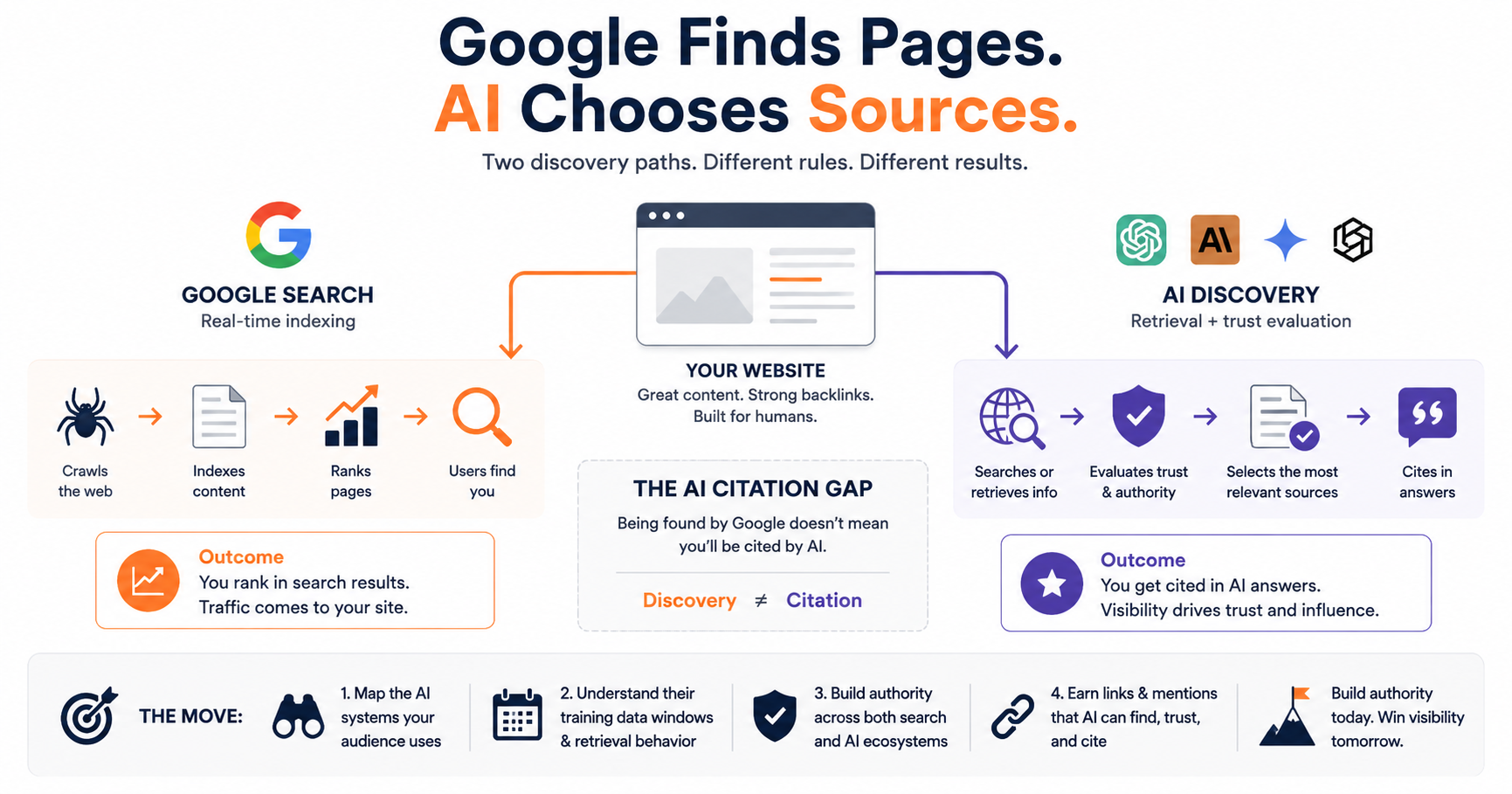
The AI Citation Gap: Why Great Content Still Doesn't Get Cited
For nearly three decades, search visibility has been built around one assumption.
If Google can discover your content, your customers can discover it too.
That assumption is no longer enough.
Today, people don't rely on a single discovery channel. They search Google, ask ChatGPT, consult Claude, explore Perplexity, and increasingly use AI assistants as the first step before clicking on a website.
This changes something fundamental.
Search engines and AI systems don't discover, evaluate, and present information in exactly the same way.
Google's job is to crawl, index, and rank billions of web pages.
AI systems have a different objective.
Their goal is to generate the most useful answer by selecting information they consider trustworthy and relevant.
That difference creates what I call the AI Citation Gap.
A business may publish outstanding content.
It may earn high-quality editorial backlinks.
It may rank on the first page of Google.
Yet it may never appear in an AI-generated answer.
The issue isn't necessarily content quality.
The issue is whether AI systems discover that content, trust it, and decide it deserves to become part of an answer.
Ranking and citation are related, but they are not identical.
Many organizations still treat AI visibility as an extension of traditional SEO.
That mindset risks optimizing for yesterday's internet instead of tomorrow's.
Modern AI systems retrieve information through different mechanisms.
Some perform real-time web searches.
Some combine retrieval systems with model knowledge.
Some prioritize authoritative publishers.
Others compare multiple sources before generating a response.
Different systems may reach completely different conclusions from the same question.
Ask several AI assistants for the best cybersecurity platform, the most reliable CRM, or the top accounting software, and the recommendations may vary significantly.
The difference isn't always about which company has the best product.
Often, it's about which sources each AI system can discover and trust.
This changes how businesses should think about authority.
For years, SEO has focused on one primary objective.
Rank higher.
The next era introduces a second objective.
Become a trusted source.
Those are not always the same thing.
Businesses should begin asking a different question.
Instead of asking,
"How do we improve our rankings?"
they should also ask,
"Will AI systems choose our content when customers ask questions about our industry?"
That subtle shift changes everything.
Backlinks still matter.
Editorial coverage still matters.
Brand mentions still matter.
Expertise still matters.
But their value is no longer limited to improving search rankings.
Together, these signals contribute to something much larger.
They build digital authority.
Authority is what increases the probability that both humans and AI systems recognize your brand as a trustworthy source of information.
That is becoming one of the most valuable competitive advantages on the internet.
Authority Is Becoming a Multi-Layer Problem
One of the biggest strategic mistakes businesses can make today is assuming that digital authority is measured by a single platform.
For years, success was relatively easy to define.
Higher rankings produced more organic traffic.
More traffic generated more opportunities.
That model still works.
It simply no longer explains the entire discovery landscape.
Today's internet has multiple layers.
Traditional search remains important.
AI-powered search is growing rapidly.
AI-generated answers are becoming another discovery channel.
Industry publications continue to shape credibility.
Editorial mentions strengthen reputation.
Brand recognition influences trust long before someone visits your website.
Each of these layers contributes differently to visibility.
The organizations that perform well across all of them will become increasingly difficult to compete against.
This doesn't mean traditional SEO is becoming obsolete.
On the contrary.
Strong SEO remains one of the foundations of digital authority.
Editorial backlinks, expert content, technical optimization, structured information, and credible publications continue to strengthen a brand's online presence.
The difference is that those investments are no longer serving a single destination.
They're supporting multiple discovery ecosystems simultaneously.
Businesses should start measuring success differently.
Instead of looking only at rankings and traffic, they should also ask:
Are respected publications mentioning our brand?
Is our expertise visible beyond our own website?
Can AI systems easily discover and understand our content?
Are we becoming one of the trusted sources within our industry?
These questions are becoming just as important as keyword rankings.
No one knows exactly how AI citation systems will evolve.
Retrieval models will improve.
Ranking signals will change.
New AI products will emerge.
The way information is selected today will almost certainly be different two years from now.
But one principle is unlikely to change.
Content cannot be cited if it cannot be discovered.
Content cannot become influential if it has not earned trust.
Authority has always mattered.
What's changing is where that authority is evaluated.
For years, businesses optimized primarily for Google's algorithms.
Tomorrow, they'll need to earn recognition from multiple systems that evaluate information in different ways.
The future of SEO isn't abandoning search.
It's expanding beyond it.
The companies that invest in trustworthy content, editorial authority, credible backlinks, expert knowledge, and consistent brand signals today will be better positioned regardless of how search engines and AI platforms continue to evolve.
Google finds pages.
AI chooses sources.
The businesses that understand the difference earliest won't simply rank higher.
They'll become the sources that both humans and AI trust.
Core reading
Sources and references
Reference sources used to support SEO, search, and authority-building context.
Author

Lalida Pimpa
Founder, SEO Boost Link
Lalida Pimpa is the founder of SEO Boost Link, an editorial backlink and authority strategy platform focused on SaaS, B2B, and digital-first brands. Her work centers on editorial relevance, entity-based SEO, AI visibility, and long-term authority building through contextual placements and search-aligned content systems.
With experience across SEO, lead generation, and digital growth strategy, she focuses on how modern search engines and AI systems interpret trust, topical relevance, and brand relationships across the web.
LinkedInFocus Areas
- •Editorial link building
- •AI search visibility
- •Entity-based SEO
- •Editorial placement strategy
Related Articles
How AI Systems Decide Which Brands to Reference
AI search is changing how visibility works. Discover how AI systems evaluate brands and why trust, authority, and references matter more than ever.
AI Search Rewards Brands, Not Websites
AI search is changing how visibility works. The brands that earn trust and references are more likely to be surfaced by AI systems than websites that focus only on rankings.
Trust Matters More Than Intelligence in the AI Era
AI models are becoming smarter every year, but intelligence alone does not guarantee trust. In the age of AI search, credibility and reliable references matter more than ever.
Why Trust Is Becoming the Most Important Signal in AI Search
As AI-generated content floods the web, trust is becoming more valuable than rankings, backlinks, or metrics. Here's why businesses that earn genuine credibility will outperform those that chase visibility alone.