Future of Search & AI
AI Access May Become the Next Competitive Advantage
The future of AI may not be defined solely by capability. It may be defined by access. As governments begin treating advanced AI as strategic infrastructure, businesses face a new question: who will have access to the most powerful intelligence systems?
Published: June 15, 2026
Last updated: June 15, 2026
In this article
- 1.Introduction
- 2.The Internet Era Was Defined by Open Access
- 3.AI Is No Longer Just Software
- 4.The Shift From Capability to Access
- 5.The Emergence of an AI Access Gap
- 6.Why This Matters for Businesses
- 7.What This Means for Search, Visibility, and Digital Authority
- 8.Frequently Asked Questions
- 9.What is AI access?
- 10.Why could AI access become a competitive advantage?
- 11.Could governments restrict AI access?
- 12.How does AI access affect businesses?
- 13.Key Takeaways
- 14.Final Thoughts
- 15.CTA
- 16.AI ACCESS
# AI Access May Become the Next Competitive Advantage
Introduction
For decades, the internet helped create a more level playing field.
A founder in Thailand could access the same search engine as a founder in Silicon Valley.
A freelancer in Bali could use the same cloud software as a multinational corporation.
A remote worker in Europe could build a global business using the same digital infrastructure available in New York, London, or Singapore.
The digital economy expanded because access became increasingly open.
But artificial intelligence may be introducing a different dynamic.
As governments begin discussing restrictions around advanced AI systems, an important question emerges:
What happens if access to the most capable AI models is no longer equally available to everyone?
The answer could have significant implications for businesses, entrepreneurs, and professionals around the world.
The Internet Era Was Defined by Open Access
One of the defining characteristics of the internet age was accessibility.
Information became global.
Software became global.
Cloud infrastructure became global.
This allowed individuals and small businesses to compete in ways that would have been impossible a generation earlier.
Geography became less important.
Access became more equal.
For years, the trend was clear:
The best tools eventually became available to everyone.
AI initially appeared to follow the same path.
But recent developments suggest that assumption may not hold forever.
AI Is No Longer Just Software
Most people still think about AI as a chatbot.
A writing assistant.
A coding tool.
A productivity application.
But at a strategic level, AI is becoming something much bigger.
It is becoming infrastructure.
Infrastructure powers everything built on top of it.
Roads support commerce.
Electricity supports industry.
The internet supports digital business.
AI increasingly supports research, software development, marketing, customer support, automation, decision-making, and knowledge work.
As AI becomes more deeply integrated into economic activity, governments may begin treating it less like software and more like a strategic asset.
Historically, strategic assets have never been distributed equally.
The Shift From Capability to Access
Most AI discussions focus on capability.
Which model is smarter?
Which model writes better?
Which model achieves higher benchmark scores?
Those questions matter.
But another question may soon become even more important:
Who has access to those capabilities?
If advanced AI becomes a critical layer of productivity, access itself becomes valuable.
Organizations with access to stronger AI systems may gain advantages in:
* Research
* Automation
* Product development
* Operational efficiency
* Decision-making
* Knowledge management
The competitive advantage may not come from AI alone.
It may come from access to AI.
The Emergence of an AI Access Gap
For years, discussions about digital inequality focused on internet access.
Today, a new form of inequality may be emerging.
Not every company may have access to the same AI models.
Not every professional may have access to the same capabilities.
Not every country may have access to the same intelligence infrastructure.
This creates what could become an AI Access Gap.
Unlike traditional digital divides, this gap is not about connectivity.
It is about capability.
And capability increasingly influences productivity.
The organizations with greater access may move faster, automate faster, and innovate faster.
Why This Matters for Businesses
Every major infrastructure shift creates winners and losers.
Businesses that understood the internet early gained an advantage.
Businesses that adopted cloud computing early gained an advantage.
Businesses that embraced mobile technology early gained an advantage.
AI may represent the next infrastructure shift.
The companies that understand how access influences competitive advantage may be better positioned to adapt.
The question is no longer simply:
"How can we use AI?"
The question may become:
"Will we have access to the same AI capabilities as our competitors?"
What This Means for Search, Visibility, and Digital Authority
As AI becomes part of how information is discovered, evaluated, and surfaced, businesses will need to think beyond traditional rankings.
Visibility in an AI-first world depends on more than content.
It depends on authority.
Trust.
References.
Mentions.
Credibility.
The organizations that become visible within AI-driven ecosystems may gain significant advantages over those that remain invisible.
Understanding AI infrastructure today may be as important as understanding search engines twenty years ago.
Frequently Asked Questions
What is AI access?
AI access refers to the ability of individuals, businesses, or countries to use advanced artificial intelligence systems and their capabilities.
Why could AI access become a competitive advantage?
Organizations with access to more capable AI systems may gain advantages in productivity, automation, research, software development, and decision-making.
Could governments restrict AI access?
As AI becomes increasingly strategic, governments may regulate access similarly to other critical technologies such as advanced semiconductors, cybersecurity systems, or satellite infrastructure.
How does AI access affect businesses?
Businesses with access to stronger AI capabilities may operate more efficiently, innovate faster, and create greater leverage across their operations.
Key Takeaways
* AI may be evolving from software into infrastructure.
* Future advantages may depend not only on AI capability but also on AI access.
* Governments increasingly view advanced AI as a strategic technology.
* A new AI Access Gap may emerge between organizations with different levels of access.
* Businesses should monitor AI access trends as closely as they monitor AI innovation.
Final Thoughts
The future of AI may not be defined solely by what the technology can do.
It may also be defined by who has access to it.
For decades, open access helped fuel the growth of the digital economy.
The next chapter may be different.
And for founders, businesses, and digital professionals, understanding that shift early could become a meaningful competitive advantage.
CTA
Want to understand how AI is changing search, visibility, authority, and digital discoverability?
Explore more insights from SEO Boost Link as we examine how businesses can build trust and visibility in an AI-first world.
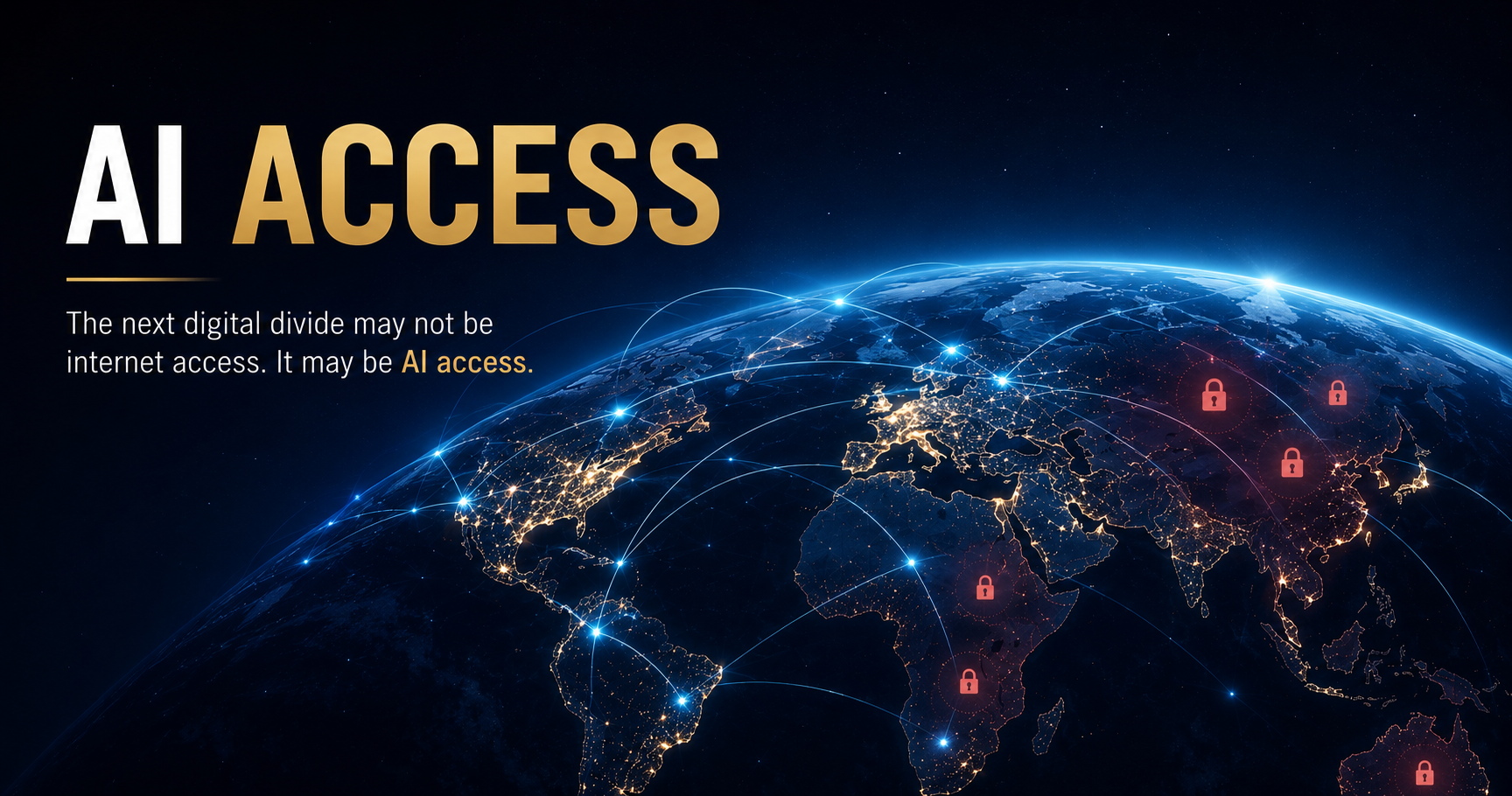
OG IMAGE BRIEF (1200 × 630)
Headline:
AI ACCESS
Subheadline:
The Next Digital Divide May Not Be Internet Access. It May Be AI Access.
Visual Direction:
Premium editorial style inspired by The Economist, Bloomberg, and MIT Technology Review.
Background:
Earth viewed from space with global data connections.
Visual Element:
Several regions connected by bright network lines, while other regions show subtle restricted-access indicators.
Color Palette:
Dark navy, black, deep blue, white typography.
No AI robots.
No chatbot icons.
No infographic boxes.
No stock business people.
Goal:
Position SEO Boost Link as a strategic voice discussing the future of AI, search, and digital visibility.
Core reading
Sources and references
Reference sources used to support SEO, search, and authority-building context.
Author

Lalida Pimpa
Founder, SEO Boost Link
Lalida Pimpa is the founder of SEO Boost Link, an editorial backlink and authority strategy platform focused on SaaS, B2B, and digital-first brands. Her work centers on editorial relevance, entity-based SEO, AI visibility, and long-term authority building through contextual placements and search-aligned content systems.
With experience across SEO, lead generation, and digital growth strategy, she focuses on how modern search engines and AI systems interpret trust, topical relevance, and brand relationships across the web.
LinkedInFocus Areas
- •Editorial link building
- •AI search visibility
- •Entity-based SEO
- •Editorial placement strategy
Related Articles
The Future of SEO May Depend on What AI Chooses, Not What Humans Click
The biggest story behind the Visa and OpenAI partnership is not payments. It is the possibility that AI may soon influence purchasing decisions at scale. If AI becomes part of how people discover, evaluate, and buy products, the future of SEO may depend on what AI chooses, not what humans click.
AI Search Visibility Is Now Measurable: What SEO Teams Should Track in 2026
AI visibility is no longer something brands have to guess. Google and Bing are beginning to expose how websites appear inside AI-generated search experiences. Here is what SEO teams should measure now, what the data actually means, and where authority building fits into the picture.
When AI Agents Become Your Second Audience: Why Digital Authority Is Evolving Beyond Search Rankings
AI is creating a second audience for your content. Alongside human readers, intelligent systems are increasingly retrieving, evaluating, and synthesizing information before presenting it to users. This shift doesn't replace SEO, but it expands what digital authority means and how businesses should think about long-term visibility.
The AI Citation Gap: Why Great Content Still Doesn't Get Cited
Ranking on Google no longer guarantees visibility in AI-generated answers. Learn why AI citations follow different discovery mechanisms and how to build authority across both search engines and AI.