AI SEO
When AI Agents Become Your Second Audience: Why Digital Authority Is Evolving Beyond Search Rankings
AI is creating a second audience for your content. Alongside human readers, intelligent systems are increasingly retrieving, evaluating, and synthesizing information before presenting it to users. This shift doesn't replace SEO, but it expands what digital authority means and how businesses should think about long-term visibility.
Published: August 10, 2026
Last updated: August 10, 2026
In this article
- 1.When AI Agents Become Your Second Audience
- 2.Every major shift on the web changes what authority means
- 3.Authority is becoming evidence-driven
- 4.Backlinks are evolving from ranking signals into trust signals
- 5.Content that serves two audiences
- 6.What this means for SEO strategy
- 7.Practical ways to prepare for an AI-driven web
- 8.Final thoughts
- 9.Frequently Asked Questions
- 10.Related articles
- 11.Editorial Backlinks vs Traditional Link Building
- 12.Why Digital Authority Matters More Than Rankings
- 13.How AI Search Is Changing SEO Strategy
- 14.Google's Search Quality Rater Guidelines
- 15.Anthropic research and documentation on tool use and AI systems
- 16.OpenAI documentation on Responses API and agent capabilities
- 17.Research on Retrieval-Augmented Generation (RAG) and information retrieval
- 18.Academic literature on information provenance and trustworthy AI
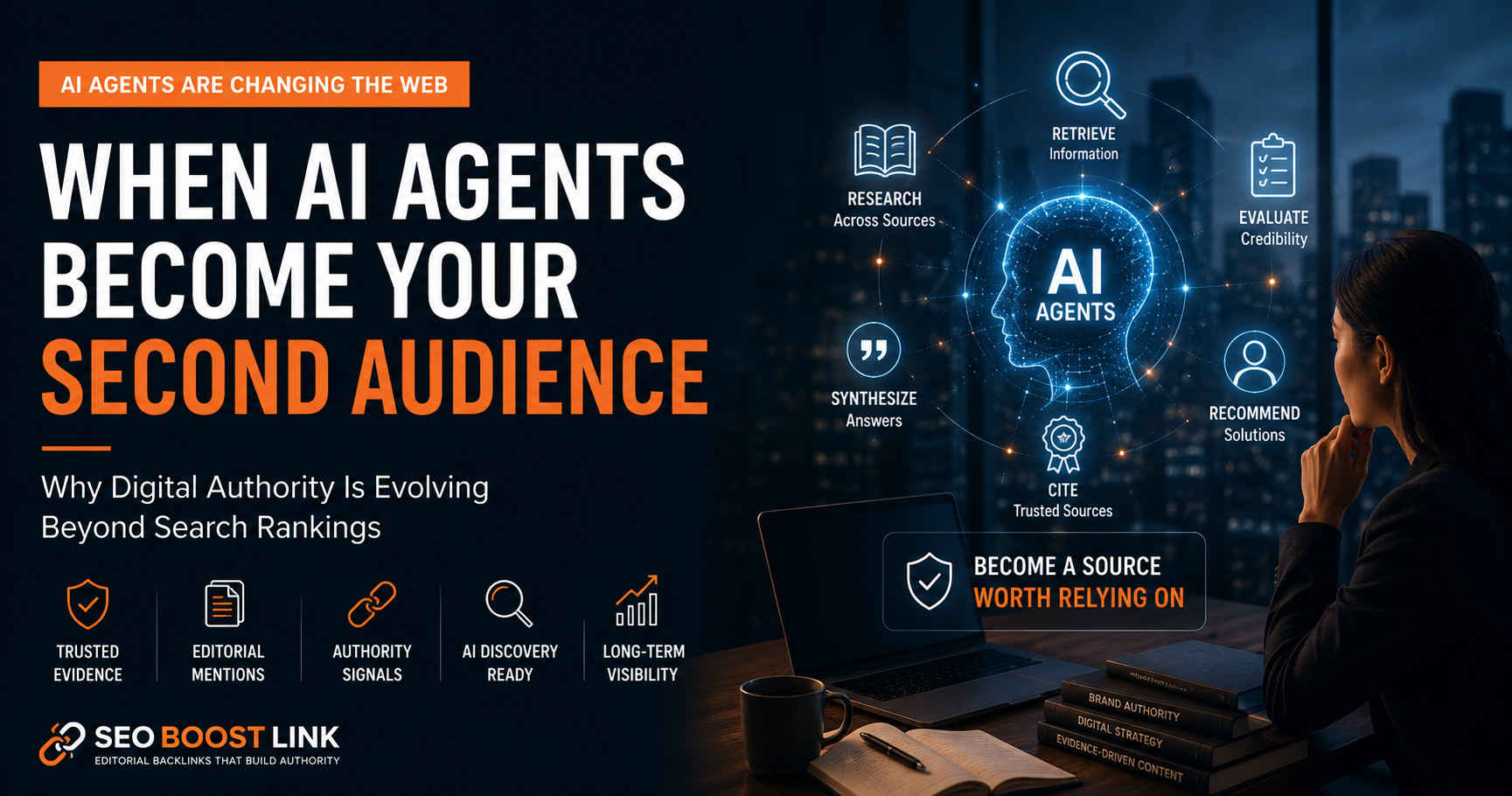
When AI Agents Become Your Second Audience
For most of the history of the web, businesses created content for one audience.
People.
Search engines existed to help people discover that content. Rankings determined visibility, backlinks influenced authority, and publishers optimized websites to attract human visitors.
That model still matters.
But something important is beginning to change.
Large language models and AI agents are no longer acting only as chat interfaces. They are increasingly retrieving information, comparing sources, coordinating tools, summarizing research, and helping users make decisions without requiring them to visit dozens of individual websites.
In other words, your content is no longer being consumed only by humans.
Increasingly, it is also being consumed by machines.
That doesn't mean people disappear from the equation.
It means your website has gained a second audience.
Understanding how this audience evaluates information may become one of the most important competitive advantages over the next few years.
Every major shift on the web changes what authority means
The internet has never had a fixed definition of authority.
In the early web, directories determined discoverability.
Later, search engines rewarded websites that earned relevance, reputation, and backlinks.
Social platforms introduced another layer where engagement influenced visibility.
Today, AI introduces another structural shift.
Instead of simply helping users find pages, AI systems increasingly help users interpret information across many different sources.
The objective is no longer only to identify the most relevant page.
The objective is increasingly to produce the most reliable answer.
That distinction matters.
Finding information and trusting information are related problems, but they are not identical.
As AI systems become more capable of assisting with business decisions, software selection, research, and technical work, the quality of the underlying information becomes increasingly important.
This is less about replacing search engines and more about adding another layer to how information flows across the internet.
Authority is becoming evidence-driven
Traditional SEO has always relied on signals that indicate authority.
Editorial backlinks.
Domain reputation.
Topical relevance.
Internal linking.
Content quality.
These signals remain valuable today.
However, AI systems introduce another consideration.
Information needs to be understandable, traceable, and supported by reliable evidence.
Different AI platforms retrieve information differently.
Some perform live searches.
Some combine retrieval systems with foundation models.
Others prioritize trusted publishers, documentation, structured information, or previously indexed knowledge.
There is no single universal retrieval model.
What they increasingly share, however, is a preference for information that demonstrates credibility rather than merely claiming it.
That is an important distinction.
Authority is becoming less about saying something confidently.
It is becoming more about making information easier to verify.
Backlinks are evolving from ranking signals into trust signals
For years, businesses viewed backlinks primarily as a ranking factor.
The goal was simple.
Earn enough high-quality links and rankings improve.
That remains true.
But backlinks may also serve another purpose.
They help establish relationships between trusted sources across the web.
When multiple independent publications reference similar research, findings, or expertise, those connections create a stronger signal that information deserves attention.
This isn't fundamentally different from how researchers evaluate academic work.
Evidence gains credibility when independent sources reinforce one another.
The same principle increasingly applies to digital publishing.
Rather than asking only,
"How many backlinks does this page have?"
A more useful question may become,
"Is this information consistently supported by other credible sources?"
That shift moves the conversation beyond traditional link building and toward something broader.
Digital authority.
Digital authority is not built by accumulating links alone.
It is built by consistently publishing information that other trustworthy sources consider worth referencing.
Content that serves two audiences
One of the most interesting consequences of AI is that content increasingly needs to satisfy two very different readers.
The first reader is human.
The second reader is an intelligent system.
Humans naturally respond to storytelling, emotion, design, and persuasive communication. They tolerate ambiguity because they understand context.
Machines are different.
AI systems perform better when information is clearly structured, internally consistent, supported by evidence, and easy to interpret. Well-defined headings, transparent methodology, clear authorship, and reliable references all make content easier to retrieve and understand.
This doesn't mean websites should be written for machines.
It means high-quality content should work well for both.
The best publishers won't choose between human-readable and machine-readable content.
They'll build content that earns the trust of both audiences simultaneously.
What this means for SEO strategy
Many businesses still think about SEO as a race for rankings.
Keywords.
Technical optimization.
Backlinks.
Those disciplines remain essential.
However, visibility is becoming more distributed.
Today, someone may discover your company through Google.
Tomorrow, they may ask an AI assistant for recommendations before ever opening a browser.
In that environment, success isn't determined only by whether your page ranks first.
It's also influenced by whether your information is considered reliable enough to contribute to an AI-generated answer.
That doesn't require abandoning traditional SEO.
It requires expanding it.
Instead of thinking only about search optimization, businesses should begin thinking about authority optimization.
That means asking different questions.
Is our content based on original expertise rather than repeating what already exists?
Do we explain how conclusions were reached?
Are important claims supported by trustworthy evidence?
Is our information kept current?
Have reputable publications referenced our work?
Would someone unfamiliar with our company have reasons to trust what we've published?
These questions improve content regardless of how someone discovers it.
Practical ways to prepare for an AI-driven web
The future doesn't require a completely new marketing strategy.
It requires improving the quality of the one you already have.
Organizations that want to strengthen long-term digital authority should focus on practices that consistently build trust across the web.
That includes:
Publishing original research, proprietary data, or genuine industry insights.
Updating important content regularly so information remains accurate.
Referencing reliable sources where appropriate instead of making unsupported claims.
Structuring content with clear headings, logical organization, and descriptive formatting.
Earning editorial mentions from reputable publications rather than relying solely on scalable link-building tactics.
Demonstrating real expertise through authorship, case studies, and transparent methodology.
None of these recommendations exist solely because of AI.
They have always represented good publishing.
AI simply increases the value of doing them well.
What could change?
It's important to acknowledge that this landscape is evolving rapidly.
Different AI systems retrieve information differently.
Some display citations.
Others summarize information without exposing every source.
Enterprise AI systems may prioritize private knowledge bases instead of public websites.
Future architectures may introduce entirely new trust mechanisms that extend beyond today's retrieval models.
For that reason, businesses should avoid optimizing for any single AI platform.
Instead, optimize for principles that are likely to remain valuable regardless of how retrieval technology evolves.
Accuracy.
Transparency.
Expertise.
Evidence.
Editorial credibility.
Those qualities have survived every major shift on the web so far.
There is little reason to believe they will become less important as AI continues to mature.
Final thoughts
Every major evolution of the internet has changed how authority is earned.
Search engines rewarded relevance.
Social platforms rewarded engagement.
AI is beginning to reward something slightly different.
Trust that can be evaluated, supported, and verified.
This doesn't mean backlinks are disappearing.
It means backlinks become one component of a much broader trust ecosystem.
The businesses that perform best over the next decade may not be those producing the largest volume of content.
They may be the ones consistently publishing information that people trust, other experts reference, and intelligent systems can confidently retrieve.
In an AI-driven web, digital authority is no longer just about being visible.
It's about becoming a source worth relying on.
Frequently Asked Questions
Will AI replace Google Search?
Not in the foreseeable future. Search and AI are increasingly complementary. Many AI systems still rely on search indexes or retrieval systems to access current information.
Are backlinks still important?
Yes. High-quality editorial backlinks remain one of the strongest indicators of authority. What is changing is that authority increasingly extends beyond rankings to include overall trustworthiness and evidence quality.
What is AI-readable content?
AI-readable content is content that is well structured, factually accurate, clearly organized, and easy for retrieval systems to interpret. It complements human-readable content rather than replacing it.
Should businesses create separate content for AI?
Generally, no. The goal is to produce content that serves both audiences. Clear structure, reliable information, and original expertise improve the experience for humans and AI alike.
Related articles
Editorial Backlinks vs Traditional Link Building
The AI Citation Gap: Why Great Content Still Goes Unnoticed
Why Digital Authority Matters More Than Rankings
How AI Search Is Changing SEO Strategy
References
Google's Search Quality Rater Guidelines
Anthropic research and documentation on tool use and AI systems
OpenAI documentation on Responses API and agent capabilities
Research on Retrieval-Augmented Generation (RAG) and information retrieval
Academic literature on information provenance and trustworthy AI
Ready to evaluate your authority for the AI era?
Strong rankings are valuable, but they are only one part of modern digital authority. If your goal is to build lasting visibility across search engines, AI assistants, and authoritative publications, the first step is understanding where your current content stands.
Request a Fit Review and we'll evaluate your backlink profile, content authority, and opportunities to strengthen your long-term visibility strategy.
Core reading
Sources and references
Reference sources used to support SEO, search, and authority-building context.
Author

Lalida Pimpa
Founder, SEO Boost Link
Lalida Pimpa is the founder of SEO Boost Link, an editorial backlink and authority strategy platform focused on SaaS, B2B, and digital-first brands. Her work centers on editorial relevance, entity-based SEO, AI visibility, and long-term authority building through contextual placements and search-aligned content systems.
With experience across SEO, lead generation, and digital growth strategy, she focuses on how modern search engines and AI systems interpret trust, topical relevance, and brand relationships across the web.
LinkedInFocus Areas
- •Editorial link building
- •AI search visibility
- •Entity-based SEO
- •Editorial placement strategy
Related Articles
AI Search Is Changing SEO From Rankings to Representation
AI search is changing SEO. The question is no longer just where your pages rank, but how AI systems understand, cite, and represent your brand.
AI Search Visibility Is Now Measurable: What SEO Teams Should Track in 2026
AI visibility is no longer something brands have to guess. Google and Bing are beginning to expose how websites appear inside AI-generated search experiences. Here is what SEO teams should measure now, what the data actually means, and where authority building fits into the picture.
The AI Citation Gap: Why Great Content Still Doesn't Get Cited
Ranking on Google no longer guarantees visibility in AI-generated answers. Learn why AI citations follow different discovery mechanisms and how to build authority across both search engines and AI.
The AI Model Race Is Ending. The Ecosystem Race Has Already Begun.
The biggest AI announcements are no longer about benchmark scores. They're about infrastructure, developer ecosystems, enterprise workflows, and trust. This shift could fundamentally change how businesses choose AI platforms—and how brands earn visibility in AI-powered search.