Editorial Backlinks
DoFollow vs NoFollow: Which Backlinks Actually Create Business Value?
Most discussions about DoFollow and NoFollow focus on SEO. The real question is different. Which type of backlink creates the greatest value for your business?
Published: July 1, 2026
Last updated: July 1, 2026
In this article
- 1.The Wrong Question
- 2.When Your Goal Is SEO Performance
- 3.Topical relevance
- 4.Editorial quality
- 5.Audience alignment
- 6.Content context
- 7.Long-term authority
- 8.Sustainable search performance
- 9.When Your Goal Is PR and Brand Authority
- 10.Build credibility
- 11.Prepare for fundraising
- 12.Increase enterprise trust
- 13.Support a sales team
- 14.Strengthen executive reputation
- 15.Improve media presence
- 16.DoFollow vs NoFollow Is the Wrong Debate
- 17.Editorial Strategy Before Website Selection
- 18.Organic growth
- 19.Brand authority
- 20.Digital PR
- 21.AI visibility
- 22.Industry credibility
- 23.Qualified lead generation
- 24.How We Approach Editorial Placements
- 25.Editorial relevance
- 26.Audience fit
- 27.Publication reputation
- 28.Topical authority
- 29.Business impact
- 30.Return on investment
- 31.Our Perspective
- 32.Frequently Asked Questions
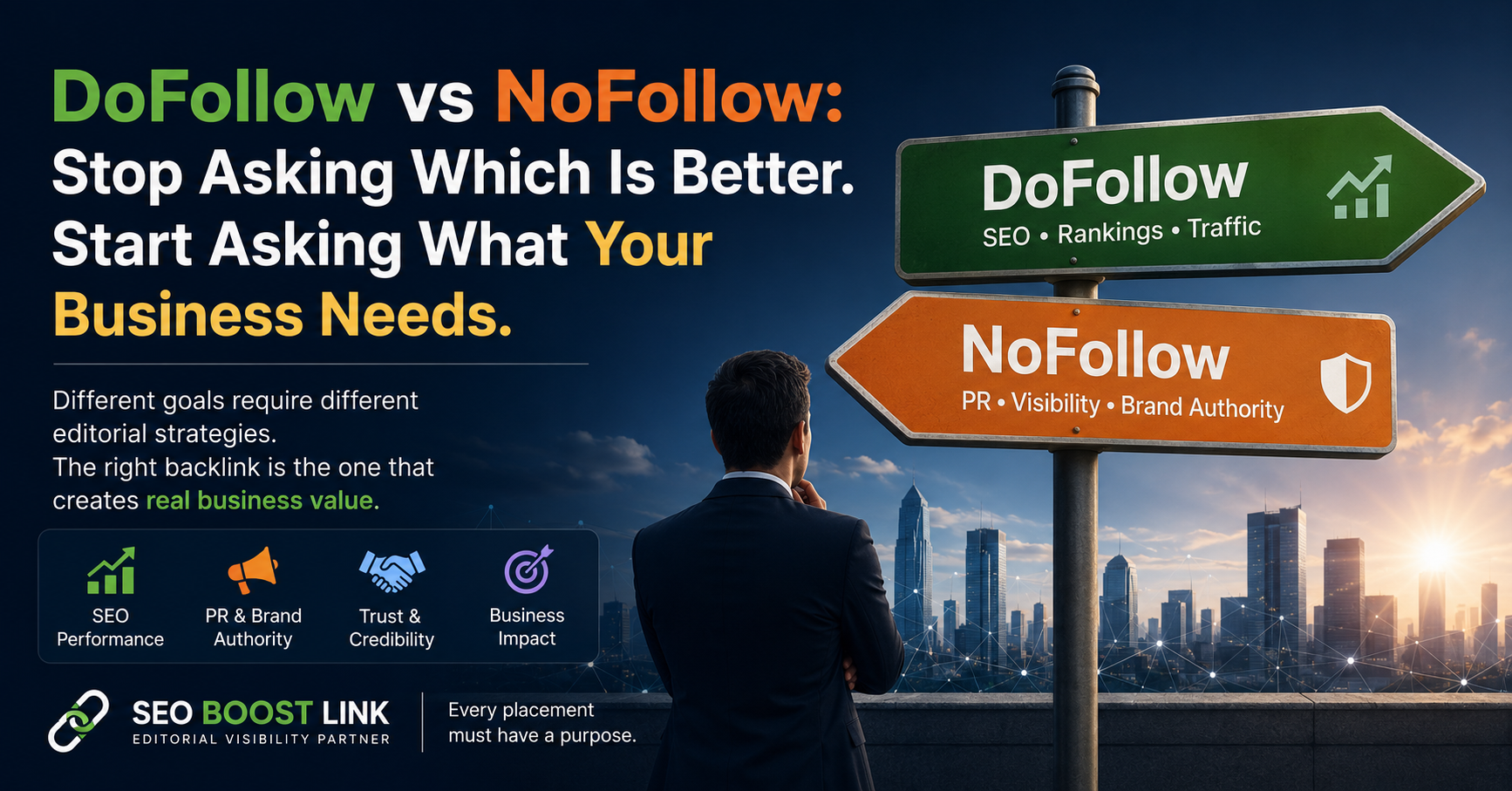
DoFollow vs NoFollow: Stop Asking Which Is Better. Start Asking What Your Business Needs.
Introduction
One of the most common questions we receive is:
"Do you provide DoFollow backlinks?"
It's a fair question.
For years, businesses have been taught that DoFollow links are valuable while NoFollow links are not.
The reality is more nuanced.
Whether a backlink creates value depends less on its attribute and more on the business objective behind it.
At SEO Boost Link, we don't begin by recommending websites.
We begin by understanding what the business is trying to achieve.
That single difference often changes the entire strategy.
The Wrong Question
Many businesses compare backlinks like products.
Which website has the highest Domain Rating?
Which one is DoFollow?
Which one is more expensive?
Those metrics can be useful.
But they should never be the starting point.
The better question is:
What outcome are you trying to create?
Different business goals require different editorial strategies.
When Your Goal Is SEO Performance
If your primary objective is improving organic visibility, rankings, AI search visibility, or qualified traffic, your backlink strategy should prioritize factors such as:
Topical relevance
Editorial quality
Audience alignment
Content context
Long-term authority
Sustainable search performance
In many cases, a highly respected industry publication will create more SEO value than a globally recognized media brand.
The largest publication is not always the most effective investment.
The most relevant one often is.
When Your Goal Is PR and Brand Authority
Sometimes SEO is not the primary objective.
A business may want to:
Build credibility
Prepare for fundraising
Increase enterprise trust
Support a sales team
Strengthen executive reputation
Improve media presence
In these situations, publications such as Forbes, Business Insider, Yahoo Finance, AP News, and other trusted media outlets can provide tremendous value.
Many of these placements may use NoFollow links.
That does not automatically reduce their business value.
Because their primary purpose is different.
Their value comes from visibility, credibility, recognition, and brand perception.
These are outcomes that cannot be measured by backlink attributes alone.
DoFollow vs NoFollow Is the Wrong Debate
The SEO industry has spent years debating which attribute is better.
Business owners should be asking a different question.
Which placement best supports my business objective?
A DoFollow backlink from an irrelevant website may contribute less value than a NoFollow mention from a publication your customers already trust.
Neither is universally better.
Both are tools.
The right choice depends entirely on the outcome you are trying to achieve.
Editorial Strategy Before Website Selection
One of the biggest mistakes businesses make is selecting publications before defining success.
At SEO Boost Link, we reverse the process.
We begin with the objective.
Only then do we recommend publications.
Our editorial recommendations are based on purpose rather than popularity.
That purpose may include:
Organic growth
Brand authority
Digital PR
AI visibility
Industry credibility
Qualified lead generation
Every recommendation should support at least one measurable business objective.
How We Approach Editorial Placements
Our process always begins with one question.
What does success look like for your business?
Only after answering that question do we evaluate:
Editorial relevance
Audience fit
Publication reputation
Topical authority
Business impact
Return on investment
This approach allows every placement to become part of a larger strategy rather than an isolated backlink.
Our Perspective
We don't believe every business needs Forbes.
We also don't believe every business should ignore it.
The right answer depends on the role that publication plays within the overall strategy.
Sometimes the best recommendation is a niche industry publication.
Sometimes it's an internationally recognized media outlet.
Sometimes it's both.
The decision should never be driven by hype.
It should be driven by purpose.
Frequently Asked Questions
Are DoFollow backlinks always better?
Not necessarily. They are often valuable for SEO, but they are only one part of a successful editorial strategy.
Are NoFollow backlinks useless?
No. They can create significant value for PR, brand authority, media credibility, referral traffic, and overall online presence.
Should I only pursue high Domain Rating websites?
No. Relevance, editorial quality, and business objectives are often more important than a single SEO metric.
Can a NoFollow placement still benefit my business?
Absolutely. If your objective is visibility, credibility, or brand recognition, a trusted publication can deliver meaningful business value regardless of link attributes.
Conclusion
The discussion should never begin with DoFollow or NoFollow.
It should begin with your business objective.
Backlinks are not products.
They are strategic business assets.
The right editorial placement is the one that supports the outcome you actually want to achieve.
Sometimes that means improving search visibility.
Sometimes it means building trust.
Sometimes it means both.
At SEO Boost Link, we believe every editorial placement should exist for a reason.
Because the best backlink is not necessarily the most famous one.
It's the one that creates the greatest value for your business.
CTA
Looking for an editorial strategy that aligns with your business goals?
Start with a Fit Review. We'll evaluate your objectives first, then recommend the editorial placements that create the highest value for your business, whether your priority is SEO performance, PR, brand authority, or long-term visibility.
Core reading
Sources and references
Reference sources used to support SEO, search, and authority-building context.
Author

Lalida Pimpa
Founder, SEO Boost Link
Lalida Pimpa is the founder of SEO Boost Link, an editorial backlink and authority strategy platform focused on SaaS, B2B, and digital-first brands. Her work centers on editorial relevance, entity-based SEO, AI visibility, and long-term authority building through contextual placements and search-aligned content systems.
With experience across SEO, lead generation, and digital growth strategy, she focuses on how modern search engines and AI systems interpret trust, topical relevance, and brand relationships across the web.
LinkedInFocus Areas
- •Editorial link building
- •AI search visibility
- •Entity-based SEO
- •Editorial placement strategy
Related Articles
AI Search Visibility Is Now Measurable: What SEO Teams Should Track in 2026
AI visibility is no longer something brands have to guess. Google and Bing are beginning to expose how websites appear inside AI-generated search experiences. Here is what SEO teams should measure now, what the data actually means, and where authority building fits into the picture.
When AI Agents Become Your Second Audience: Why Digital Authority Is Evolving Beyond Search Rankings
AI is creating a second audience for your content. Alongside human readers, intelligent systems are increasingly retrieving, evaluating, and synthesizing information before presenting it to users. This shift doesn't replace SEO, but it expands what digital authority means and how businesses should think about long-term visibility.
The AI Citation Gap: Why Great Content Still Doesn't Get Cited
Ranking on Google no longer guarantees visibility in AI-generated answers. Learn why AI citations follow different discovery mechanisms and how to build authority across both search engines and AI.
The AI Model Race Is Ending. The Ecosystem Race Has Already Begun.
The biggest AI announcements are no longer about benchmark scores. They're about infrastructure, developer ecosystems, enterprise workflows, and trust. This shift could fundamentally change how businesses choose AI platforms—and how brands earn visibility in AI-powered search.