AI Search
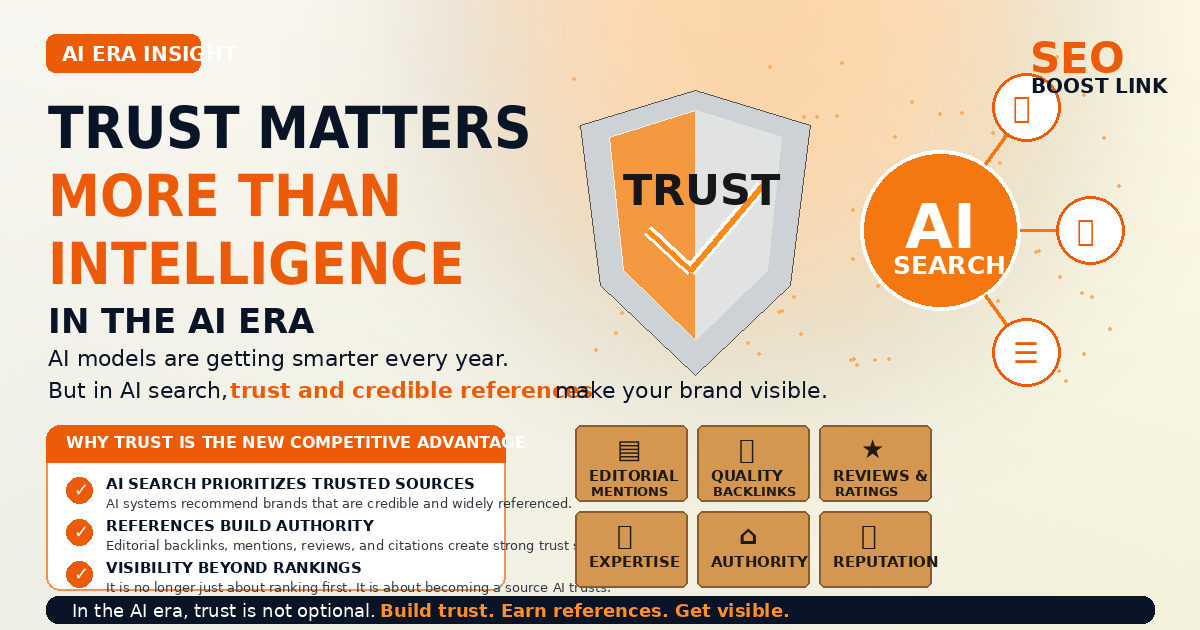
Trust Matters More Than Intelligence in the AI Era
AI models are becoming smarter every year, but intelligence alone does not guarantee trust. In the age of AI search, credibility and reliable references matter more than ever.
Published: June 18, 2026
Last updated: June 18, 2026
In this article
- 1.Introduction
- 2.Intelligence Creates Possibilities. Trust Creates Adoption.
- 3.AI Search Is Changing the Rules
- 4.Why References Matter More Than Rankings
- 5.AI Search Rewards Brands, Not Just Websites
- 6.Smart Brands Diversify Their Visibility
- 7.Trust Is Becoming the Ultimate Competitive Advantage
- 8.Conclusion
- 9.Frequently Asked Questions
- 10.Why is trust important in AI search?
- 11.Are backlinks still important?
- 12.What creates authority in the AI era?
- 13.Does AI search reward brands more than websites?
- 14.Summary
- 15.CTA
# Trust Matters More Than Intelligence in the AI Era
Introduction
Recently, Claude experienced temporary service disruptions. While the outage was eventually resolved, it highlighted something important.
Intelligence alone is not enough.
Claude remains one of the most capable AI models available. A temporary interruption does not change that. But the event reminded many people that intelligence and trust are not the same thing.
The same principle applies to brands.
In the AI era, the brands that win will not necessarily be the brands with the most content or the most backlinks. They will be the brands that people and AI systems trust.
Trust has always mattered.
Now it matters more than ever.
Intelligence Creates Possibilities. Trust Creates Adoption.
Modern AI systems are incredibly capable.
ChatGPT, Claude, Gemini, Grok, Perplexity, and other models continue to improve at an astonishing pace.
But intelligence alone does not guarantee adoption.
People do not simply ask:
"Which system is the smartest?"
They ask:
"Which system can I trust?"
The same question applies to businesses.
A company may have great products and excellent content, but if people do not trust the brand, growth becomes difficult.
Intelligence attracts attention.
Trust earns recommendations.
And recommendations create visibility.
AI Search Is Changing the Rules
Traditional SEO focused on rankings.
Businesses competed to appear first in search results.
AI search changes the equation.
Large language models do not simply retrieve pages.
They summarize information, recommend brands, and cite sources they consider trustworthy.
Increasingly, the question is no longer:
"Which website ranks number one?"
Instead, AI systems ask:
"Which source deserves to be referenced?"
This shift changes how authority is built.
Visibility is no longer only about keywords.
It is about trust.
Why References Matter More Than Rankings
Humans trust recommendations.
AI systems do something similar.
Brands that consistently appear across reputable websites become easier to trust.
Trust signals include:
* Editorial backlinks
* Brand mentions
* Case studies
* Reviews
* Expert content
* Citations from trusted publications
* Consistent presence across multiple channels
These signals tell AI systems that a brand is credible.
This is why editorial backlinks are different from links built purely for rankings.
Editorial references represent recognition.
Recognition creates trust.
Trust creates visibility.
AI Search Rewards Brands, Not Just Websites
For many years, SEO focused heavily on websites.
But AI search focuses increasingly on brands.
AI systems connect information from many sources.
They analyze mentions, references, reviews, and context.
As a result, brands with strong reputations have an advantage.
Authority no longer comes from one page ranking first.
Authority comes from repeated signals across the web.
This includes:
* Industry publications
* Podcasts
* News sites
* Reviews
* Editorial mentions
A single ranking can disappear.
Trust compounds over time.
Smart Brands Diversify Their Visibility
Relying on one traffic source creates risk.
Relying on one platform creates risk.
Relying on one tactic creates risk.
Smart brands diversify.
They build visibility through:
* Organic search
* AI search
* Editorial backlinks
* Digital PR
* Communities
* Social platforms
* Industry references
The goal is not simply to rank.
The goal is to become recognizable and trustworthy.
When multiple sources talk about a brand naturally, AI systems are more likely to reference it.
Trust Is Becoming the Ultimate Competitive Advantage
Technology will continue to evolve.
AI models will become smarter.
Search engines will change.
Algorithms will change.
But trust remains durable.
People trust brands they recognize.
AI systems trust sources that are repeatedly cited.
In many ways, trust has become the ultimate competitive advantage.
Because trust is difficult to fake.
And trust compounds over time.
Conclusion
Intelligence attracts attention.
Trust earns recommendations.
And recommendations create visibility.
In the AI era, the brands that succeed will not necessarily be those with the most content or the highest rankings.
They will be the brands that people trust and AI systems consistently choose to reference.
Because trust is no longer optional.
It is the signal that gets you seen, cited, and remembered.
Frequently Asked Questions
Why is trust important in AI search?
AI systems prioritize information from sources that demonstrate authority, credibility, and consistent references across the web.
Are backlinks still important?
Yes. But quality matters more than quantity. Editorial backlinks and natural references carry significantly more weight than artificial link building.
What creates authority in the AI era?
Editorial mentions, reviews, citations, case studies, expert content, and consistent visibility across trusted platforms all contribute to authority.
Does AI search reward brands more than websites?
Increasingly, yes. AI systems are designed to identify trustworthy brands and sources rather than simply showing pages with strong keyword rankings.
Summary
AI models are becoming smarter every year.
But intelligence alone is not enough.
Trust is what earns recommendations.
Trust is what builds authority.
And in the AI era, trust is the signal that gets your brand discovered.
CTA
Want to build authority that AI systems are more likely to trust and reference?
Request a Fit Review and discover whether your brand is earning the kind of visibility that matters in the AI era.
Core reading
Sources and references
Reference sources used to support SEO, search, and authority-building context.
Author

Lalida Pimpa
Founder, SEO Boost Link
Lalida Pimpa is the founder of SEO Boost Link, an editorial backlink and authority strategy platform focused on SaaS, B2B, and digital-first brands. Her work centers on editorial relevance, entity-based SEO, AI visibility, and long-term authority building through contextual placements and search-aligned content systems.
With experience across SEO, lead generation, and digital growth strategy, she focuses on how modern search engines and AI systems interpret trust, topical relevance, and brand relationships across the web.
LinkedInFocus Areas
- •Editorial link building
- •AI search visibility
- •Entity-based SEO
- •Editorial placement strategy
Related Articles
The AI Citation Gap: Why Great Content Still Doesn't Get Cited
Ranking on Google no longer guarantees visibility in AI-generated answers. Learn why AI citations follow different discovery mechanisms and how to build authority across both search engines and AI.
How AI Systems Decide Which Brands to Reference
AI search is changing how visibility works. Discover how AI systems evaluate brands and why trust, authority, and references matter more than ever.
AI Search Rewards Brands, Not Websites
AI search is changing how visibility works. The brands that earn trust and references are more likely to be surfaced by AI systems than websites that focus only on rankings.
Why Trust Is Becoming the Most Important Signal in AI Search
As AI-generated content floods the web, trust is becoming more valuable than rankings, backlinks, or metrics. Here's why businesses that earn genuine credibility will outperform those that chase visibility alone.