AI Search
AI Search Rewards Brands, Not Websites
AI search is changing how visibility works. The brands that earn trust and references are more likely to be surfaced by AI systems than websites that focus only on rankings.
Published: June 18, 2026
Last updated: June 18, 2026
In this article
- 1.Rankings Are No Longer the Entire Story
- 2.Editorial references
- 3.Industry publications
- 4.Social discussions
- 5.Consistency across channels
- 6.Visibility Comes From Recognition
- 7.Editorial articles
- 8.News publications
- 9.Reddit discussions
- 10.Case studies
- 11.Industry blogs
- 12.Why Brand Authority Matters More Than Ever
- 13.Editorial backlinks
- 14.Brand mentions
- 15.Editorial Backlinks Still Matter
- 16.Recognition Compounds Over Time
- 17.The Future Belongs to Brands
- 18.Frequently Asked Questions
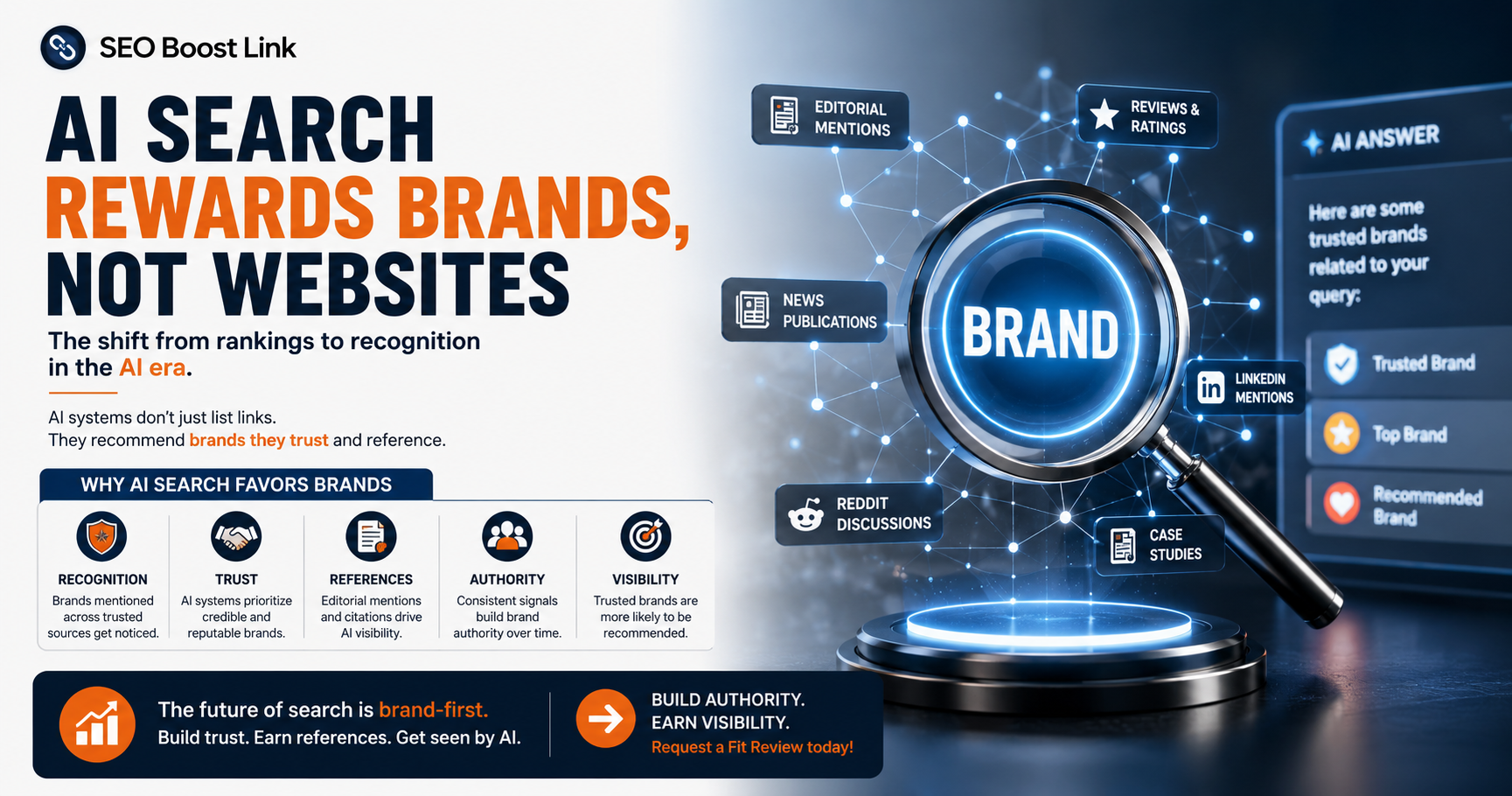
AI Search Rewards Brands, Not Websites
Introduction
For years, SEO was primarily about websites.
Businesses competed for rankings, keywords, and backlinks. Success was often measured by where a page appeared in search results.
But AI search is changing the rules.
ChatGPT, Gemini, Perplexity, and other AI systems are shifting attention away from individual pages and toward brands.
The question is no longer:
"Which website ranks number one?"
Increasingly, the question becomes:
"Which brand deserves to be referenced?"
This shift changes how visibility is earned.
Rankings Are No Longer the Entire Story
Traditional search engines display lists of links.
AI search works differently.
Instead of showing pages, AI systems summarize information and recommend sources.
Users often receive answers without visiting multiple websites.
That means visibility depends on more than rankings.
It depends on recognition.
Brands that are known, trusted, and consistently referenced across the web are more likely to appear inside AI-generated answers.
The future of search is becoming less about pages and more about reputation.
AI Systems Understand Entities, Not Just Pages
Modern AI systems understand entities.
An entity can be a company, person, product, or brand.
AI models connect information from multiple sources to determine credibility and context.
They evaluate signals such as:
Mentions
Reviews
Editorial references
Industry publications
Social discussions
Consistency across channels
Authority is no longer attached only to a page.
Authority increasingly belongs to the brand itself.
This is why businesses should think beyond website optimization and focus on building recognition across the web.
Visibility Comes From Recognition
Many businesses focus exclusively on rankings.
But rankings alone do not guarantee visibility inside AI search.
AI systems tend to favor brands that are repeatedly mentioned across trusted sources.
Examples include:
Editorial articles
News publications
Reddit discussions
Case studies
Reviews
Podcasts
Industry blogs
Repeated references create familiarity.
Familiarity creates trust.
Trust creates visibility.
People trust what they recognize.
AI systems increasingly behave the same way.
Why Brand Authority Matters More Than Ever
Strong brands have an advantage.
Not because they necessarily have more content.
Not because they publish more pages.
But because they have accumulated trust signals over time.
Authority is built through:
Editorial backlinks
Brand mentions
Reviews
Expertise
Reputation
Consistency
These signals help both humans and AI systems understand who deserves attention.
As AI search becomes more common, brand authority becomes a competitive advantage.
Businesses that invest in authority are investing in future visibility.
Editorial Backlinks Still Matter
Backlinks have not disappeared.
But their role is evolving.
The most valuable links are no longer those created solely for rankings.
Editorial backlinks matter because they represent recognition.
When reputable websites mention a brand naturally, they create trust signals that AI systems can recognize.
This is one reason quality matters more than quantity.
A trusted editorial mention is often more valuable than dozens of low-quality links.
Editorial backlinks are not simply ranking signals.
They are signals of credibility.
And credibility is what AI search increasingly rewards.
Recognition Compounds Over Time
Brand visibility is rarely created overnight.
Recognition compounds over time.
Every mention, editorial backlink, review, case study, podcast appearance, LinkedIn article, or discussion on platforms like Reddit contributes to a larger picture.
Individually, these signals may seem small.
Collectively, they create authority.
AI systems rely on patterns rather than isolated pages.
When a brand consistently appears across multiple trusted sources, it becomes easier for both humans and AI systems to recognize it as credible.
Businesses that focus only on rankings may experience short-term gains.
Businesses that invest in reputation and recognition are more likely to benefit from long-term visibility.
Recognition compounds.
And over time, compounded trust becomes authority.
The Future Belongs to Brands
SEO is evolving.
Keywords still matter.
Technical SEO still matters.
Content still matters.
But brands matter even more.
As AI search becomes increasingly common, businesses that invest in reputation and authority will have an advantage.
Visibility is becoming less about individual pages and more about becoming a source worth mentioning.
The brands that are repeatedly referenced are more likely to become the brands AI systems recommend.
In many ways, AI search rewards brands, not websites.
Conclusion
AI search is changing how visibility works.
The brands that earn references, authority, and trust are more likely to be surfaced by AI systems.
Visibility is no longer only about rankings.
It is about recognition.
And recognition begins with becoming a brand that deserves to be referenced.
Because in the AI era, AI systems do not simply reward websites.
They reward authority.
Frequently Asked Questions
Does AI search replace traditional SEO?
No. Traditional SEO still matters, but AI search introduces new visibility signals centered around authority and trust.
Why do brands matter in AI search?
AI systems connect information across multiple sources and tend to recommend brands that are consistently recognized and referenced.
Are backlinks still important?
Yes. Editorial backlinks remain valuable because they represent trust and recognition rather than simply passing ranking signals.
What creates brand authority?
Editorial mentions, reviews, expert content, case studies, and consistent visibility across trusted platforms all contribute to authority.
Summary
The future of visibility is changing.
AI systems increasingly reward brands that are trusted, recognized, and repeatedly referenced.
Because AI search does not simply reward websites.
It rewards authority.
CTA
Want to build authority that AI systems are more likely to recognize and reference?
Request a Fit Review and discover how editorial backlinks and trusted mentions can strengthen your brand visibility.
Core reading
Sources and references
Reference sources used to support SEO, search, and authority-building context.
Author

Lalida Pimpa
Founder, SEO Boost Link
Lalida Pimpa is the founder of SEO Boost Link, an editorial backlink and authority strategy platform focused on SaaS, B2B, and digital-first brands. Her work centers on editorial relevance, entity-based SEO, AI visibility, and long-term authority building through contextual placements and search-aligned content systems.
With experience across SEO, lead generation, and digital growth strategy, she focuses on how modern search engines and AI systems interpret trust, topical relevance, and brand relationships across the web.
LinkedInFocus Areas
- •Editorial link building
- •AI search visibility
- •Entity-based SEO
- •Editorial placement strategy
Related Articles
The AI Citation Gap: Why Great Content Still Doesn't Get Cited
Ranking on Google no longer guarantees visibility in AI-generated answers. Learn why AI citations follow different discovery mechanisms and how to build authority across both search engines and AI.
How AI Systems Decide Which Brands to Reference
AI search is changing how visibility works. Discover how AI systems evaluate brands and why trust, authority, and references matter more than ever.
Trust Matters More Than Intelligence in the AI Era
AI models are becoming smarter every year, but intelligence alone does not guarantee trust. In the age of AI search, credibility and reliable references matter more than ever.
Why Trust Is Becoming the Most Important Signal in AI Search
As AI-generated content floods the web, trust is becoming more valuable than rankings, backlinks, or metrics. Here's why businesses that earn genuine credibility will outperform those that chase visibility alone.