Link Strategy
DoFollow vs NoFollow: Why the Right Link Attribute Depends on Context, Not Just SEO
DoFollow or NoFollow? The answer isn't as simple as choosing one over the other. Learn how editorial context, business goals, and link purpose determine the right strategy.
Published: June 25, 2026
Last updated: June 25, 2026
In this article
- 1.Why Link Attributes Are Often Overrated
- 2.When DoFollow Makes Editorial Sense
- 3.When NoFollow Is the Better Choice
- 4.A Healthy Backlink Profile Is Never Built Around One Attribute
- 5.The Questions We Ask Before Recommending Any Website
- 6.Context Is More Important Than Link Attributes
- 7.Our Editorial Philosophy
- 8.Frequently Asked Questions
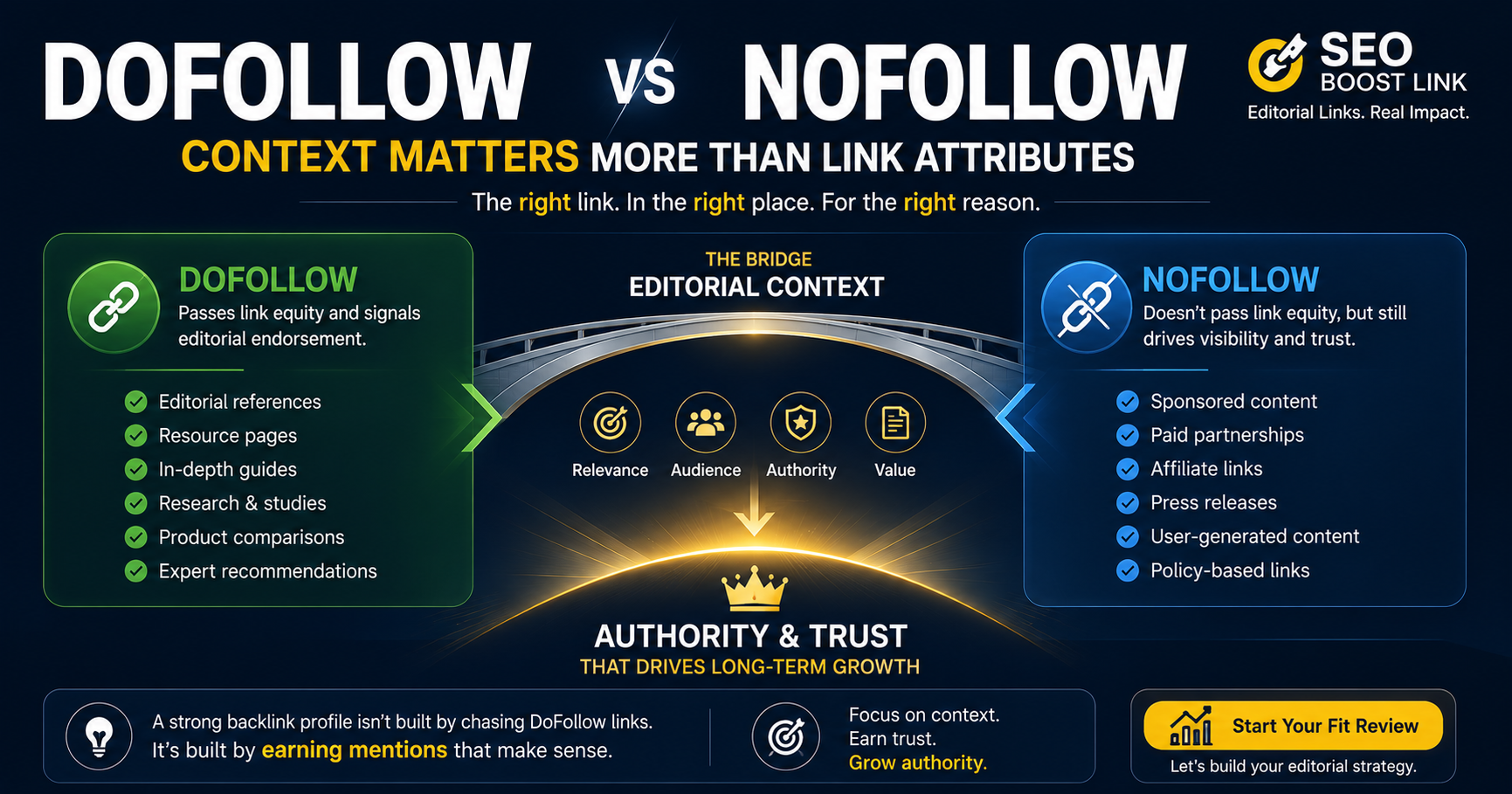
Introduction
Ask almost anyone about backlinks, and the conversation usually starts with one question.
"Is it DoFollow?"
For years, the SEO industry has treated DoFollow as the ultimate goal, while NoFollow has often been viewed as something less valuable.
Unfortunately, this oversimplified way of thinking has caused many businesses to focus on the wrong metric.
The reality is that link attributes tell only a small part of the story.
A backlink should never be judged by its attribute alone.
It should first be judged by why it exists, where it appears, who is reading it, and whether it genuinely adds value to the surrounding content.
At SEO Boost Link, we don't recommend backlink opportunities simply because they offer DoFollow links.
We evaluate every opportunity from an editorial perspective first.
Only then do we determine whether DoFollow or NoFollow is the appropriate choice.
What Are DoFollow and NoFollow Links?
Before deciding which one is better, it's important to understand their purpose.
A DoFollow link allows search engines to treat the reference as a standard editorial hyperlink.
A NoFollow link tells search engines that the publisher has chosen not to pass ranking signals in the traditional way.
Years ago, marketers simplified this into a single idea.
DoFollow is good.
NoFollow is bad.
Today's search landscape is far more sophisticated.
Search engines evaluate context, topical relevance, editorial quality, authority, user intent, content quality, and hundreds of additional signals.
The link attribute is only one piece of a much larger picture.
Why Link Attributes Are Often Overrated
Imagine two different situations.
The first website publishes a detailed guide comparing CRM software for small businesses.
Your product is mentioned naturally because it genuinely helps readers solve the problem discussed in the article.
The mention is relevant, useful, and fits perfectly within the content.
Now imagine another website with a much higher Domain Rating.
The article has little relevance to your industry, exists mainly to sell backlinks, and your brand is inserted simply because a placement was available.
Both links might be DoFollow.
Neither creates the same value.
The difference isn't the attribute.
The difference is the editorial context.
That's why we believe businesses should stop asking,
"Can you get us a DoFollow link?"
and start asking,
"Does this reference genuinely belong here?"
When DoFollow Makes Editorial Sense
There are many situations where DoFollow is exactly the right recommendation.
When a publisher naturally references your company because your product, service, research, or expertise genuinely improves the article, a DoFollow link makes perfect editorial sense.
Examples include:
• Industry resource pages
• Educational guides
• Product comparisons
• Research articles
• Software roundups
• Expert recommendations
• Business tool collections
In these situations, the publisher isn't creating a backlink for SEO.
They're making an editorial decision because the reference improves the content and helps readers.
Those are the opportunities businesses should actively pursue.
DoFollow Is Earned, Not Requested
One principle guides every recommendation we make.
Editorial links should exist because they deserve to exist.
Asking every publisher to change every backlink into DoFollow misses the bigger picture.
The credibility of any publication depends on maintaining editorial integrity.
The strongest backlinks are the ones that feel completely natural within the article.
When readers never question why your business is being referenced, that's usually a sign the placement has been done correctly.
When NoFollow Is the Better Choice
One of the biggest misconceptions in link building is assuming that NoFollow links have little or no value.
In reality, NoFollow often reflects responsible editorial practices rather than poor-quality websites.
Many respected publishers apply NoFollow attributes because of editorial policies, sponsored collaborations, affiliate relationships, legal requirements, or transparency guidelines. The attribute doesn't automatically reduce the value of the mention.
Being referenced by a trusted publication can increase brand awareness, referral traffic, credibility, and industry recognition, regardless of whether the link is DoFollow or NoFollow.
This is why we never evaluate a backlink by looking at the attribute alone.
We evaluate the entire opportunity.
A Healthy Backlink Profile Is Never Built Around One Attribute
If you look at the backlink profiles of established brands, you'll notice something interesting.
They don't have 100% DoFollow backlinks.
They naturally earn a combination of editorial mentions, media coverage, business directories, industry resources, interviews, podcasts, community discussions, customer reviews, research reports, and social references.
Some are DoFollow.
Some are NoFollow.
Some use Sponsored or UGC attributes.
This diversity reflects how brands are genuinely discussed across the web.
A backlink profile made up entirely of DoFollow links can actually appear less natural than one built through authentic editorial references over time.
The Questions We Ask Before Recommending Any Website
At SEO Boost Link, we never begin by asking whether a website offers DoFollow links.
Instead, we ask a series of editorial questions.
Does this publication genuinely relate to the client's industry?
Will the publication reach the right audience?
Does the surrounding article provide the right context?
Will mentioning this business improve the content for readers?
Would the reference still make sense if search engines didn't exist?
Could we confidently explain this recommendation to the publisher, the client, and a search engine?
If the answer to these questions is yes, we continue our evaluation.
If the answer is no, we don't recommend the opportunity, even if the website has exceptional authority metrics.
Because editorial quality always comes before technical SEO preferences.
Context Is More Important Than Link Attributes
Imagine a cybersecurity company.
The first opportunity is a DoFollow backlink inside a generic article covering dozens of unrelated industries.
The second opportunity is a NoFollow mention inside a detailed cybersecurity resource published by a respected industry publication.
Which one is more likely to build trust?
Which one reaches decision-makers looking for cybersecurity solutions?
Which one positions the brand as an authority?
For us, the answer is obvious.
The second opportunity creates far greater long-term value because it provides relevance, credibility, and context.
The attribute becomes secondary.
Our Editorial Philosophy
We don't sell DoFollow links.
We don't sell NoFollow links.
We recommend editorial opportunities.
Every recommendation begins with understanding your business, your audience, your products, and your long-term objectives.
Only after evaluating the publication, its topical authority, editorial quality, audience alignment, and contextual relevance do we recommend the most appropriate approach.
Sometimes that's a DoFollow link.
Sometimes it's NoFollow.
Sometimes we recommend not pursuing the opportunity at all.
Our goal isn't to maximise the number of backlinks.
Our goal is to maximise the quality of the references your business earns.
Frequently Asked Questions
Is DoFollow always better than NoFollow?
No. A relevant editorial mention on a trusted publication can provide significant value regardless of the link attribute. Context, topical relevance, and editorial credibility usually matter far more.
Should I avoid NoFollow backlinks?
Not at all. Many authoritative publishers use NoFollow links because of editorial policy rather than quality concerns. Ignoring these opportunities can mean missing valuable visibility and highly qualified referral traffic.
Should every backlink campaign focus on DoFollow links?
No. Natural backlink profiles contain a healthy mix of editorial references, media mentions, directories, community discussions, and different link attributes. Diversity is a characteristic of genuine authority.
What matters most when evaluating a backlink?
We believe the most important factors are editorial relevance, topical authority, audience alignment, contextual placement, content quality, and long-term value.
The link attribute is simply one factor within a much broader editorial decision.
Conclusion
The debate between DoFollow and NoFollow often distracts businesses from the more important question.
Why does the link exist?
Search engines continue evolving toward understanding relationships, context, editorial quality, and topical authority.
Businesses that focus only on link attributes risk overlooking the opportunities that create genuine authority.
At SEO Boost Link, we don't measure success by the number of DoFollow links we build.
We measure success by whether your business is referenced in places where it genuinely belongs.
Because the strongest backlinks aren't defined by a technical attribute.
They're defined by the trust, relevance, and value they create.
CTA
Looking beyond DoFollow and NoFollow?
Start with a Fit Review and let us recommend the editorial strategy, publications, and backlink opportunities that best fit your business, your industry, and your long-term growth goals.
Core reading
Sources and references
Reference sources used to support SEO, search, and authority-building context.
Author

Lalida Pimpa
Founder, SEO Boost Link
Lalida Pimpa is the founder of SEO Boost Link, an editorial backlink and authority strategy platform focused on SaaS, B2B, and digital-first brands. Her work centers on editorial relevance, entity-based SEO, AI visibility, and long-term authority building through contextual placements and search-aligned content systems.
With experience across SEO, lead generation, and digital growth strategy, she focuses on how modern search engines and AI systems interpret trust, topical relevance, and brand relationships across the web.
LinkedInFocus Areas
- •Editorial link building
- •AI search visibility
- •Entity-based SEO
- •Editorial placement strategy
Related Articles
Link Insert vs Guest Post: Which Businesses Benefit Most from Link Insert?
Not every business should start with a Guest Post. Learn which industries benefit most from Link Insert, why context matters more than metrics, and how the right editorial placement can create lasting SEO value.
AI Search Visibility Is Now Measurable: What SEO Teams Should Track in 2026
AI visibility is no longer something brands have to guess. Google and Bing are beginning to expose how websites appear inside AI-generated search experiences. Here is what SEO teams should measure now, what the data actually means, and where authority building fits into the picture.
When AI Agents Become Your Second Audience: Why Digital Authority Is Evolving Beyond Search Rankings
AI is creating a second audience for your content. Alongside human readers, intelligent systems are increasingly retrieving, evaluating, and synthesizing information before presenting it to users. This shift doesn't replace SEO, but it expands what digital authority means and how businesses should think about long-term visibility.
The AI Citation Gap: Why Great Content Still Doesn't Get Cited
Ranking on Google no longer guarantees visibility in AI-generated answers. Learn why AI citations follow different discovery mechanisms and how to build authority across both search engines and AI.