Link Building
Link Insertions vs Guest Posts: Which Strategy Makes More Sense in 2026?
Compare link insertions and guest posts through contextual relevance, editorial trust, topical authority, and long-term SEO visibility.
Published: May 26, 2026
Last updated: May 26, 2026
In this article
- 1.What Link Insertions Actually Do
- 2.the page already ranks for relevant queries
- 3.the article has existing crawl history
- 4.the publication already holds topical trust
- 5.and the surrounding semantic context aligns naturally with the destination brand
- 6.What Guest Posts Are Better For
- 7.topic framing
- 8.editorial structure
- 9.entity positioning
- 10.semantic relevance
- 11.and how a brand is associated with specific industry conversations
- 12.Context Matters More Than the Tactic
- 13.contextual coherence
- 14.topical alignment
- 15.entity consistency
- 16.and editorial credibility
- 17.Why the Strongest Campaigns Combine Both
- 18.link insertions for reinforcing existing contextual signals
- 19.guest posts for expanding topical depth and editorial footprint
- 20.stronger topical reinforcement
- 21.broader semantic coverage
- 22.more believable editorial diversity
- 23.and clearer authority positioning across a market ecosystem
- 24.How AI Search Changes Link Strategy
- 25.what a brand represents
- 26.which industries it belongs to
- 27.what expertise areas it is associated with
- 28.and whether those associations appear consistently across trusted sources
- 29.Google AI Overviews
- 30.ChatGPT browsing systems
- 31.and other conversational search interfaces
- 32.Final Thoughts
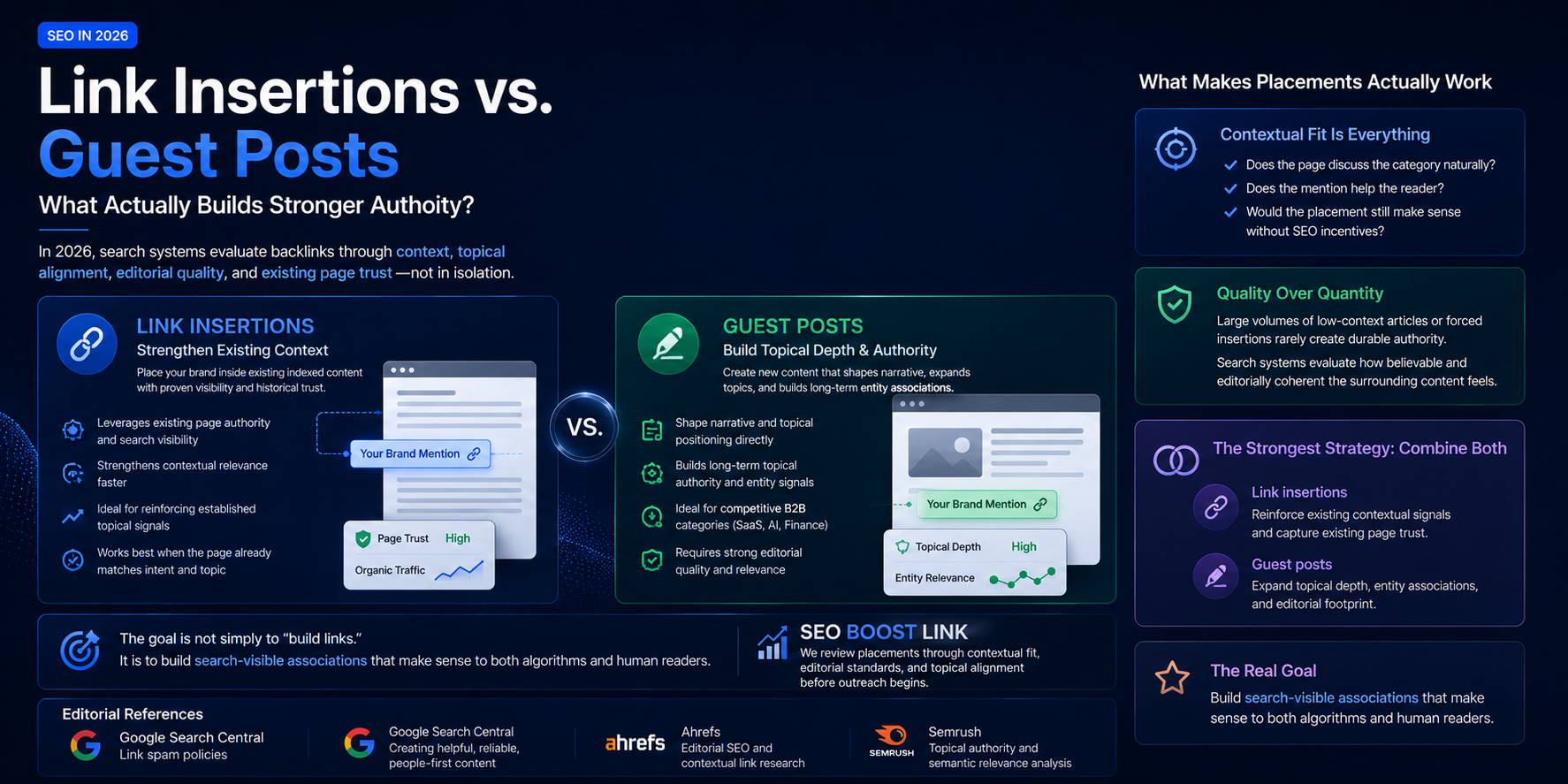
In 2026, the difference between link insertions and guest posts is less about which tactic is “better” and more about what kind of authority a brand is trying to build.
Search systems no longer evaluate backlinks in isolation.
Context, topical alignment, editorial quality, and existing page trust all influence how a mention is interpreted.
What Link Insertions Actually Do
Link insertions place your brand inside existing indexed content that already has search visibility and historical trust signals.
When the surrounding page already matches the target topic and reader intent, insertions can strengthen contextual relevance faster than waiting for a newly published page to mature.
This is especially useful when:
the page already ranks for relevant queries
the article has existing crawl history
the publication already holds topical trust
and the surrounding semantic context aligns naturally with the destination brand
In many cases, a strong contextual insertion inside an already trusted article can reinforce search visibility efficiently because the page itself already carries established authority signals.
This is one reason why contextual backlinks continue outperforming generic low-context placements in modern search environments.
What Guest Posts Are Better For
Guest posts serve a different purpose.
They allow brands to shape narrative depth, topical positioning, and entity association more directly.
This makes them useful for building long-term topical authority, especially in:
SaaS
AI
finance
cybersecurity
and competitive B2B categories where category understanding matters as much as raw link equity
Unlike insertions, guest posts allow more control over:
topic framing
editorial structure
entity positioning
semantic relevance
and how a brand is associated with specific industry conversations
This makes guest posting particularly valuable for brands trying to establish clearer market positioning over time.
This is also why editorially relevant guest posting strategies continue outperforming scalable low-context outreach campaigns.
Context Matters More Than the Tactic
Neither approach works well when forced into irrelevant placements.
A strong insertion depends on contextual fit:
Does the page already discuss the category naturally?
Does the mention help the reader?
Would the placement still make sense without SEO incentives?
The same applies to guest posts.
Publishing large volumes of low-context articles rarely creates durable authority because search systems increasingly evaluate how believable and editorially coherent the surrounding content feels.
This is one reason why many scalable link-building tactics produce weaker long-term outcomes today.
AI-assisted search systems increasingly prioritize:
contextual coherence
topical alignment
entity consistency
and editorial credibility
over raw link volume alone.
This shift is becoming increasingly important as AI-assisted search systems evolve toward semantic retrieval and contextual trust evaluation.
Why the Strongest Campaigns Combine Both
In practice, the strongest campaigns usually combine both models:
link insertions for reinforcing existing contextual signals
guest posts for expanding topical depth and editorial footprint
The goal is not simply to “build links.”
It is to build search-visible associations that make sense to both algorithms and human readers.
A balanced strategy often creates:
stronger topical reinforcement
broader semantic coverage
more believable editorial diversity
and clearer authority positioning across a market ecosystem
This is especially important as AI-powered search systems increasingly evaluate patterns of contextual trust rather than isolated backlink metrics.
This is also why many SEO teams now evaluate placements beyond Domain Authority metrics alone when building long-term authority strategies.
How AI Search Changes Link Strategy
Modern AI-assisted search systems attempt to understand:
what a brand represents
which industries it belongs to
what expertise areas it is associated with
and whether those associations appear consistently across trusted sources
This means backlinks increasingly function as contextual validation signals rather than simple ranking votes.
Brands that repeatedly appear inside credible, topically aligned environments gradually strengthen retrieval confidence across:
Google AI Overviews
Perplexity
Gemini
ChatGPT browsing systems
and other conversational search interfaces
The consistency of those contextual associations matters more than raw placement volume.
Final Thoughts
The future of link building is becoming increasingly editorial and semantic.
Link insertions and guest posts both remain useful, but their effectiveness depends heavily on contextual fit, topical alignment, and the credibility of the surrounding publication environment.
The strongest SEO strategies in 2026 are usually the ones that build believable authority patterns over time rather than chasing isolated backlink metrics.
At SEO Boost Link, we review placements through contextual fit, editorial standards, and topical alignment before outreach begins.
Q: What is the difference between a link insertion and a guest post?
A: A link insertion adds a backlink into existing indexed content, while a guest post involves publishing a new article on another website.
Q: Are link insertions better than guest posts?
A: Neither tactic is universally better. Link insertions often help reinforce existing contextual signals, while guest posts are useful for building broader topical authority and editorial positioning.
Q: Why does contextual relevance matter in both strategies?
A: Contextual relevance helps search systems understand how naturally a brand fits within a topic ecosystem, which strengthens semantic trust and topical authority.
Q: Do AI-powered search systems evaluate backlinks differently?
A: Modern AI-assisted search systems increasingly evaluate contextual trust, semantic relationships, editorial quality, and entity consistency rather than relying only on raw backlink metrics.
Q: Should brands combine guest posts and link insertions?
A: In many cases, yes. Combining both strategies can create stronger contextual coverage, editorial diversity, and long-term authority positioning.
Core reading
Frequently asked questions
Blog post FAQ
What is the difference between a link insertion and a guest post?
A link insertion adds a backlink into existing indexed content, while a guest post involves publishing a new article on another website.
Are link insertions better than guest posts?
Neither tactic is universally better. Link insertions often help reinforce existing contextual signals, while guest posts are useful for building broader topical authority and editorial positioning.
Why does contextual relevance matter in both strategies?
Contextual relevance helps search systems understand how naturally a brand fits within a topic ecosystem, which strengthens semantic trust and topical authority.
Do AI-powered search systems evaluate backlinks differently?
Modern AI-assisted search systems increasingly evaluate contextual trust, semantic relationships, editorial quality, and entity consistency rather than relying only on raw backlink metrics.
Should brands combine guest posts and link insertions?
In many cases, yes. Combining both strategies can create stronger contextual coverage, editorial diversity, and long-term authority positioning.
Sources and references
Reference sources used to support SEO, search, and authority-building context.
Author

Lalida Pimpa
Founder, SEO Boost Link
Lalida Pimpa is the founder of SEO Boost Link, an editorial backlink and authority strategy platform focused on SaaS, B2B, and digital-first brands. Her work centers on editorial relevance, entity-based SEO, AI visibility, and long-term authority building through contextual placements and search-aligned content systems.
With experience across SEO, lead generation, and digital growth strategy, she focuses on how modern search engines and AI systems interpret trust, topical relevance, and brand relationships across the web.
LinkedInFocus Areas
- •Editorial link building
- •AI search visibility
- •Entity-based SEO
- •Editorial placement strategy
Related Articles
Do Backlinks Still Matter in 2026? The Truth About SEO, GEO, and AI Search
Many marketers claim backlinks are becoming obsolete because of AI search. The reality is more nuanced. Here's what businesses need to understand about backlinks, authority, and visibility in 2026.
Why Contextual Backlinks Outperform Generic Links in 2026
Not all backlinks carry the same weight. Learn why contextual backlinks placed within relevant editorial content outperform generic links for SEO, AI visibility, and long-term authority growth.