Link Building
Do Backlinks Still Matter in 2026? The Truth About SEO, GEO, and AI Search
Many marketers claim backlinks are becoming obsolete because of AI search. The reality is more nuanced. Here's what businesses need to understand about backlinks, authority, and visibility in 2026.
Published: June 7, 2026
Last updated: June 7, 2026
In this article
- 1.Why people think backlinks are losing value
- 2.Search engines and AI systems have the same problem
- 3.Backlinks are no longer the entire strategy
- 4.Contextual backlinks
- 5.Brand mentions
- 6.Topical authority
- 7.Author expertise
- 8.Content quality
- 9.Industry citations
- 10.Consistent topical coverage
- 11.The backlinks that matter most today
- 12.Published on legitimate websites
- 13.Relevant to the topic being discussed
- 14.Surrounded by useful content
- 15.Naturally integrated into the article
- 16.Helpful for readers
- 17.What GEO changes
- 18.Authority is becoming the real competitive advantage
- 19.What businesses should focus on in 2026
- 20.Building topical authority
- 21.Publishing genuinely useful content
- 22.Earning relevant editorial mentions
- 23.Acquiring contextual backlinks
- 24.Strengthening brand recognition
- 25.Why authority signals matter more than ever
- 26.Final Thoughts
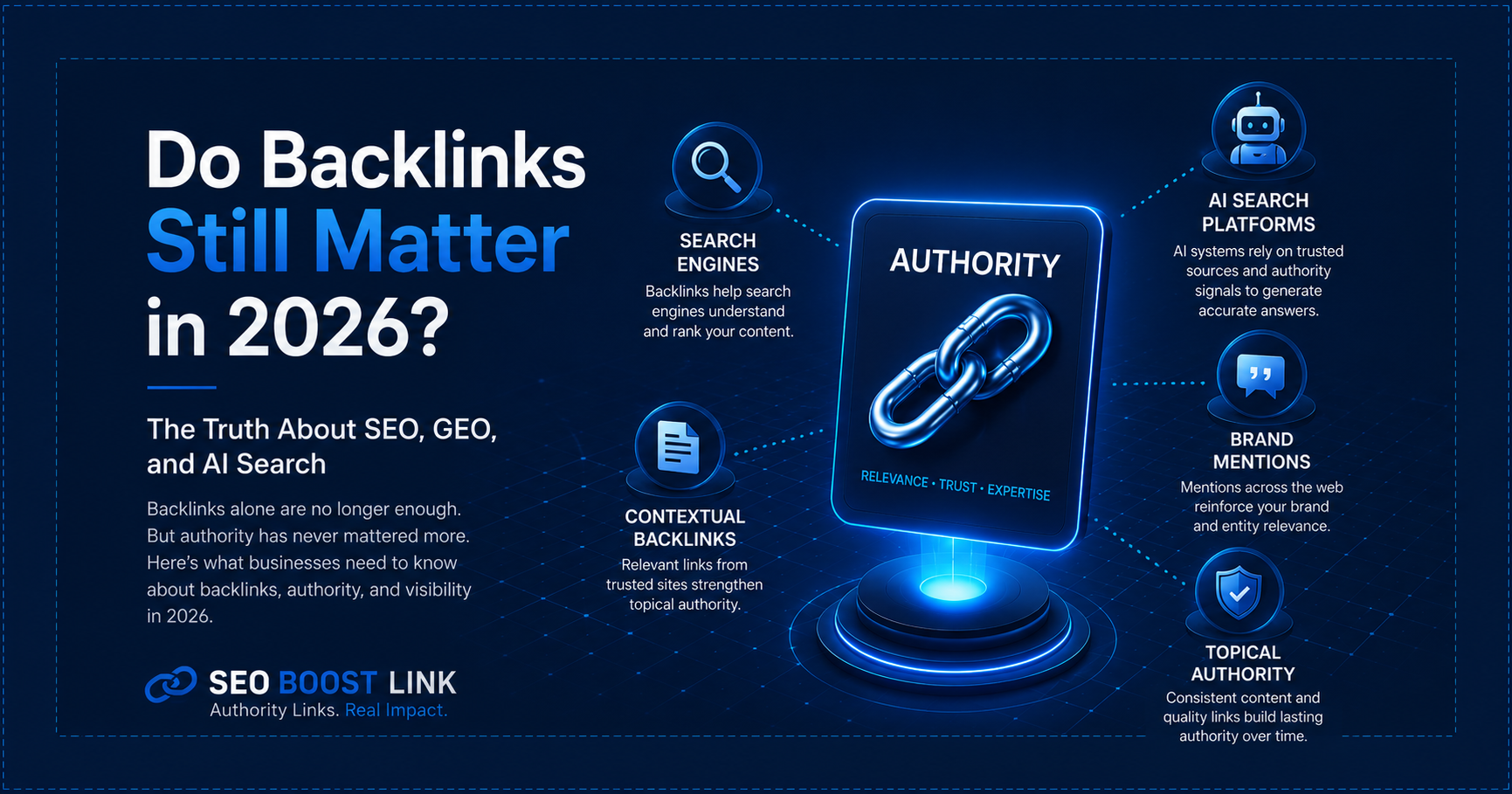
Do Backlinks Still Matter in 2026? The Truth About SEO, GEO, and AI Search
Every time search evolves, someone declares backlinks dead.
When social media became dominant, backlinks were supposedly finished.
When voice search arrived, backlinks were supposedly finished.
Now that AI-powered search experiences are growing, the same claim has returned once again.
Backlinks are dead.
GEO has replaced SEO.
AI no longer cares about links.
The problem is that none of these statements accurately describe how authority works on the web.
The reality is much simpler.
Backlinks alone are no longer enough.
But authority has never mattered more.
Why people think backlinks are losing value
The argument sounds logical.
Users are increasingly asking questions directly inside ChatGPT, Gemini, Claude, and Perplexity rather than clicking through traditional search results.
If people are no longer browsing search results in the same way, why would backlinks still matter?
The answer lies in understanding the difference between rankings and authority.
A backlink was never valuable simply because it improved rankings.
A backlink is valuable because it helps establish trust, relevance, and relationships between websites.
That principle has not changed.
Search engines and AI systems have the same problem
Whether it is Google or an AI assistant, every system faces the same challenge:
How do we determine which sources deserve attention?
Google uses hundreds of ranking signals.
AI systems use a combination of training data, retrieval systems, citations, entity recognition, content quality, and source credibility.
The methods differ.
The goal does not.
Both are trying to identify trustworthy information.
This is why authority signals continue to matter regardless of how users search.
Backlinks are no longer the entire strategy
A decade ago, many SEO campaigns focused heavily on link quantity.
Today, that approach is increasingly ineffective.
Modern search visibility depends on a broader collection of signals, including:
Contextual backlinks
Brand mentions
Topical authority
Author expertise
Content quality
Industry citations
Consistent topical coverage
In other words, backlinks are still important.
They are simply part of a much larger authority framework.
The backlinks that matter most today
Not all backlinks contribute equally.
A contextual editorial placement on a relevant website often provides significantly more value than dozens of unrelated links.
The strongest backlinks typically share several characteristics:
Published on legitimate websites
Relevant to the topic being discussed
Surrounded by useful content
Naturally integrated into the article
Helpful for readers
These are the same characteristics that make content trustworthy for humans.
And increasingly, they are the same characteristics that help search systems understand expertise.
What GEO changes
Generative Engine Optimization (GEO) introduces a new objective.
Traditional SEO focused on helping pages rank.
GEO focuses on helping brands become discoverable within AI-powered search experiences.
This does not eliminate backlinks.
Instead, it changes how we think about them.
A backlink is no longer just a ranking signal.
It becomes one of many signals contributing to a website's overall authority profile.
The brands most likely to appear in AI-generated answers are often the same brands that have built strong reputations across their industry.
Authority is becoming the real competitive advantage
Imagine two companies in the same niche.
The first company has accumulated hundreds of low-quality backlinks over the years.
The second company has earned mentions from respected industry publications, publishes useful content consistently, and receives contextual backlinks from relevant sources.
Which company appears more trustworthy?
Which company appears more authoritative?
Which company would you expect search systems to reference?
The answer is obvious.
Authority has always mattered.
AI simply makes weak signals easier to ignore.
What businesses should focus on in 2026
Instead of asking:
"How many backlinks do we need?"
A better question is:
"How do we become a trusted source within our industry?"
That shift changes everything.
The focus moves toward:
Building topical authority
Publishing genuinely useful content
Earning relevant editorial mentions
Acquiring contextual backlinks
Strengthening brand recognition
The goal is no longer collecting links.
The goal is building trust.
Why authority signals matter more than ever
As search becomes increasingly driven by AI systems, visibility is no longer determined by rankings alone.
Modern search platforms attempt to understand which brands, websites, and authors consistently demonstrate expertise within a topic. This means that backlinks, brand mentions, topical authority, and content quality often work together rather than independently.
A website with strong authority signals is more likely to earn trust from both traditional search engines and AI-powered search experiences. While no single factor guarantees visibility, businesses that focus on building genuine authority are often better positioned than those relying on isolated SEO tactics.
The future of search belongs to trusted sources, not simply well-optimized pages.
Final Thoughts
Backlinks are not dead.
They are evolving.
Businesses that continue chasing link quantity alone will likely struggle.
Businesses that focus on authority, relevance, expertise, and trust will continue benefiting from backlinks for years to come.
Search technology will continue to change.
The importance of credibility will not.
That is why backlinks still matter in 2026—not as an isolated tactic, but as part of a broader strategy designed to build lasting authority online.
Core reading
Sources and references
Reference sources used to support SEO, search, and authority-building context.
Author

Lalida Pimpa
Founder, SEO Boost Link
Lalida Pimpa is the founder of SEO Boost Link, an editorial backlink and authority strategy platform focused on SaaS, B2B, and digital-first brands. Her work centers on editorial relevance, entity-based SEO, AI visibility, and long-term authority building through contextual placements and search-aligned content systems.
With experience across SEO, lead generation, and digital growth strategy, she focuses on how modern search engines and AI systems interpret trust, topical relevance, and brand relationships across the web.
LinkedInFocus Areas
- •Editorial link building
- •AI search visibility
- •Entity-based SEO
- •Editorial placement strategy
Related Articles
Link Insertions vs Guest Posts: Which Strategy Makes More Sense in 2026?
Compare link insertions and guest posts through contextual relevance, editorial trust, topical authority, and long-term SEO visibility.
Why Contextual Backlinks Outperform Generic Links in 2026
Not all backlinks carry the same weight. Learn why contextual backlinks placed within relevant editorial content outperform generic links for SEO, AI visibility, and long-term authority growth.